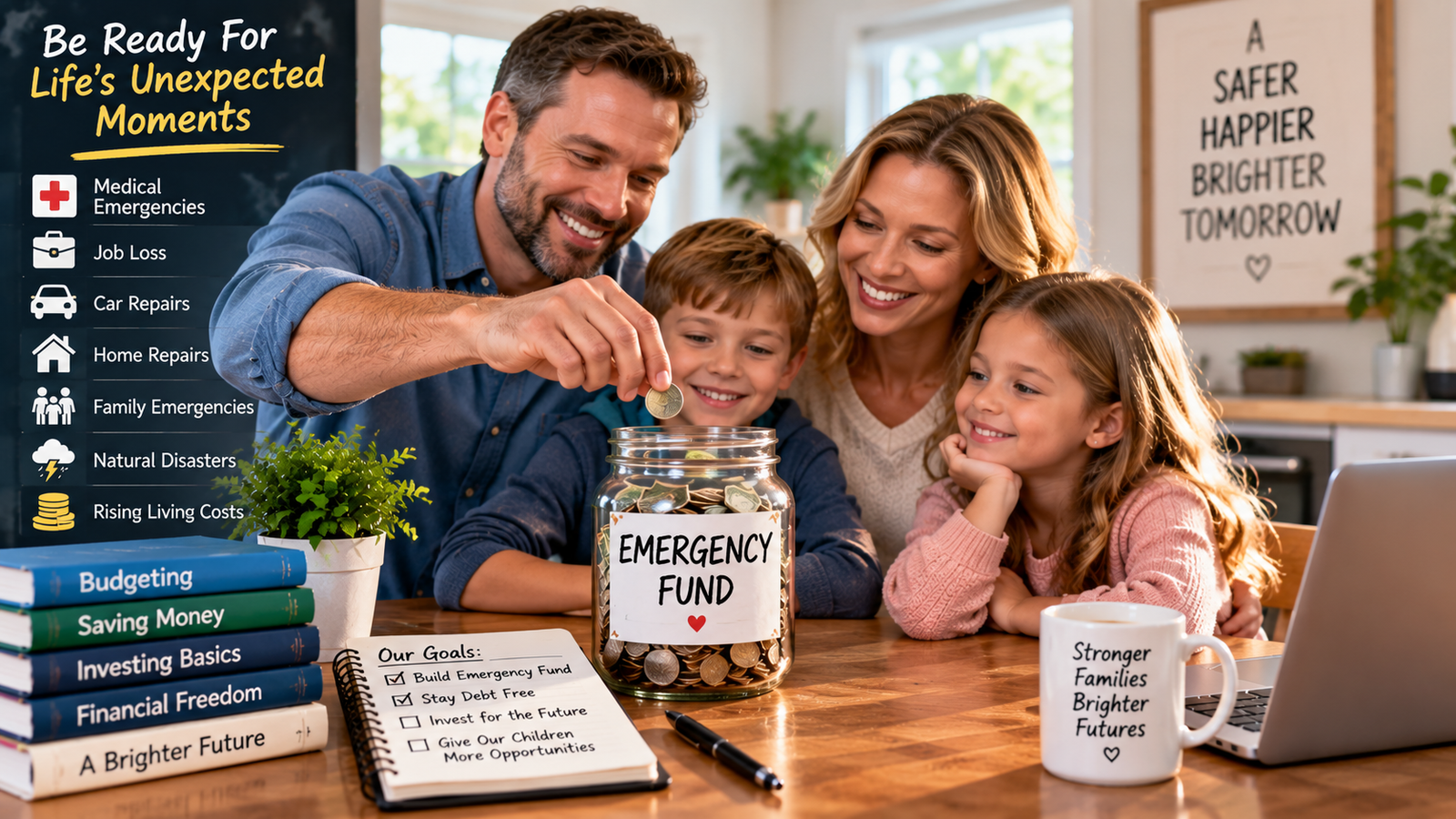
How to Build an Emergency Savings Fund, Protect Your Family From Financial Shocks and Prepare for Investing
Introduction
Financial Security Should Come Before Financial Growth
Most families want their money to grow. They want to invest, buy property, build businesses, prepare for retirement and create a better financial future for their children. But before focusing entirely on investment returns, there is another financial priority that deserves attention: building an emergency fund.
An emergency fund is money specifically reserved for expenses you did not reasonably expect—such as job loss, urgent medical costs, essential vehicle repairs, emergency travel or major home repairs. The Consumer Financial Protection Bureau’s emergency-fund guide explains that even relatively small savings can help families recover more quickly from financial shocks, while FINRA’s guidance for new investors recommends putting basic financial needs—including emergency savings—in order before beginning to invest.
That distinction is important because emergency savings and investments serve different purposes. Investments are generally intended to grow money over time and may fluctuate in value. Emergency savings should emphasize safety, accessibility and liquidity.
This guide explains how much to consider saving, where to keep the money, how to build your first reserve, how to prepare for family and medical emergencies, and how to rebuild your fund after you use it.
What Is an Emergency Fund?
An emergency fund is a dedicated pool of money reserved for unexpected and necessary financial expenses, rather than routine monthly spending or planned purchases. According to the CFPB, common uses include car and home repairs, medical bills and loss of income. FINRA’s financial-hardship guidance similarly recommends keeping emergency money somewhere safe and readily accessible rather than exposing it to investment risk.
An emergency fund is therefore different from money for a holiday, new television, wedding, planned school fees or routine annual insurance premium. Those predictable costs can be handled through ordinary savings or sinking funds. Emergency savings should be protected for genuine financial shocks.
Think of your emergency fund as a financial shock absorber. It does not prevent bad things from happening, but it can reduce the damage when they do.
Why Build an Emergency Fund Before Investing?
Investing can be an important part of long-term wealth creation, but investments can lose value—especially over short periods. If your entire financial reserve is invested and an emergency occurs during a market decline, you may be forced to sell at an unfavorable time. FINRA’s guidance for new investors recommends having funds available for emergencies before investing, while the CFPB emphasizes that emergency savings can reduce dependence on loans and credit cards after an unexpected expense.
The principle can be summarized as:
Emergency savings protect the present. Investments help finance the future.
You may eventually need both. But building some financial resilience first can make your long-term investment strategy more sustainable.
How Much Should You Save in an Emergency Fund?
There is no universal amount appropriate for every household. Your target depends on family size, essential expenses, income stability, insurance, health circumstances, employment prospects and other sources of financial support. The CFPB recommends considering the unexpected expenses you have experienced previously when establishing your target, while FINRA describes three to six months of expenses as a useful goal while emphasizing that any amount you can afford to save is helpful.
A practical approach is to build your fund in stages:
Stage 1: First emergency cushion — $500, $1,000 or an achievable equivalent in your local currency.
Stage 2: One month of essential expenses.
Stage 3: Three months of essential expenses.
Stage 4: Work toward three to six months—or another amount appropriate for your circumstances.
For example, if your family’s essential monthly expenses are $2,500, three months would equal $7,500 and six months would equal $15,000. Someone with irregular income, dependents or uncertain employment may prefer a larger reserve than someone with highly stable income and strong household support
Where Should You Keep Emergency Savings?
Emergency money should generally satisfy three requirements: safe, accessible and separate from everyday spending. The CFPB emergency savings guide identifies dedicated bank or credit-union accounts as one option and warns that physical cash can be stolen, lost or destroyed. FINRA similarly recommends keeping emergency funds in a savings account or another safe location offering immediate access.
Where available, consider a regulated savings account that provides competitive interest without sacrificing reasonable access to the money. Readers should check the deposit-insurance system applicable in their own country and verify account fees, withdrawal rules and institutional protections.
Emergency savings generally should not depend on volatile stocks, cryptocurrencies or speculative assets. You don’t want to discover that the $10,000 you expected to use for an emergency is worth substantially less precisely when you need it.
Building Your First Emergency Reserve From Scratch
If you have no emergency savings today, don’t become discouraged by a target of several months of expenses. Start smaller. The CFPB specifically emphasizes that even small amounts can provide financial security, and its automatic-saving guidance recommends regular automatic transfers as one of the easiest ways to build savings consistently.
Start with an amount you can maintain:
$5 a week = $260 per year
$10 a week = $520 per year
$25 a week = $1,300 per year
$50 a week = $2,600 per year
If your income is irregular, consider saving a percentage of every payment instead of a fixed monthly amount.
Bonuses, gifts, business profits, overtime payments and other occasional income can also accelerate progress. The key is to create a repeatable savings system rather than waiting for the mythical month when you suddenly have plenty of money left over.
Make Emergency Saving Automatic
Automation changes emergency saving from a monthly decision into a financial system. The CFPB recommends automatic transfers from checking to savings and notes that some workers may be able to divide direct deposits between accounts. Its separate automatic-saving guide similarly explains that recurring transfers can make consistent saving easier.
For example, if you are paid every two weeks, arrange for $25 to move automatically into emergency savings after each paycheck. You would contribute approximately $650 over 26 pay periods without needing to manually make 26 separate saving decisions.
When your income increases, increase the automatic contribution before your lifestyle absorbs the entire raise.
What Counts as a Real Emergency?
An emergency is generally unexpected, necessary and financially significant. The CFPB gives examples such as medical bills, car repairs, home repairs and loss of income, while its family emergency-preparedness guidance also highlights emergency travel and disaster-related costs.
Common legitimate emergencies might include:
- Essential vehicle repairs needed to get to work
- Urgent medical or dental treatment
- Sudden job loss
- Emergency travel for a serious family situation
- Critical home repairs
- Temporary loss of income
- Essential appliance replacement
- Disaster-related expenses not immediately covered by insurance
A discounted vacation, new smartphone, designer clothing or spontaneous shopping opportunity is generally not an emergency.
Establish your family’s rules before temptation appears.
Emergency Funds Can Help You Avoid Credit Card Debt
Without cash reserves, a $1,500 emergency may become a $1,500 credit-card balance. Interest and fees can then make the original emergency substantially more expensive. The CFPB warns that using credit or loans for emergency expenses can turn a one-time financial shock into harder-to-repay debt, while FINRA recommends addressing high-interest debt as part of establishing a sound financial foundation.
Credit cards can be useful financial tools when managed carefully, but they are not the same thing as emergency savings.
An emergency fund allows you to use yesterday’s savings instead of tomorrow’s income to solve today’s problem.
That difference can prevent one emergency from creating months or years of repayments.
How Inflation Affects Your Emergency Fund
Inflation gradually increases the cost of food, housing, transportation, utilities, healthcare and other necessities. That means an emergency target calculated several years ago may no longer cover the same number of months. Families can use an official inflation measure applicable to their country; for international comparisons and economic data, the World Bank’s inflation indicator provides country-level information, while the International Monetary Fund provides broader educational and economic resources on inflation.
Review your emergency target at least annually.
If essential monthly expenses rise from $2,000 to $2,400, a six-month target rises from $12,000 to $14,400.
Interest earned on a savings account can help offset some loss of purchasing power, but the primary purpose of emergency money remains liquidity and financial protection, not maximizing investment returns.
Preparing for Family Emergencies
Family emergencies often affect more than one person and may require money immediately. Emergency travel, temporary caregiving, home repairs, natural disasters or supporting dependent children can create expenses that ordinary monthly budgets cannot absorb. The CFPB’s family emergency guide recommends financial preparation before disasters occur, while the CFPB’s broader emergency-fund guidance emphasizes establishing clear rules for when emergency savings should be used.
Families should discuss:
Who can access the emergency account?
What qualifies as an emergency?
Where are important financial documents?
Which expenses are insured?
Who should be contacted during a crisis?
Families in areas exposed to natural disasters may also benefit from keeping a small, secure amount of physical cash for situations when electricity, payment networks or ATMs are unavailable. However, the CFPB notes that cash stored at home can be vulnerable to theft, fire or other loss.
Preparing for Medical Emergencies
Medical emergencies can create both direct and indirect financial costs. Families may face treatment bills, deductibles, medication, transportation, childcare or lost wages while someone recovers. Emergency savings can help absorb costs not immediately covered by insurance; the CFPB emergency-fund guide specifically identifies unexpected medical bills as a common reason for emergency savings, while the World Health Organization provides global information about health financing and financial protection.
Healthcare systems vary dramatically across countries. Some countries provide broad public healthcare coverage; others place more costs directly on households.
Review your health coverage and understand what you might have to pay yourself. Where appropriate, maintain insurance or other health coverage alongside emergency savings.
An emergency fund should complement insurance—not necessarily replace it.
Preparing Financially for Job Loss
Job loss is particularly difficult because it can remove income while household expenses continue. The CFPB notes that savings can help households weather furloughs, job losses and reduced working hours, while FINRA’s hardship guide identifies job loss as a major financial shock for which advance planning can help.
Calculate your survival budget now.
Identify what your household would absolutely need each month for:
Housing
Basic food
Utilities
Essential transportation
Insurance
Healthcare
Minimum debt obligations
Necessary communication
Suppose normal household spending is $4,000 monthly, but essential survival expenses are $2,700. A $10,800 emergency fund could potentially cover approximately four months of those essential costs.
Knowing this number gives your emergency-fund goal a concrete purpose.
Should You Invest While Building an Emergency Fund?
This is not always an either-or decision. Individual circumstances differ, especially when employer retirement contributions, pensions, high-interest debt, taxes or other benefits are involved. However, FINRA’s new-investor guidance recommends ensuring that basic needs and emergency savings are addressed before investing, while the CFPB explains how a dedicated cash reserve protects against financial shocks.
A beginner might therefore prioritize building an initial emergency cushion before committing significant discretionary money to higher-risk investments.
As the reserve becomes stronger, the balance can gradually shift toward long-term investment goals.
Remember:
Emergency fund = protection and liquidity.
Investment portfolio = long-term growth with risk.
Trying to make one account perform both jobs can create problems.
What Should You Do After Using Your Emergency Fund?
Using an emergency fund for a genuine emergency does not mean you failed.
That is exactly why the money existed.
The CFPB explicitly advises consumers who use their emergency savings to work on building the fund again, while its saving resources encourage establishing recurring contributions that make rebuilding more systematic.
Suppose you had $8,000 and used $2,500 for an urgent home repair.
Your new balance is $5,500.
Create a temporary rebuilding plan. Perhaps redirect some discretionary spending, bonuses or extra income toward replacing the $2,500. If you were previously contributing $100 monthly, temporarily increasing that to $200 may accelerate recovery if your budget permits.
Do not punish yourself for using emergency savings appropriately.
Use it. Recover. Rebuild it. Continue.
Emergency Fund Checklist for Families
Before moving aggressively toward investing, ask:
☐ Do we have a dedicated emergency savings account?
☐ Do we know our essential monthly expenses?
☐ Have we established an initial savings target?
☐ Could we handle an urgent vehicle or home repair?
☐ Have we planned for possible job loss?
☐ Have we considered medical expenses?
☐ Do we understand our insurance coverage?
☐ Have we defined what qualifies as an emergency?
☐ Is the money reasonably accessible?
☐ Is it protected from everyday spending?
☐ Are we contributing automatically?
☐ Do we review the target as living costs change?
☐ Do we have a plan for rebuilding the fund after using it?
If several answers are “no,” strengthening your financial safety net may deserve priority.
Conclusion
Build Your Financial Safety Net Before Chasing Returns
Investing is exciting because it offers the possibility of growth.
Emergency savings rarely feels exciting.
But financial security is not built only by maximizing returns. It is also built by surviving financial shocks without destroying the progress you have already made.
A strong emergency fund gives your family options.
When the car breaks down, you have money.
When an urgent medical bill appears, you have a reserve.
When employment suddenly ends, you have time to make better decisions.
When an unexpected family situation requires travel or caregiving, you are better prepared.
And when markets fall, you may be less likely to sell long-term investments simply because you urgently need cash.
Start small if necessary. Establish your first $500, $1,000 or an appropriate amount in your local currency. Then work toward one month of essential expenses and gradually build a larger reserve suited to your household.
Keep it safe. Keep it accessible. Protect it from unnecessary spending. Adjust it as your family’s expenses change.
And when you eventually use it, rebuild it.
Emergency savings protect your family today so that your long-term investments have a better chance to build your future.
Educational Disclaimer: This article provides general financial education and does not constitute individualized financial, investment, tax, insurance, medical or legal advice. Appropriate emergency savings amounts and financial products vary by household and country. Verify local deposit protections, account rules, taxes and regulations before making financial decisions.