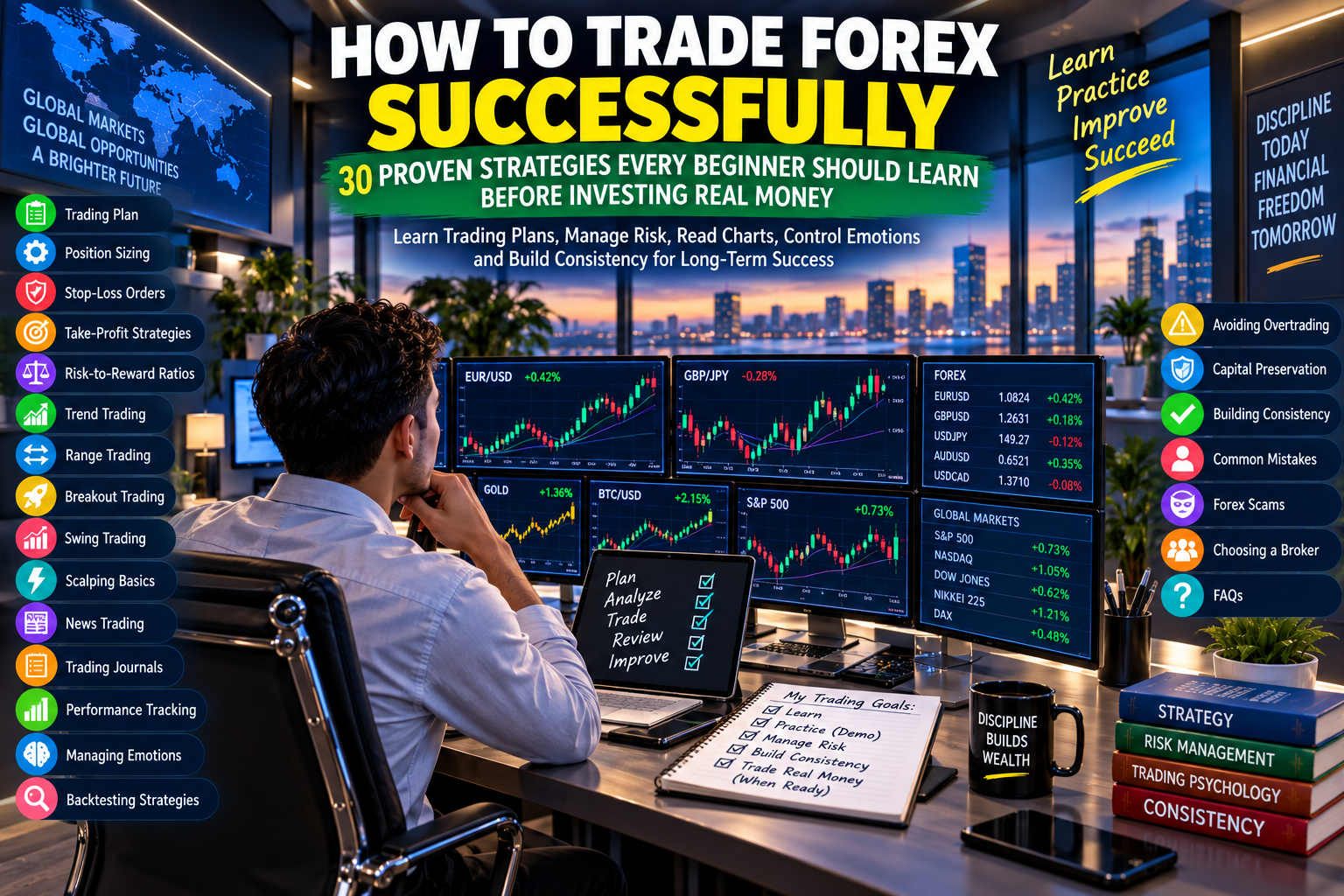
Learn Trading Plans, Position Sizing, Stop-Loss Strategies, Risk Management, Technical Setups, Backtesting, Trading Psychology and the Habits Needed to Protect Your Capital
Introduction
Learning how to place a forex trade is easy.
Learning how to trade forex responsibly and consistently is much harder.
Modern trading platforms allow someone to open a position within seconds. A beginner can select EUR/USD, click Buy or Sell, choose leverage and suddenly have thousands of dollars of currency exposure.
That technological simplicity can create a dangerous illusion:
Trading is easy because placing a trade is easy.
It isn’t.
Successful trading requires understanding probabilities, risk, market behavior, costs, psychology and—perhaps most importantly—how to survive when you are wrong.
And every trader will sometimes be wrong.
The Bank for International Settlements reported that global over-the-counter foreign-exchange turnover averaged approximately $9.6 trillion per day in April 2025.
That enormous market attracts:
Commercial banks
Central banks
Asset managers
Corporations
Hedge funds
Professional trading firms
Institutional investors
Retail traders
But a huge market does not create guaranteed profits.
The U.S. Commodity Futures Trading Commission warns that leveraged retail forex trading carries substantial risk and that leverage magnifies both gains and losses.
The UK’s Financial Conduct Authority also warns consumers about forex and CFD promotions promising unrealistic or guaranteed returns.
Therefore, the objective of this guide is not to give you a “secret forex system.”
Instead, you will learn 30 established trading and risk-management strategies, practices and principles that every beginner should understand before considering risking real money.
The fundamental rule is:
Learn first. Practice second. Risk real money last.
1. Develop a Written Forex Trading Plan
Never begin trading simply because a chart “looks good.”
Before placing a trade, you should know:
What currency pairs you trade
What timeframe you use
What creates an entry
Where you exit if wrong
Where you may take profit
How much capital you risk
When you do not trade
A simple plan might say:
Market: EUR/USD
Timeframe: 4-hour chart
Strategy: Trend continuation
Entry: Pullback toward predefined support within an established trend
Stop: Below the point that invalidates the setup
Profit objective: Based on market structure and predetermined risk/reward
Maximum risk: According to the trader’s written risk rules
Your plan creates structure.
Without one, every market movement can become an excuse to trade.
2. Define Your Risk Before Your Potential Profit
Beginners often ask:
“How much can I make?”
Risk-conscious traders ask:
“How much could I lose?”
before entering.
Suppose your account contains:
$5,000
Before opening a trade, determine the maximum acceptable loss under your trading plan.
Do not enter first and decide risk later.
The sequence should be:
Identify Setup → Determine Invalidation → Calculate Risk → Calculate Position Size → Decide Whether Trade Qualifies → Execute
Risk should determine the trade—not excitement.
3. Master Position Sizing
Position sizing determines how large your trade should be relative to your predetermined risk.
Suppose two traders identify exactly the same EUR/USD setup.
Trader A takes an enormous position.
Trader B uses a substantially smaller position.
The chart is identical.
Their financial risk is not.
Position size depends on factors such as:
Account size
Stop distance
Currency pair
Contract specifications
Maximum acceptable loss
One of the most dangerous beginner mistakes is selecting a large lot size simply because the broker permits it.
Maximum available position ≠ appropriate position.
4. Use Stop-Loss Orders Intelligently
A stop-loss is designed to close a position when price reaches a specified level.
It can help answer:
“At what point is my original trading idea no longer valid?”
Imagine buying EUR/USD because price breaks above an important resistance level.
If price subsequently falls sharply below the breakout structure, your original thesis may be invalid.
A stop should therefore have a logical reason.
Avoid placing stops randomly simply because:
“20 pips sounds reasonable.”
Market structure, volatility and position size should be considered together.
Remember that stop orders do not guarantee execution at the exact stop price during gaps, extreme volatility or certain market conditions.
5. Develop a Take-Profit Strategy
Beginners often spend enormous time deciding when to enter.
They spend much less time deciding when to leave.
That is backwards.
Before entering, consider:
Where could profit reasonably be taken?
Possible approaches include:
Previous resistance/support
Defined risk multiple
Trailing exit
Technical target
Partial profit-taking
Time-based exit
There is no universal best method.
The important point is having an exit framework before emotion becomes involved.
6. Understand Risk-to-Reward Ratios
Suppose a trade risks:
$50
with a planned potential reward of:
$100
The potential reward is twice the amount at risk.
This is often described as approximately:
1:2 risk-to-reward
But this ratio does not mean the trade is automatically good.
A strategy with attractive reward potential can still lose money if its winning probability is extremely low.
Profitability depends on the interaction between:
Win rate
Average win
Average loss
Trading costs
Execution
Do not evaluate risk-to-reward in isolation.
7. Think in Probabilities, Not Certainty
Trading is not about knowing exactly what happens next.
Imagine a strategy that historically wins 55 out of 100 comparable trades under its tested assumptions.
That does not tell you whether:
Trade #101
will win.
It means the trader is working with probabilities.
This mindset changes everything.
Instead of saying:
“This trade must win.”
you begin thinking:
“This setup meets my rules. I know the predefined risk. Now I accept the uncertain outcome.”
Probability-based thinking can reduce emotional decision-making.
8. Learn Trend Trading
Trend trading attempts to participate in sustained directional market movement.
Markets may form:
Uptrends
Downtrends
Sideways conditions
A simple price-based description of an uptrend can involve:
Higher highs + Higher lows
A downtrend can involve:
Lower highs + Lower lows
Trend traders may use:
Market structure
Moving averages
Trendlines
Momentum indicators
Support and resistance
The objective is not to predict the exact beginning and end of every trend.
It is to identify a directional environment and establish rules for participating in it.
9. Learn Range Trading
Markets do not trend constantly.
Sometimes price moves repeatedly between support and resistance.
This creates a range.
A simplified range might look like:
Resistance
↕
Trading Range
↕
Support
Range traders may look for opportunities around these boundaries.
But ranges eventually break.
Therefore, a range strategy also needs an answer to:
What happens if price leaves the range?
Never assume support or resistance must hold forever.
10. Learn Breakout Trading
A breakout occurs when price moves beyond an established technical boundary.
For example:
Resistance → Price breaks above
or:
Support → Price breaks below
Breakout traders may look for:
Strong momentum
Increasing volatility
Consolidation before breakout
Retests of broken levels
Fundamental catalysts
But false breakouts occur frequently.
Price may break a level briefly and then reverse.
Therefore:
Breakout ≠ Guaranteed continuation
Risk management remains essential.
11. Understand Pullback Trading
Instead of entering after a large price movement, some traders wait for price to temporarily retrace.
Imagine an established uptrend:
Rise → Pullback → Rise → Pullback → Rise
A trader might look for a pullback toward:
Previous support
Moving average
Trendline
Other predefined technical area
The objective is to participate in the larger trend without blindly chasing an extended move.
But a pullback can become a reversal.
You need predefined invalidation criteria.
12. Learn Swing Trading
Swing trading attempts to capture price movements that may develop over multiple sessions or days.
Swing traders generally trade less frequently than scalpers or many day traders.
They may analyze:
Daily charts
4-hour charts
1-hour charts
and combine:
Trend
Support/resistance
Momentum
Fundamentals
Economic calendars
Swing trading can appeal to people who cannot watch markets constantly.
However, holding positions longer can create overnight and event risk.
13. Understand Scalping Before Attempting It
Scalping involves attempting to profit from relatively small short-term price movements, often through frequent trades.
It sounds attractive:
Small movement + Quick trade + Frequent opportunity
But scalping can be demanding.
Challenges include:
Spreads
Commissions
Slippage
Fast decisions
Overtrading
Stress
Execution quality
A strategy making many trades can accumulate substantial transaction costs.
Beginners should not assume:
More trades = More profits
Often, more trades simply mean more opportunities to make mistakes.
14. Understand Day Trading
Day traders generally open and close positions within the same trading day.
Potential advantages include avoiding some overnight exposure.
Challenges include:
High decision frequency
Transaction costs
Emotional pressure
News volatility
Screen time
Overtrading
Day trading should be approached as a structured process—not entertainment.
15. Learn News Trading Carefully
Economic announcements can cause substantial currency volatility.
Important releases may include:
Central-bank decisions
Inflation
Employment
GDP
Retail sales
Manufacturing indicators
Political developments
Reliable global sources include the:
Bank for International Settlements
and official central-bank websites.
Major examples include the Federal Reserve, European Central Bank, Bank of England and Bank of Japan.
But news trading can involve:
Rapid price movements
Wider spreads
Slippage
False initial reactions
Beginners should observe how markets behave around major announcements before attempting to trade them.
16. Never Trade News Based Only on the Headline
Suppose inflation rises.
A beginner might immediately assume:
Currency must rise.
But markets price expectations.
If investors expected inflation to rise even more, the currency might react differently.
Markets often respond to:
Actual result vs. Expected result vs. Previous result
They also react to what the information implies for future central-bank policy.
This is why economic-market reactions can initially appear irrational.
17. Combine Technical and Fundamental Analysis
Technical analysis asks:
What is price doing?
Fundamental analysis asks:
What economic forces might influence the currency?
Combining them can provide broader context.
For example:
Fundamental research suggests monetary-policy conditions may favor one currency.
Technical analysis identifies an established trend.
Price pulls back toward a technical area.
The trader then evaluates whether the setup satisfies the written plan.
This does not guarantee success.
It simply creates a structured analytical process.
18. Backtest Your Strategy
Backtesting involves evaluating trading rules against historical market data.
Suppose your strategy says:
Trade only with trend
Wait for pullback
Enter after confirmation
Place stop beyond invalidation
Use predefined exit
You can examine historical periods and record what would have happened.
Track:
Number of trades
Wins
Losses
Average win
Average loss
Maximum drawdown
Consecutive losses
Trading costs where possible
Do not simply search charts for beautiful examples that worked.
Test the rules consistently.
19. Avoid Overfitting Your Backtest
There is a hidden danger in backtesting.
You can create rules that fit historical data perfectly but fail when market conditions change.
For example:
You repeatedly modify indicators until you discover a combination that would have performed extremely well over one historical period.
That does not mean it will perform well in the future.
This is called overfitting.
A strategy should be understandable and economically or behaviorally plausible—not merely optimized to make historical results look spectacular.
20. Forward-Test on a Demo Account
After backtesting, test the strategy in current market conditions without real money.
A demo account can help you practice:
Entries
Stops
Position sizing
Order types
Exits
Journaling
Discipline
Use the same rules you would use with real money.
If your demo account contains $100,000 but you expect to eventually trade $2,000, practicing enormous positions may teach unrealistic habits.
Make the simulation relevant to your intended circumstances.
21. Keep a Detailed Trading Journal
Your trading journal is one of your most valuable learning tools.
Record:
Date
Currency pair
Market session
Strategy
Entry
Stop
Target
Position size
Result
Screenshot
Economic context
Emotional state
Mistakes
Lessons
After enough trades, your journal becomes data.
Instead of saying:
“I think I’m good at breakout trading,”
you can examine evidence.
22. Track Your Performance With Numbers
Do not judge yourself based only on account balance.
Track:
Win rate
Average win
Average loss
Profit factor where useful
Maximum drawdown
Consecutive wins
Consecutive losses
Average risk per trade
Strategy-specific performance
Suppose:
Strategy A wins 70% of trades but loses much more on losing trades.
Strategy B wins only 45% but its average winner is substantially larger than its average loser.
Win rate alone does not tell you which is better.
Trading performance must be evaluated as a system.
23. Measure Expectancy
A useful conceptual framework is expectancy.
Imagine a hypothetical strategy where:
50% of trades win $100
and:
50% lose $50
Across many trades, the average expected result before costs would be positive under those assumptions.
But historical expectancy is not a guarantee of future returns.
Market conditions change.
Execution changes.
Costs change.
Trader behavior changes.
Use expectancy as an analytical tool—not a promise.
24. Control Fear and Greed
Two emotions frequently dominate trading:
Fear
and
Greed
Fear can cause traders to:
Exit winners too early
Avoid valid setups
Move stops irrationally
Greed can cause traders to:
Increase position size
Remove profit targets
Use excessive leverage
Overtrade
The solution is not eliminating emotion.
You are human.
The objective is building systems that reduce emotion’s influence over decisions.
25. Stop Revenge Trading
Imagine losing:
Trade 1.
Then Trade 2.
Then Trade 3.
You become angry.
You think:
“I need to win it back.”
You double the position size.
That is revenge trading.
Your objective has changed from executing your strategy to recovering emotional pain.
A predetermined daily or session loss limit can help interrupt this cycle.
When your rules say stop:
Stop.
Markets will still exist tomorrow
26. Avoid Overtrading
Overtrading can happen because of:
Boredom
FOMO
Losses
Greed
Need for excitement
Desire to recover money
Ask before every position:
Does this trade meet my written rules?
If the answer is no, don’t manufacture a reason to enter.
Professional discipline often means doing nothing.
Sometimes the best trade is:
No trade.
27. Protect Your Capital Above Everything Else
Your trading capital is your ability to continue participating.
Imagine two beginners.
Trader A
Tries to double the account quickly.
Uses extreme leverage.
Takes huge positions.
Trader B
Prioritizes education.
Controls position size.
Accepts small losses.
Keeps detailed records.
Trader B may appear slower.
But trading survival is itself an advantage.
A trader who loses all capital cannot benefit from future opportunities.
Capital preservation comes before capital multiplication.
28. Build Consistency Before Increasing Position Size
Do not increase risk simply because you had three winning trades.
A short winning streak proves very little.
Before increasing position size, evaluate performance across a meaningful sample of trades and different market environments.
Ask:
Did I follow my plan?
Were results repeatable?
How large was my drawdown?
How did I perform during losing streaks?
Were profits dependent on one unusually large trade?
Scale slowly, if appropriate.
Consistency should come before size.
29. Develop a Pre-Trade and Post-Trade Routine
Create a repeatable routine.
Before Trading
Check:
Economic calendar
Market conditions
Trend/range
Important levels
Trading setup
Position size
Risk
Stop
Potential exit
After Trading
Record:
Result
Screenshot
Execution quality
Emotional behavior
Rule violations
Lesson
This transforms trading from impulsive activity into a process.
30. Know When Not to Trade
One of the most advanced trading skills is recognizing when conditions do not suit your strategy.
You may decide not to trade when:
You are emotionally upset
You are exhausted
Your strategy has no valid setup
Spreads are unusually wide
Market liquidity is poor
A major event creates unacceptable uncertainty
You have reached your loss limit
You feel pressure to recover money
Trading is optional.
Protecting your financial well-being is not.
A Practical Beginner Forex Strategy Framework
Instead of searching for a magical system, construct a framework.
Step 1 — Choose a limited number of currency pairs
Learn their behavior.
Step 2 — Choose your timeframe
Avoid jumping randomly between charts.
Step 3 — Define market conditions
Trend, range, breakout or another clearly defined environment.
Step 4 — Define your entry
Write objective conditions.
Step 5 — Define invalidation
Know where your analysis becomes wrong.
Step 6 — Calculate position size
Base exposure on predetermined risk.
Step 7 — Define potential exit
Know your plan before entering.
Step 8 — Execute
Do not change rules because of temporary emotion.
Step 9 — Journal
Document everything.
Step 10 — Review
Improve based on evidence rather than feelings.
The Forex Consistency Formula
A useful way to think about responsible trading is:
Education + Tested Strategy + Risk Management + Discipline + Record Keeping + Continuous Review
Not:
High Leverage + More Trades + Bigger Positions = Wealth
There is no legitimate formula guaranteeing forex profits.
But there are processes that can help traders manage risk more systematically.
A 90-Day Beginner Forex Learning Plan
Days 1–30: Learn
Study:
Currency pairs
Pips
Lots
Spreads
Leverage
Margin
Trading sessions
Charts
Economic news
Use authoritative resources such as:
Bank for International Settlements
and your country’s central bank and financial regulator.
Do not risk real money.
Days 31–60: Build and Test
Choose one strategy.
Define:
Entry
Stop
Target
Risk
Position sizing
Trading conditions
Backtest historical examples.
Record results.
Do not constantly change strategies.
Days 61–90: Demo Trade
Trade the strategy in a demo environment.
Keep a detailed journal.
Measure:
Rule compliance
Wins
Losses
Average win
Average loss
Drawdown
Emotional mistakes
At Day 90, do not ask only:
“Did I make virtual money?”
Ask:
“Did I consistently follow a well-defined process?”
That is a much better measure of progress.
How to Recognize Fake Forex Strategies
Be skeptical when someone claims:
“100% win rate.”
“Guaranteed daily income.”
“Never loses.”
“Turn $100 into $10,000.”
“Secret institutional strategy.”
“AI bot guarantees profits.”
“No stop-loss required.”
Financial markets do not offer guaranteed speculative profits.
The CFTC provides extensive education about derivatives and trading fraud.
International readers can use the IOSCO Investor Alerts Portal to review alerts contributed by participating financial regulators around the world.
Choosing a Broker Before Trading Real Money
Strategy means little if your broker is fraudulent.
Before depositing money, independently verify the provider.
Check:
Legal company name
Regulatory authorization
Official domain
License number
Client-money rules
Withdrawal policy
Trading costs
Leverage rules
Dispute procedures
Useful official resources include:
IOSCO — international securities-regulator network.
IOSCO Investor Alerts Portal — international warnings submitted by participating regulators.
ASIC MoneySmart — Australia.
FCA Register — United Kingdom.
MAS Financial Institutions Directory — Singapore.
CFTC Check — United States.
NFA BASIC — U.S. derivatives registration information.
Readers elsewhere should identify the official financial regulator in their own country and verify the broker directly through its database.
Frequently Asked Questions
What Is the Best Forex Strategy for Beginners?
There is no universally best strategy.
Trend trading, range trading, breakout trading and swing trading can all produce both winning and losing trades.
A beginner should prioritize a strategy that is:
Understandable
Testable
Rule-based
Compatible with their schedule
Compatible with their risk tolerance
Can a Forex Strategy Guarantee Profit?
No.
A strategy can have historically favorable results and still experience losses in future market conditions.
Anyone promising guaranteed forex profits should be treated with extreme caution.
What Risk-to-Reward Ratio Is Best?
There is no universally correct ratio.
Risk-to-reward must be considered alongside:
Win probability
Market conditions
Trading costs
Strategy characteristics
A 1:3 setup is not automatically superior to 1:1 if its probability of success is dramatically lower.
How Many Forex Trades Should a Beginner Make Each Day?
There is no required number.
A strategy may produce several valid setups or none.
Do not create trades simply to meet a daily quota.
Is Scalping Good for Beginners?
Scalping can be demanding because transaction costs, execution speed, decision frequency and psychology become especially important.
Beginners should understand these challenges before attempting high-frequency approaches.
Is Swing Trading Easier for Beginners?
Some beginners may find slower timeframes easier to analyze because decisions occur less frequently.
However, swing positions can face overnight and event risk.
No style is automatically easy or profitable.
Should I Trade Forex News?
Major economic releases can create rapid volatility, spread changes and slippage.
Beginners may benefit from observing news reactions on demo accounts before considering real-money news trading.
How Long Should I Demo Trade?
There is no universal duration.
The objective is not simply spending a certain number of days on demo.
You should be able to demonstrate:
Understanding of the platform
Consistent risk rules
A defined strategy
Journal records
Evidence of disciplined execution
before even considering real capital.
Can AI Create a Winning Forex Strategy?
AI can help analyze data, organize information, assist with backtesting and identify patterns.
It cannot guarantee future market behavior.
Markets respond to unpredictable economic, political and financial events.
Treat “guaranteed AI forex robot” claims as major warning signs.
Can I Become Rich Quickly With Forex?
Trying to become rich quickly often encourages:
Excessive leverage
Oversized positions
Overtrading
Emotional decisions
Those behaviors can rapidly destroy capital.
Forex should never be treated as a guaranteed shortcut to wealth.
Conclusion
Learning forex successfully is not about finding one magical indicator.
It is about developing a repeatable decision-making process.
A disciplined trader learns to:
Plan before entering.
Calculate position size.
Define risk.
Use exits intelligently.
Understand risk-to-reward.
Recognize trends and ranges.
Evaluate breakouts.
Understand economic news.
Backtest strategies.
Practice on demo accounts.
Keep detailed journals.
Track performance.
Control emotions.
Avoid revenge trading.
Avoid overtrading.
Protect capital.
Build consistency.
The strongest traders are not necessarily the people who make the most dramatic trades.
They are often the people who remain disciplined when nothing exciting is happening.
They understand that losses are part of uncertain markets.
They don’t need every trade to win.
They need losses to remain manageable enough that they can continue executing their strategy.
Therefore, before investing real money, remember this sequence:
Learn → Plan → Backtest → Demo Trade → Journal → Measure → Improve → Manage Risk → Protect Capital → Build Consistency
And only after developing those foundations should you decide whether real-money forex trading belongs in your financial plan.
The market will always offer another trade.