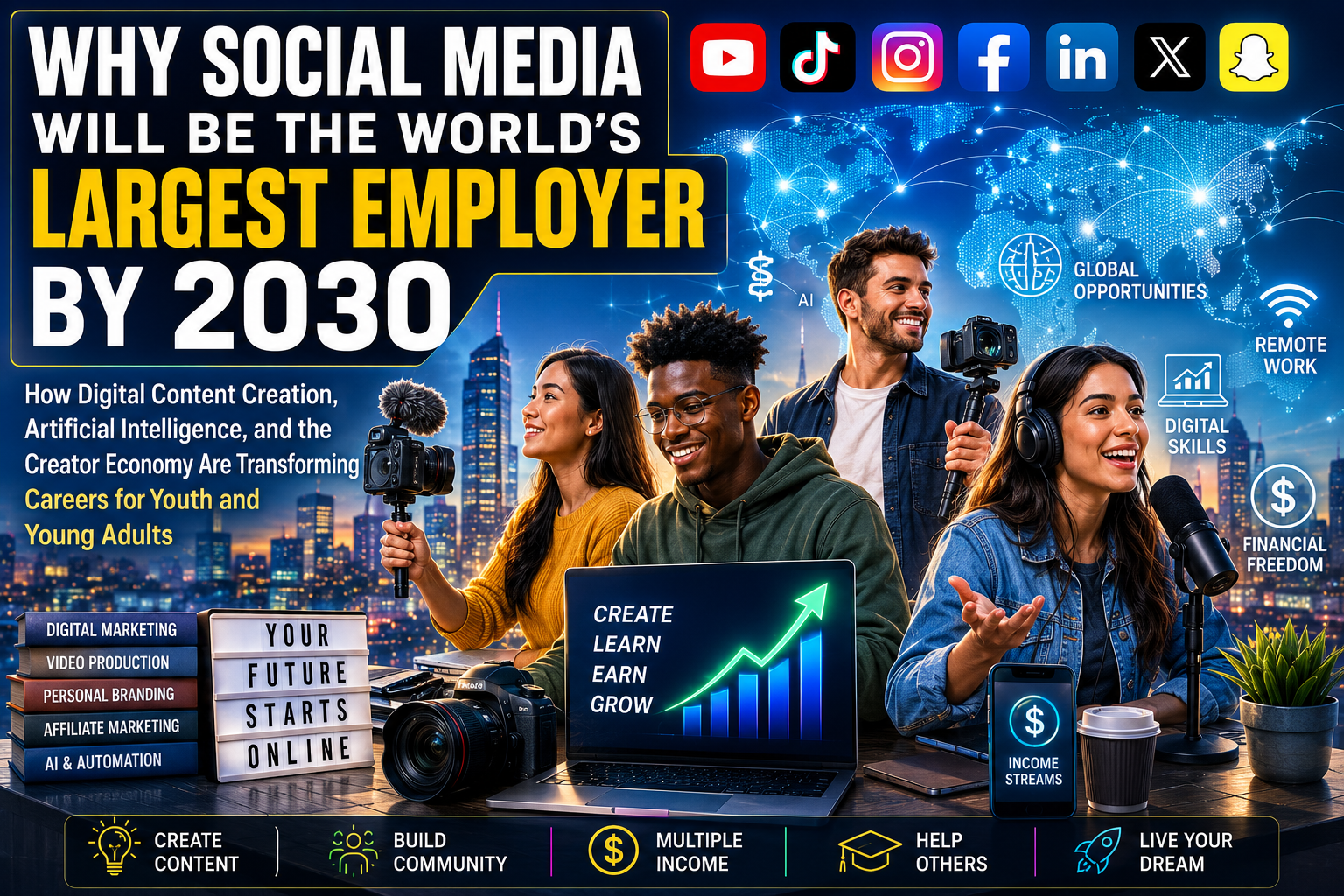
How Artificial Intelligence, Digital Skills, and the Creator Economy Are Transforming Careers for Youth and Young Adults Worldwide
Discover why social media is expected to become one of the world’s largest sources of employment by 2030. Learn how YouTube, TikTok, Instagram, Facebook, LinkedIn, Snapchat, X, artificial intelligence, and the creator economy are creating millions of career opportunities for young people worldwide.
Introduction
The world of work is undergoing one of the most significant transformations in modern history. Advances in digital technology, artificial intelligence (AI), high-speed internet, cloud computing, and mobile devices have fundamentally changed how people learn, communicate, conduct business, and earn a living. Among all these developments, social media has emerged as one of the most powerful forces shaping the global economy.
What began as platforms for sharing photos and connecting with friends has evolved into a worldwide digital marketplace where people build businesses, educate millions, influence purchasing decisions, promote brands, develop professional careers, and generate sustainable income. Today, billions of people use social media every day, making it one of the largest communication ecosystems ever created. According to the Digital 2025 Global Overview Report by We Are Social and Meltwater, billions of people worldwide actively use social media, demonstrating its central role in communication, commerce, and information sharing.
By 2030, many experts expect digital careers and creator-led businesses to continue expanding as organizations invest more heavily in online communication, e-commerce, artificial intelligence, and digital marketing. While traditional careers will remain important, social media is expected to become one of the world’s largest sources of entrepreneurship, freelance work, and digital employment.
1. The Future of Work Is Digital
For decades, employment largely depended on physical workplaces, office buildings, factories, or retail locations. Workers generally needed to live near their employers, commute daily, and rely on local job markets. Today’s digital economy has dramatically changed those assumptions.
A graphic designer in Kenya can work with a company in Canada. A video editor in the Philippines can produce content for creators in Australia. A financial educator in the United States can teach thousands of students across Africa, Europe, and Asia through YouTube and online courses. Geographic boundaries are becoming less significant for many digital professions.
The World Economic Forum has repeatedly highlighted that technological change, AI adoption, automation, and digital transformation are reshaping labor markets while increasing demand for analytical thinking, creativity, technological literacy, resilience, and lifelong learning.
Unlike many traditional careers, digital professions reward practical skills, creativity, adaptability, and continuous learning. Employers increasingly evaluate portfolios, demonstrated expertise, certifications, and measurable results alongside—or sometimes instead of—formal educational credentials.
For young adults entering the workforce, this shift presents unprecedented opportunities. A smartphone, reliable internet connection, and dedication to learning can now become the foundation for building an international career.
2. Why Social Media Is Becoming a Global Employer
Social media has evolved far beyond entertainment. It has become one of the world’s largest ecosystems for communication, education, commerce, advertising, customer service, and entrepreneurship.
Every day, people watch educational videos, attend live classes, purchase products recommended by creators, participate in online communities, discover businesses, and learn new professional skills through platforms such as:
- YouTube
- TikTok
- Snapchat
- X
Behind every successful social media account exists an entire ecosystem of professionals.
For example, a successful YouTube educational channel may involve:
- Script writers
- Researchers
- Video editors
- Thumbnail designers
- SEO specialists
- Graphic designers
- Motion graphics artists
- Social media managers
- Community moderators
- Virtual assistants
- Advertising specialists
- Brand partnership managers
Consequently, one successful creator often generates employment opportunities for numerous other professionals.
According to HubSpot’s marketing research, organizations continue increasing investment in social media marketing because consumers increasingly discover products, brands, and educational content through digital platforms.
This growing demand means businesses of every size—from local shops to multinational corporations—require skilled professionals capable of producing engaging digital content.
3. The Rise of the Creator Economy
One of the most important economic developments of the past decade has been the rapid expansion of the creator economy.
The creator economy refers to individuals who build audiences online and earn income by creating valuable content, products, services, or communities.
Unlike traditional employment, creators often operate as entrepreneurs rather than employees. They may generate revenue from several sources simultaneously, including:
- Advertising revenue
- Affiliate marketing
- Brand sponsorships
- Online courses
- Digital downloads
- eBooks
- Consulting
- Coaching
- Membership communities
- Merchandise
- Speaking engagements
- Freelance services
This diversified approach reduces dependence on a single employer and provides greater financial flexibility.
Research from Adobe’s Future of Creativity studies has shown that millions of people worldwide identify themselves as creators, and the creator economy continues expanding across age groups, industries, and geographic regions.
Importantly, creators are no longer limited to entertainment.
Today’s successful creators include:
- Teachers
- Doctors
- Lawyers
- Financial advisors
- Economists
- Engineers
- Software developers
- Fitness coaches
- Nutrition experts
- Farmers
- Scientists
- Language instructors
- Historians
- Career coaches
People increasingly search social media for practical solutions to everyday problems, creating opportunities for experts in virtually every field.
4. Artificial Intelligence Is Empowering Creators
Artificial Intelligence has become one of the most influential technologies transforming digital careers.
Contrary to fears that AI will replace all human creativity, its greatest current impact is helping creators become more productive.
Modern AI tools assist with:
- Brainstorming content ideas
- Research assistance
- Script writing
- Grammar improvement
- Translation into multiple languages
- Video editing
- Automatic subtitles
- Voice enhancement
- Image generation
- Graphic design
- Content scheduling
- Audience analysis
- Marketing optimization
These technologies allow creators to spend less time on repetitive tasks and more time developing original ideas, teaching, storytelling, and engaging with their communities.
Google, Microsoft, Adobe, and many other technology companies continue investing heavily in AI-powered creative tools, signaling that AI literacy will become an increasingly valuable workplace skill over the coming decade.
However, AI should be viewed as an assistant—not a replacement for originality, integrity, critical thinking, or authentic human communication.
Audiences continue valuing trustworthy creators who provide unique perspectives, lived experiences, and meaningful solutions.
5. Building a Career Without Traditional Barriers
One of the most remarkable aspects of social media is its accessibility.
Previous generations often needed substantial financial resources to launch businesses:
- Office space
- Expensive equipment
- Employees
- Printing costs
- Marketing budgets
- Distribution networks
Today, many successful entrepreneurs begin with:
- A smartphone
- Free editing software
- Internet access
- Consistent effort
- Valuable knowledge
A university student can teach mathematics on YouTube.
A chef can demonstrate recipes on TikTok.
A photographer can sell digital products through Instagram.
A financial educator can explain investing through LinkedIn.
A language teacher can attract international students through Facebook or YouTube.
These opportunities are available regardless of age, gender, nationality, or geographic location.
This democratization of entrepreneurship is one of the defining characteristics of the modern digital economy.
Of course, accessibility does not guarantee success. Building a sustainable audience requires patience, continuous learning, ethical behavior, originality, and consistent publishing over time. Nevertheless, social media has significantly lowered the barriers that once prevented many talented individuals from sharing their expertise with the world.
Building Careers, Businesses, and a Global Workforce Through Digital Skills
6. New Professions Created by Social Media
One of the strongest indicators that social media is becoming a major global employer is the emergence of entirely new professions. Twenty years ago, careers such as YouTuber, TikTok Creator, Social Media Manager, Podcast Producer, Influencer Marketing Specialist, and UGC (User-Generated Content) Creator were virtually unknown. Today, these roles represent legitimate career paths for millions of people.
The creator economy has expanded far beyond individuals posting videos online. Successful creators often operate like small media companies, supported by teams of editors, writers, designers, marketers, virtual assistants, photographers, accountants, legal advisors, and business managers. In many cases, one creator supports the livelihoods of several other professionals.
Examples of fast-growing digital careers include:
- Content Creator
- Social Media Influencer
- Video Editor
- AI Content Strategist
- Podcast Producer
- Livestream Host
- Affiliate Marketing Specialist
- Community Manager
- Thumbnail Designer
- SEO Content Writer
- Social Media Advertising Specialist
- Digital Brand Consultant
- Online Course Creator
- Newsletter Publisher
- Creator Business Manager
As brands increasingly rely on digital storytelling instead of traditional advertising, demand for these professionals is expected to continue growing. Industry analyses also show that brands are moving toward longer-term partnerships with creators and using AI to identify the most effective collaborators, reflecting the increasing maturity of the creator economy.
7. Education Has Entered the Digital Age
Education is no longer limited to classrooms, textbooks, or lecture halls. Social media has transformed how people acquire practical knowledge, making high-quality educational content accessible to anyone with an internet connection.
Today, millions of learners use YouTube tutorials, LinkedIn Learning, educational podcasts, and short-form video platforms to develop skills in:
- Artificial Intelligence
- Digital Marketing
- Coding
- Graphic Design
- Video Editing
- Entrepreneurship
- Investing
- Personal Finance
- Foreign Languages
- Photography
- Public Speaking
- Career Development
This shift has created enormous opportunities for educators and professionals to share expertise while building sustainable online businesses.
Educational creators now serve audiences that traditional institutions may never reach. Someone living in a rural village can learn coding, digital marketing, or financial literacy from experts located thousands of miles away. This democratization of education is helping reduce barriers to lifelong learning and enabling people to update their skills throughout their careers.
8. Remote Work and the Global Digital Workforce
The growth of remote work has reinforced the importance of social media and digital platforms in the modern economy.
Companies increasingly hire people based on demonstrated skills rather than geographic location. Creative professionals routinely collaborate across continents, using social media not only to communicate but also to showcase portfolios, attract clients, and build professional reputations.
A freelance designer in Kenya can work with businesses in Canada. A video editor in the Philippines can support YouTube creators in Australia. A consultant in Brazil can advise companies across Europe and North America.
Many organizations are also embracing remote-first work models. For example, HubSpot reports that a large majority of its workforce operates remotely, illustrating how digital collaboration has become a permanent feature of many knowledge-based businesses.
Remote work expands opportunities for talented individuals regardless of where they live, provided they possess the necessary skills, communication abilities, and professionalism.
9. Multiple Income Streams: The New Career Model
Traditional careers often rely on a single employer and a monthly paycheck. The creator economy encourages a different model: multiple streams of income.
Many successful digital entrepreneurs earn revenue from several sources simultaneously, such as:
- Platform advertising revenue
- Affiliate marketing
- Brand sponsorships
- Digital products
- Online courses
- Membership communities
- Consulting
- Coaching
- Freelance services
- Merchandise
- Public speaking
- Licensing original content
This diversified approach provides greater financial resilience because creators are not dependent on one source of income. If one revenue stream declines, others may continue supporting the business.
However, building multiple income streams requires patience, planning, and a commitment to delivering genuine value. Sustainable success comes from trust, quality content, and ethical business practices rather than shortcuts or unrealistic promises.
10. The Skills Every Future Creator Should Learn
Technology changes rapidly, but several foundational skills are likely to remain valuable well beyond 2030.
Digital Skills
- Content creation
- Video production
- Photography
- Graphic design
- Website publishing
- Email marketing
- Search engine optimization (SEO)
Communication Skills
- Storytelling
- Public speaking
- Copywriting
- Community engagement
- Customer service
- Presentation skills
Business Skills
- Personal branding
- Sales
- Negotiation
- Project management
- Financial literacy
- Entrepreneurship
AI Skills
Artificial intelligence is increasingly becoming a productivity tool rather than a replacement for human creativity. Learning how to use AI responsibly for research, editing, brainstorming, translation, analytics, and workflow automation will become a valuable advantage. The World Economic Forum notes that AI is changing the skills required in many occupations while increasing the importance of both technological and human-centered capabilities.
11. Challenges and Responsibilities
While social media presents tremendous opportunities, it also requires responsibility.
Successful creators should understand:
- Copyright and intellectual property
- Privacy protection
- Data security
- Ethical advertising
- Transparency in sponsored content
- Responsible AI use
- Online misinformation
- Digital well-being
The OECD has observed that younger adults are among the most active users of social networking and generative AI, but also emphasizes the importance of balancing digital opportunities with concerns about well-being, screen time, trust, and responsible technology use.
Creators who prioritize accuracy, authenticity, and audience trust are more likely to build lasting careers than those who focus only on short-term attention.
12. Looking Beyond 2030
Although this article focuses on 2030, the long-term outlook extends even further.
Several trends are likely to shape the next decade:
- Greater integration of AI into creative workflows
- Expansion of multilingual content
- Increased demand for educational creators
- Growth in remote and freelance work
- Continued rise of digital entrepreneurship
- More personalized learning experiences
- Stronger collaboration between brands and creators
- Greater emphasis on authenticity and community
Digital trend analyses consistently show that AI, video content, mobile technology, and social media continue to reshape how people discover information, learn new skills, and interact with businesses. Social media is becoming not only a communication platform but also a marketplace for knowledge, services, and entrepreneurship.
Key Takeaways
- Social media has evolved into a major global economic ecosystem.
- Digital skills are becoming as valuable as many traditional workplace skills.
- AI is increasing productivity and creating new opportunities for creators who use it responsibly.
- The creator economy supports far more careers than just influencers.
- Remote work enables people to serve clients and audiences worldwide.
- Multiple income streams improve long-term financial resilience.
- Continuous learning will remain essential as technology evolves.
- Authenticity, trust, and ethical practices are key to sustainable success.
Frequently Asked Questions
Can someone start a social media career without a college degree?
Yes. Many successful creators build careers through practical skills, portfolios, and consistent content. Formal education can be valuable, but many digital careers also reward demonstrated ability and continuous learning.
Which social media platform is best for beginners?
The best platform depends on your goals and audience. YouTube is well suited for long-form educational content, TikTok and Instagram excel at short-form video, LinkedIn is strong for professional networking, and Facebook remains valuable for communities and local engagement.
Will artificial intelligence replace content creators?
AI is expected to automate many repetitive tasks, but human creativity, expertise, trust, and authentic communication remain essential. The most successful creators are likely to combine AI tools with original thinking and strong relationships with their audiences.
What is the most important skill for future creators?
Adaptability. Technology changes quickly, so creators who continue learning, experimenting, and improving are best positioned for long-term success.
Conclusion
The future of work is becoming increasingly digital, connected, and knowledge-driven. Social media is no longer simply a place to communicate with friends or share personal experiences—it has become a global platform for education, entrepreneurship, innovation, and professional growth. As technology continues to evolve, the ability to create valuable content, understand digital marketing, leverage artificial intelligence, and build trusted online communities will become increasingly important for individuals, businesses, and economies around the world.
Young people entering today’s workforce have access to opportunities that previous generations could scarcely imagine. A smartphone, an internet connection, curiosity, and a commitment to lifelong learning can provide access to global audiences, international clients, and diverse income opportunities. While success is never guaranteed and requires persistence, integrity, and continuous improvement, the creator economy offers one of the most accessible pathways to entrepreneurship in history.
By investing in digital skills today, individuals can prepare themselves for careers that are flexible, global, and resilient in the face of technological change. Whether your goal is to become a content creator, educator, freelancer, consultant, marketer, or entrepreneur, the digital economy rewards those who continue learning and adapting.
If you want to continue building your knowledge in digital technology, personal finance, artificial intelligence, social media, and online business, visit ConvertsCurrency.com for practical guides, tools, and educational resources. You can also subscribe to Growth Mind and Motivation on YouTube for free videos covering social media skills, AI, digital careers, entrepreneurship, and strategies to help you succeed in the rapidly evolving digital economy.