Category: Financial Mindset

  • The Complete Beginner’s Guide to Building Wealth From Zero

    The Complete Beginner’s Guide to Building Wealth From Zero

    Building Wealth from Zero is possible. it depends on how you look at it

    Introduction

    Building wealth from zero can feel impossible when you have a small income, little savings, debt, or no investments.

    But wealth usually does not begin with a million-dollar investment.

    It begins with something much smaller:

    Knowledge.

    Then comes income.

    Then saving.

    Then investing.

    Then productive assets.

    Then time.

    The basic wealth-building process can be summarized as:

    Learn → Earn → Save → Invest → Build Assets → Increase Income → Diversify → Protect → Reinvest → Repeat

    Investor.gov explains that investing can help build wealth over time, while emphasizing that investment decisions should reflect your goals, time horizon and risk tolerance.

    Investor.gov Introduction to Investing

    This guide explains how someone starting with very little can begin building a stronger financial foundation through income, saving, investing, business ownership, stocks, bonds, real estate, digital assets and other opportunities—without pretending that any investment guarantees wealth.

    1. Understand What Wealth Really Means

    Wealth is not the same as income.

    Someone can earn $150,000 annually and spend $160,000.

    Another person might earn $70,000, control expenses, invest consistently and gradually accumulate productive assets.

    Income tells you how much money comes in.

    Wealth is more closely connected to what you own minus what you owe.

    A simple calculation is:

    Net Worth = Assets − Liabilities

    Assets may include:

    Cash + Savings + Investments + Retirement Accounts + Business Equity + Property

    Liabilities can include:

    Credit Cards + Personal Loans + Student Loans + Auto Loans + Mortgages + Other Debts

    Your starting net worth might be $500.

    It might be $0.

    It might even be negative.

    The important question is:

    Can you improve it year after year?

    2. Build Your Wealth Foundation Before Chasing Investments

    People sometimes begin their wealth journey by asking:

    “Which stock should I buy?”

    or:

    “Which cryptocurrency will make me rich?”

    Those are usually the wrong first questions.

    A stronger foundation begins with:

    Reliable income
    Controlled spending
    Emergency savings
    Manageable debt
    Financial education
    Clear goals

    Only then does investing become part of a broader wealth-building strategy.

    Think of your financial life as a house.

    Your income is the ground.

    Your budget is the foundation.

    Emergency savings provide stability.

    Investments and businesses build the upper floors.

    Trying to build the roof first creates unnecessary risk.

    3. Income: Your First Wealth-Building Engine

    When you are starting from zero, your most valuable financial asset may be your ability to earn.

    If you have $200 available to invest, finding a miraculous investment isn’t the most realistic path to major wealth.

    Increasing your income by $10,000 annually could have a much larger impact.

    Ways to increase income include:

    Career advancement
    Additional qualifications
    Higher-value skills
    Freelancing
    Overtime
    Consulting
    Small businesses
    Digital services
    Entrepreneurship

    Ask yourself:

    What skill could I develop over the next 12 months that employers or customers would pay me more to perform?

    Improving earning capacity gives you additional capital to save and invest.

    4. Control Spending Without Making Yourself Miserable

    Building wealth does not require eliminating everything enjoyable from life.

    It requires making sure consumption does not absorb everything you earn.

    Suppose your income rises by $500 per month.

    If spending immediately increases by $500, your wealth-building capacity has not improved.

    Instead, consider directing part of every raise toward:

    Savings
    Investments
    Debt reduction
    Business capital

    Lifestyle improvement is fine.

    Just make sure your net worth improves along with your lifestyle.

    5. Saving: Create Your First Financial Safety Net

    Before taking substantial investment risk, build emergency savings.

    Unexpected expenses happen:

    Car repairs
    Medical bills
    Job loss
    Family emergencies
    Home repairs
    Urgent travel

    Without savings, these events can become debt.

    Start with an achievable milestone.

    For example:

    $500 → $1,000 → One month of essential expenses → Three months → Several months

    The appropriate emergency reserve depends on your income stability, household responsibilities and other circumstances.

    The Consumer Financial Protection Bureau provides guidance on establishing emergency savings.

    6. Automate Your Wealth-Building Habits

    Willpower is unreliable.

    Systems are stronger.

    Consider automatically transferring money when income arrives.

    For example:

    Paycheck → Bills → Emergency Savings → Investments → Other Goals → Spending

    Automation makes wealth building part of your financial routine.

    Even $25 or $50 per paycheck establishes the habit.

    As your income increases, increase the amount.

    7. Investing: Understand the Purpose Before You Begin

    Saving and investing serve different purposes.

    Savings are generally appropriate for emergencies and shorter-term needs where accessibility and capital preservation are priorities.

    Investing involves accepting risk in pursuit of potential returns.

    Investor.gov explains that investment returns can come from increases in asset value, interest or dividends, but also emphasizes that all investments involve risk.

    Investor.gov Investment Products Guide

    Your investment strategy should consider:

    Financial goals
    Time horizon
    Risk tolerance
    Diversification
    Fees
    Taxes
    Liquidity

    Never invest in something simply because it is popular.

    8. Compound Growth: Give Your Money Time

    Compound growth occurs when investment returns potentially generate additional returns over time.

    Imagine investing $200 every month.

    In one year, you contribute:

    $2,400

    In ten years:

    $24,000

    In thirty years:

    $72,000

    If those investments also generate positive returns over the period, the portfolio could potentially become substantially larger than your direct contributions.

    This is why starting small can still matter.

    Use the official Investor.gov Compound Interest Calculator to test different contribution, return and time assumptions.

    Time can become one of your most powerful wealth-building resources.

    9. Stocks: Own Part of a Business

    A stock represents an ownership interest in a company.

    If the business becomes more valuable, the stock price may increase.

    Some companies also distribute part of their profits to shareholders through dividends.

    But stocks can decline significantly.

    A successful company today can struggle tomorrow.

    Investor.gov provides a detailed beginner’s explanation of stocks and how investors can buy them.

    The biggest beginner mistake is assuming:

    Popular company = Guaranteed investment return

    It doesn’t.

    Business performance, valuation, economic conditions, competition and investor expectations all influence stock prices.

    10. Individual Stocks vs. Diversified Funds

    Buying one company means your result depends heavily on that company.

    Diversified funds can spread exposure across many securities.

    Mutual funds and exchange-traded funds can make diversification easier, although narrowly focused funds may still be concentrated. Investor.gov emphasizes diversification both between asset classes and within them.

    Investor.gov Guide to Asset Allocation and Diversification

    Diversification does not guarantee against losses.

    It is a method of managing concentration risk

    11. Bonds: Understand Lending as an Investment

    When you buy certain bonds, you are essentially lending money to an issuer such as a government, municipality or company.

    In return, the issuer generally promises interest and repayment according to specified terms.

    Bonds are often considered less volatile than stocks, but they are not risk-free.

    Risks can include:

    Interest-rate risk
    Inflation risk
    Credit/default risk
    Liquidity risk

    Investor.gov notes that bonds generally have lower volatility and more modest return potential than stocks, although higher-yield bonds can carry substantially greater risk.

    Investor.gov Investment Options

    12. Real Estate: Build Wealth Through Property Carefully

    Real estate has created wealth for many people, but property is not automatically a profitable investment.

    Potential ways to participate include:

    Primary residences
    Rental properties
    Commercial property
    Real estate investment trusts
    Real-estate-related funds

    For rental property, calculate:

    Rent − Mortgage − Taxes − Insurance − Maintenance − Vacancies − Management − Other Expenses = Approximate Cash Flow

    Do not assume:

    $2,000 monthly rent = $2,000 monthly profit.

    Real estate can provide rental income and potential appreciation, but it can also create concentrated risk, debt, repair costs and illiquidity.

    13. Business Ownership: Build an Asset You Control

    Employment produces income.

    Business ownership can potentially produce both income and equity.

    A successful company may eventually become an asset that has value beyond the owner’s monthly salary.

    You don’t necessarily need millions of dollars to start.

    Small businesses can include:

    Cleaning
    Tutoring
    Graphic design
    Marketing
    Baking
    Photography
    Consulting
    Landscaping
    Web development
    Transportation
    E-commerce
    Digital services

    The U.S. Small Business Administration provides extensive information about planning and launching businesses.

    Business structure also matters because liability, taxation and ownership rules differ. The SBA notes, for example, that a sole proprietorship generally does not create a separate legal business entity, while other structures can have different liability characteristics.

    Readers outside the United States should consult their local business-registration and tax authorities.

    14. Digital Assets: Turn Knowledge and Creativity Into Products

    Not every productive asset is physical.

    You can create digital assets such as:

    Websites
    eBooks
    Online courses
    Templates
    Software
    Apps
    Educational resources
    Membership platforms
    Original media libraries

    A useful digital asset may continue producing revenue after the original work is completed, although maintenance, marketing and customer support are usually still necessary.

    Think of digital wealth creation as:

    Knowledge → Product → Audience → Distribution → Revenue → Reinvestment

    The strongest digital products solve specific problems.

    15. AI Opportunities: Use Technology to Increase Productivity

    Artificial intelligence is creating opportunities for entrepreneurs and workers to perform certain tasks faster.

    Potential applications include:

    Business automation
    Research assistance
    Customer support
    Data organization
    Marketing workflows
    Educational products
    Software development
    Content assistance
    Design workflows

    But don’t build a business around the phrase “AI.”

    Build it around a customer problem.

    Ask:

    What valuable problem can I solve better, faster or more affordably using AI?

    Also protect confidential business and personal information when using AI services.

    AI should increase human productivity—not replace judgment where accuracy, privacy or professional expertise is required.

    16. Forex: Understand the Risk Before Trading

    Forex means foreign exchange—the trading of currencies.

    Currencies constantly fluctuate relative to one another because of factors such as:

    Interest rates
    Inflation
    Economic growth
    Central-bank policies
    Trade
    Political developments
    Market expectations

    Forex is frequently promoted online as an easy wealth-building opportunity.

    That framing can be dangerous.

    The U.S. Commodity Futures Trading Commission warns that most customers at registered over-the-counter forex dealers lose money after costs, and leverage can amplify losses; in some circumstances, losses can exceed the initial deposit.

    CFTC: Eight Things You Should Know Before Trading Forex

    For a beginner building wealth from zero, forex trading should not be confused with a basic savings or diversified long-term investment plan.

    Never trade essential household money, emergency savings or borrowed money.

    17. Commodities: Gold, Oil, Agriculture and More

    Commodities include physical resources such as:

    Gold
    Silver
    Oil
    Natural gas
    Corn
    Wheat
    Coffee
    Other agricultural and industrial products

    Investors may gain exposure through different financial products.

    Commodity futures are particularly specialized and can involve substantial risk.

    Investor.gov explains that commodity futures involve agreements to buy or sell specified quantities at predetermined terms and notes that futures and forex are areas where regulators warn about fraudulent high-yield offers.

    Investor.gov Commodities Guide

    Beginners should understand exactly what product they are buying before gaining commodity exposure.

    18. Gold and Precious Metals

    Gold is sometimes used as a portfolio diversifier or store-of-value asset.

    But gold does not automatically increase in value.

    It can experience long periods of disappointing performance.

    Precious metals also do not produce business earnings in the way a profitable company can.

    If you include commodities in your portfolio, understand why they are there.

    Do not buy simply because someone predicts economic collapse.

    19. Cryptocurrency Basics

    Cryptocurrency and other crypto assets use blockchain or related distributed-ledger technologies.

    They can include:

    Coins
    Tokens
    Stablecoins
    Other blockchain-based assets

    Crypto markets can experience extreme price movements.

    The CFTC warns that virtual currencies can be highly volatile and that leverage can amplify both gains and losses.

    Custody introduces additional considerations. Investor.gov explains that crypto wallets generally hold the private keys used to access crypto assets, making secure custody an important part of understanding ownership.

    Investor.gov Crypto Asset Custody Basics

    Never assume crypto accounts provide the same protections as insured bank deposits. Some crypto products carry materially different protections and risks.

    For beginners, crypto should be approached as a high-risk area requiring substantial education, not as guaranteed wealth.

    20. Never Build Your Wealth Plan Around Speculation

    There is an important distinction between:

    Building wealth

    and

    trying to get rich quickly.

    Wealth building generally emphasizes:

    Income
    Saving
    Productive assets
    Diversification
    Compounding
    Patience

    Speculation focuses heavily on predicting future price movements.

    Speculative assets may rise dramatically.

    They can also collapse.

    The more your strategy depends on predicting tomorrow’s price, the more risk you may be taking.

    21. Diversification: Don’t Let One Investment Determine Your Future

    A diversified portfolio spreads exposure across multiple investments or asset categories.

    Depending on the investor, these might include:

    Cash
    Stocks
    Bonds
    Real estate
    Business interests
    Other appropriate assets

    Investor.gov explains that diversification cannot guarantee against losses, but it can reduce dependence on any single investment.

    Investor.gov Diversification Guide

    Your appropriate allocation depends on your goals, time horizon, financial position and tolerance for loss.

    22. Understand Risk Before Thinking About Return

    Beginners frequently ask:

    “How much can I make?”

    A better first question is:

    “How much could I lose?”

    Investor.gov emphasizes that higher potential returns generally come with higher risk and that investors should consider risk, fees, goals and time horizon when evaluating investments.

    Before buying any investment, understand:

    How it generates returns
    What could make it lose value
    How easily you can sell it
    What fees you pay
    What taxes may apply
    Whether leverage is involved
    Whether the provider is regulated

    If you cannot explain how an investment works, continue learning before committing money.

    23. Avoid High-Cost Consumer Debt

    Compound growth can work for you through investments.

    Interest can also work against you through debt.

    High-interest credit-card or consumer debt can absorb money that could otherwise build assets.

    A sensible wealth-building sequence often involves controlling expensive debt while establishing emergency savings and gradually preparing to invest.

    Do not borrow at extremely high rates hoping to earn even higher investment returns.

    That can transform investing into dangerous speculation.

    24. Financial Habits Matter More Than Financial Motivation

    Motivation comes and goes.

    Habits remain.

    Useful wealth-building habits include:

    Tracking spending
    Saving automatically
    Investing regularly
    Reviewing debt
    Reading financial information
    Increasing contributions with income
    Avoiding emotional purchases
    Reviewing net worth annually

    A $100 monthly habit maintained for years can be more valuable than an ambitious financial plan abandoned after three months.

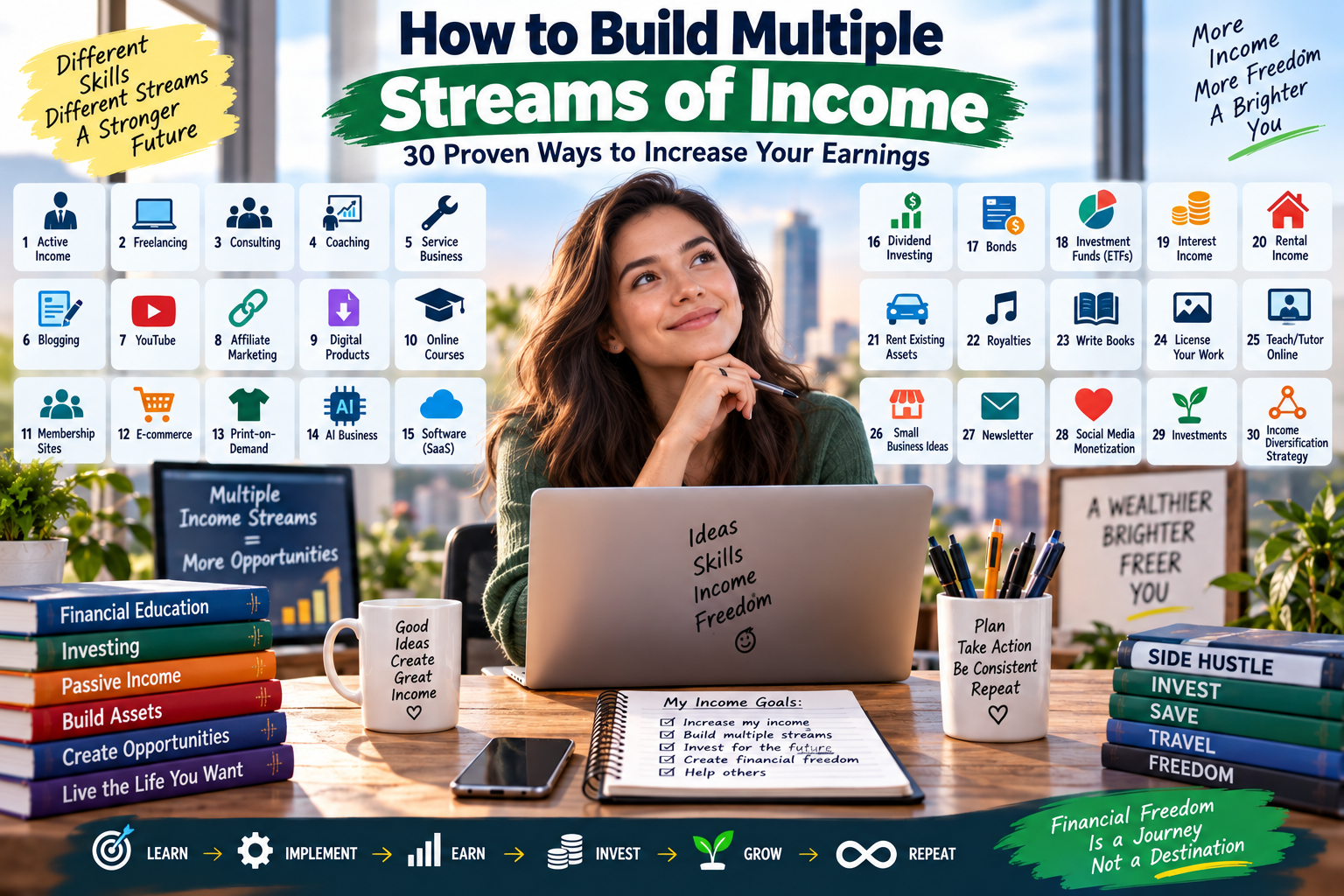
    25. Build Multiple Income Streams Gradually

    Your wealth journey may begin with one salary.

    Eventually it might evolve into:

    Salary + Freelancing + Business + Investment Income + Digital Assets

    You don’t need seven side hustles.

    Build one additional income stream.

    Make it profitable.

    Improve the system.

    Then consider another.

    Income diversification can reduce dependence on a single paycheck and provide additional capital for acquiring assets.

    26. Reinvest Instead of Consuming Every Profit

    Suppose your side business generates an additional $500 monthly.

    You could immediately spend the entire $500.

    Or you could divide it:

    Emergency Savings
    Business Reinvestment
    Long-Term Investments
    Debt Reduction
    Personal Enjoyment

    Reinvestment is how additional income can gradually become productive capital.

    The goal is:

    Income → Assets → More Potential Income → More Assets

    27. Protect the Wealth You Build

    Building wealth is only half the journey.

    You must also protect it.

    Wealth preservation may involve:

    Emergency reserves
    Diversification
    Appropriate insurance
    Cybersecurity
    Fraud prevention
    Responsible debt
    Tax planning
    Legal structures where appropriate
    Estate planning

    As your wealth grows, one preventable financial disaster becomes increasingly expensive.

    28. Protect Yourself From Investment Scams

    Wealth-building beginners are prime targets for scammers.

    Warning signs include:

    Guaranteed profits
    No-risk returns
    Secret investment opportunities
    Pressure to act immediately
    Unregistered forex brokers
    Fake crypto platforms
    Celebrity impersonations
    Requests to transfer money privately

    For forex, the CFTC specifically recommends researching dealers and checking regulatory registration before depositing money.

    For securities investing, use Investor.gov and appropriate national securities regulators.

    Never let fear of missing out replace due diligence.

    29. Legacy Planning: Decide What Your Wealth Is For

    Wealth is not only about what happens during your lifetime.

    As assets grow, think about:

    Who depends on you?
    What happens if you die unexpectedly?
    Who should receive your assets?
    Who can manage important affairs if you cannot?

    Depending on local law and your circumstances, legacy planning might involve:

    Wills
    Beneficiary designations
    Insurance
    Powers of attorney
    Trusts
    Business succession planning
    Charitable giving

    Estate and inheritance laws differ substantially by country, so obtain qualified local legal and tax guidance when needed.

    The objective is to make sure the wealth you spent decades building is transferred according to your intentions

    30. Your 10-Year Financial Roadmap From Zero

    Building wealth becomes easier when you stop thinking only about next month.

    Think in years.

    Year 1 — Financial Stabilization

    Focus on:

    Budgeting
    Tracking expenses
    Initial emergency savings
    High-cost debt
    Financial education
    Increasing employable skills

    Goal:

    Stop financial instability from controlling your decisions.

    Year 2 — Increase Your Financial Capacity

    Work on:

    Increasing income
    Improving skills
    Building emergency reserves
    Reducing expensive debt
    Beginning basic investing education

    Goal:

    Create consistent monthly financial surplus.

    Year 3 — Become an Investor

    Once financially prepared, establish an appropriate long-term investment strategy.

    Learn about:

    Stocks
    Bonds
    Diversified funds
    Retirement accounts
    Risk
    Fees
    Taxes

    Goal:

    Begin acquiring productive financial assets consistently.

    Year 4 — Build Your Second Income Stream

    Choose one realistic opportunity:

    Freelancing
    Consulting
    Digital products
    Service business
    Online business
    Part-time enterprise

    Goal:

    Reduce dependence on one paycheck.

    Year 5 — Increase Your Asset Ownership

    Increase contributions as income improves.

    Your financial picture might now include:

    Emergency savings + Investments + Retirement assets + Business assets

    Goal:

    Make asset ownership a normal part of your financial life.

    Year 6 — Explore Additional Asset Classes

    Once you understand basic investing, learn about other opportunities such as:

    Real estate
    Bonds
    Business equity
    Digital assets
    Appropriate alternative investments

    This does not mean buying everything.

    Goal:

    Understand opportunities before deciding whether they belong in your plan.

    Year 7 — Scale What Works

    By now, you should have evidence about which income and investment strategies work for you.

    Scale successful areas.

    Stop wasting resources on unsuccessful ones.

    Goal:

    Concentrate effort without creating dangerous financial concentration.

    Year 8 — Strengthen Wealth Protection

    Review:

    Insurance
    Emergency reserves
    Investment diversification
    Cybersecurity
    Taxes
    Legal structures
    Estate planning

    Goal:

    Protect accumulated assets from avoidable risks.

    Year 9 — Build Greater Financial Independence

    Calculate:

    Annual expenses
    Investment assets
    Business income
    Passive or portfolio income
    Net worth
    Debt

    Ask:

    How dependent am I on employment income today compared with nine years ago?

    Goal:

    Increase your financial options.

    Year 10 — Review, Rebalance and Design the Next Decade

    Measure your progress.

    Compare:

    Year 1 Income → Year 10 Income

    Year 1 Savings → Year 10 Savings

    Year 1 Investments → Year 10 Investments

    Year 1 Debt → Year 10 Debt

    Year 1 Net Worth → Year 10 Net Worth

    Then build the next ten-year plan.

    Your financial journey doesn’t end at Year 10.

    You have simply built a stronger starting point for the next decade.

    The Wealth-Building Pyramid

    Think about wealth in layers.

    Level 1 — Knowledge

    Learn money fundamentals.

    Level 2 — Income

    Develop valuable skills and increase earnings.

    Level 3 — Financial Stability

    Budget, save and manage expensive debt.

    Level 4 — Investing

    Acquire diversified productive assets.

    Level 5 — Ownership

    Build business, property and other appropriate assets.

    Level 6 — Diversification

    Avoid depending on one income source or investment.

    Level 7 — Wealth Preservation

    Protect assets through appropriate risk management.

    Level 8 — Legacy

    Transfer wealth intentionally.

    Trying to jump directly from Level 1 to speculative trading at Level 6 is not a shortcut.

    It may simply expose you to risks you are not financially prepared to absorb.

    A Beginner’s Wealth-Building Checklist

    Before considering yourself ready for increasingly complex investments, ask:

    Do I understand my monthly cash flow?

    Do I have emergency savings?

    Is expensive consumer debt under control?

    Am I consistently saving?

    Do I understand what I am investing in?

    Do I understand potential losses?

    Am I diversified appropriately?

    Am I paying reasonable fees?

    Am I investing for a defined goal?

    Am I protecting myself from fraud?

    Am I increasing my earning capacity?

    Am I building productive assets?

    Do I have a long-term financial plan?

    If several answers are no, those areas may deserve attention before chasing higher-risk opportunities.

    Conclusion

    Building wealth from zero does not begin with finding the perfect stock, predicting currency markets, buying cryptocurrency or discovering the next investment sensation.

    It begins with fundamentals.

    Learn how money works.
    Increase your income.
    Control unnecessary spending.
    Build emergency savings.
    Manage destructive debt.
    Invest consistently.
    Diversify.
    Build businesses and productive assets.
    Protect what you accumulate.
    Plan for the next generation.

    Stocks can contribute to wealth.

    Bonds can have a role.

    Real estate can create opportunities.

    Business ownership can become enormously valuable.

    Digital assets can generate income.

    AI can improve productivity.

    Commodities may serve particular portfolio purposes.

    Crypto assets may offer opportunities alongside substantial risks.

    Forex exists as a massive global market—but leveraged retail forex trading should never be mistaken for a guaranteed wealth-building system.

    There is no single asset that every person must own.

    Your appropriate strategy depends on your income, goals, responsibilities, time horizon and ability to withstand losses.

    The most important thing about starting from zero is understanding that zero does not have to be your permanent financial position.

    Your first $100 matters.

    Your first emergency fund matters.

    Your first investment matters.

    Your first profitable business matters.

    Your first $10,000 matters.

    And every responsible financial decision can move you further from dependence and closer to ownership.

    The journey may take ten, twenty or thirty years.

    That is not failure.

    That is how long-term wealth is often built:

    One skill.
    One paycheck.
    One saved dollar.
    One investment.
    One productive asset.
    One disciplined decision at a time.

  • How to Trade Forex Successfully: 30 Proven Strategies Every Beginner Should Learn Before Investing Real Money

    How to Trade Forex Successfully: 30 Proven Strategies Every Beginner Should Learn Before Investing Real Money

    Learn Trading Plans, Position Sizing, Stop-Loss Strategies, Risk Management, Technical Setups, Backtesting, Trading Psychology and the Habits Needed to Protect Your Capital

    Introduction

    Learning how to place a forex trade is easy.

    Learning how to trade forex responsibly and consistently is much harder.

    Modern trading platforms allow someone to open a position within seconds. A beginner can select EUR/USD, click Buy or Sell, choose leverage and suddenly have thousands of dollars of currency exposure.

    That technological simplicity can create a dangerous illusion:

    Trading is easy because placing a trade is easy.

    It isn’t.

    Successful trading requires understanding probabilities, risk, market behavior, costs, psychology and—perhaps most importantly—how to survive when you are wrong.

    And every trader will sometimes be wrong.

    The Bank for International Settlements reported that global over-the-counter foreign-exchange turnover averaged approximately $9.6 trillion per day in April 2025.

    That enormous market attracts:

    Commercial banks
    Central banks
    Asset managers
    Corporations
    Hedge funds
    Professional trading firms
    Institutional investors
    Retail traders

    But a huge market does not create guaranteed profits.

    The U.S. Commodity Futures Trading Commission warns that leveraged retail forex trading carries substantial risk and that leverage magnifies both gains and losses.

    The UK’s Financial Conduct Authority also warns consumers about forex and CFD promotions promising unrealistic or guaranteed returns.

    Therefore, the objective of this guide is not to give you a “secret forex system.”

    Instead, you will learn 30 established trading and risk-management strategies, practices and principles that every beginner should understand before considering risking real money.

    The fundamental rule is:

    Learn first. Practice second. Risk real money last.

    1. Develop a Written Forex Trading Plan

    Never begin trading simply because a chart “looks good.”

    Before placing a trade, you should know:

    What currency pairs you trade
    What timeframe you use
    What creates an entry
    Where you exit if wrong
    Where you may take profit
    How much capital you risk
    When you do not trade

    A simple plan might say:

    Market: EUR/USD

    Timeframe: 4-hour chart

    Strategy: Trend continuation

    Entry: Pullback toward predefined support within an established trend

    Stop: Below the point that invalidates the setup

    Profit objective: Based on market structure and predetermined risk/reward

    Maximum risk: According to the trader’s written risk rules

    Your plan creates structure.

    Without one, every market movement can become an excuse to trade.

    2. Define Your Risk Before Your Potential Profit

    Beginners often ask:

    “How much can I make?”

    Risk-conscious traders ask:

    “How much could I lose?”

    before entering.

    Suppose your account contains:

    $5,000

    Before opening a trade, determine the maximum acceptable loss under your trading plan.

    Do not enter first and decide risk later.

    The sequence should be:

    Identify Setup → Determine Invalidation → Calculate Risk → Calculate Position Size → Decide Whether Trade Qualifies → Execute

    Risk should determine the trade—not excitement.

    3. Master Position Sizing

    Position sizing determines how large your trade should be relative to your predetermined risk.

    Suppose two traders identify exactly the same EUR/USD setup.

    Trader A takes an enormous position.

    Trader B uses a substantially smaller position.

    The chart is identical.

    Their financial risk is not.

    Position size depends on factors such as:

    Account size
    Stop distance
    Currency pair
    Contract specifications
    Maximum acceptable loss

    One of the most dangerous beginner mistakes is selecting a large lot size simply because the broker permits it.

    Maximum available position ≠ appropriate position.

    4. Use Stop-Loss Orders Intelligently

    A stop-loss is designed to close a position when price reaches a specified level.

    It can help answer:

    “At what point is my original trading idea no longer valid?”

    Imagine buying EUR/USD because price breaks above an important resistance level.

    If price subsequently falls sharply below the breakout structure, your original thesis may be invalid.

    A stop should therefore have a logical reason.

    Avoid placing stops randomly simply because:

    “20 pips sounds reasonable.”

    Market structure, volatility and position size should be considered together.

    Remember that stop orders do not guarantee execution at the exact stop price during gaps, extreme volatility or certain market conditions.

    5. Develop a Take-Profit Strategy

    Beginners often spend enormous time deciding when to enter.

    They spend much less time deciding when to leave.

    That is backwards.

    Before entering, consider:

    Where could profit reasonably be taken?

    Possible approaches include:

    Previous resistance/support
    Defined risk multiple
    Trailing exit
    Technical target
    Partial profit-taking
    Time-based exit

    There is no universal best method.

    The important point is having an exit framework before emotion becomes involved.

    6. Understand Risk-to-Reward Ratios

    Suppose a trade risks:

    $50

    with a planned potential reward of:

    $100

    The potential reward is twice the amount at risk.

    This is often described as approximately:

    1:2 risk-to-reward

    But this ratio does not mean the trade is automatically good.

    A strategy with attractive reward potential can still lose money if its winning probability is extremely low.

    Profitability depends on the interaction between:

    Win rate
    Average win
    Average loss
    Trading costs
    Execution

    Do not evaluate risk-to-reward in isolation.

    7. Think in Probabilities, Not Certainty

    Trading is not about knowing exactly what happens next.

    Imagine a strategy that historically wins 55 out of 100 comparable trades under its tested assumptions.

    That does not tell you whether:

    Trade #101

    will win.

    It means the trader is working with probabilities.

    This mindset changes everything.

    Instead of saying:

    “This trade must win.”

    you begin thinking:

    “This setup meets my rules. I know the predefined risk. Now I accept the uncertain outcome.”

    Probability-based thinking can reduce emotional decision-making.

    8. Learn Trend Trading

    Trend trading attempts to participate in sustained directional market movement.

    Markets may form:

    Uptrends
    Downtrends
    Sideways conditions

    A simple price-based description of an uptrend can involve:

    Higher highs + Higher lows

    A downtrend can involve:

    Lower highs + Lower lows

    Trend traders may use:

    Market structure
    Moving averages
    Trendlines
    Momentum indicators
    Support and resistance

    The objective is not to predict the exact beginning and end of every trend.

    It is to identify a directional environment and establish rules for participating in it.

    9. Learn Range Trading

    Markets do not trend constantly.

    Sometimes price moves repeatedly between support and resistance.

    This creates a range.

    A simplified range might look like:

    Resistance
    ↕
    Trading Range
    ↕
    Support

    Range traders may look for opportunities around these boundaries.

    But ranges eventually break.

    Therefore, a range strategy also needs an answer to:

    What happens if price leaves the range?

    Never assume support or resistance must hold forever.

    10. Learn Breakout Trading

    A breakout occurs when price moves beyond an established technical boundary.

    For example:

    Resistance → Price breaks above

    or:

    Support → Price breaks below

    Breakout traders may look for:

    Strong momentum
    Increasing volatility
    Consolidation before breakout
    Retests of broken levels
    Fundamental catalysts

    But false breakouts occur frequently.

    Price may break a level briefly and then reverse.

    Therefore:

    Breakout ≠ Guaranteed continuation

    Risk management remains essential.

    11. Understand Pullback Trading

    Instead of entering after a large price movement, some traders wait for price to temporarily retrace.

    Imagine an established uptrend:

    Rise → Pullback → Rise → Pullback → Rise

    A trader might look for a pullback toward:

    Previous support
    Moving average
    Trendline
    Other predefined technical area

    The objective is to participate in the larger trend without blindly chasing an extended move.

    But a pullback can become a reversal.

    You need predefined invalidation criteria.

    12. Learn Swing Trading

    Swing trading attempts to capture price movements that may develop over multiple sessions or days.

    Swing traders generally trade less frequently than scalpers or many day traders.

    They may analyze:

    Daily charts
    4-hour charts
    1-hour charts

    and combine:

    Trend
    Support/resistance
    Momentum
    Fundamentals
    Economic calendars

    Swing trading can appeal to people who cannot watch markets constantly.

    However, holding positions longer can create overnight and event risk.

    13. Understand Scalping Before Attempting It

    Scalping involves attempting to profit from relatively small short-term price movements, often through frequent trades.

    It sounds attractive:

    Small movement + Quick trade + Frequent opportunity

    But scalping can be demanding.

    Challenges include:

    Spreads
    Commissions
    Slippage
    Fast decisions
    Overtrading
    Stress
    Execution quality

    A strategy making many trades can accumulate substantial transaction costs.

    Beginners should not assume:

    More trades = More profits

    Often, more trades simply mean more opportunities to make mistakes.

    14. Understand Day Trading

    Day traders generally open and close positions within the same trading day.

    Potential advantages include avoiding some overnight exposure.

    Challenges include:

    High decision frequency
    Transaction costs
    Emotional pressure
    News volatility
    Screen time
    Overtrading

    Day trading should be approached as a structured process—not entertainment.

    15. Learn News Trading Carefully

    Economic announcements can cause substantial currency volatility.

    Important releases may include:

    Central-bank decisions
    Inflation
    Employment
    GDP
    Retail sales
    Manufacturing indicators
    Political developments

    Reliable global sources include the:

    Bank for International Settlements

    International Monetary Fund

    World Bank

    and official central-bank websites.

    Major examples include the Federal Reserve, European Central Bank, Bank of England and Bank of Japan.

    But news trading can involve:

    Rapid price movements
    Wider spreads
    Slippage
    False initial reactions

    Beginners should observe how markets behave around major announcements before attempting to trade them.

    16. Never Trade News Based Only on the Headline

    Suppose inflation rises.

    A beginner might immediately assume:

    Currency must rise.

    But markets price expectations.

    If investors expected inflation to rise even more, the currency might react differently.

    Markets often respond to:

    Actual result vs. Expected result vs. Previous result

    They also react to what the information implies for future central-bank policy.

    This is why economic-market reactions can initially appear irrational.

    17. Combine Technical and Fundamental Analysis

    Technical analysis asks:

    What is price doing?

    Fundamental analysis asks:

    What economic forces might influence the currency?

    Combining them can provide broader context.

    For example:

    Fundamental research suggests monetary-policy conditions may favor one currency.

    Technical analysis identifies an established trend.

    Price pulls back toward a technical area.

    The trader then evaluates whether the setup satisfies the written plan.

    This does not guarantee success.

    It simply creates a structured analytical process.

    18. Backtest Your Strategy

    Backtesting involves evaluating trading rules against historical market data.

    Suppose your strategy says:

    Trade only with trend
    Wait for pullback
    Enter after confirmation
    Place stop beyond invalidation
    Use predefined exit

    You can examine historical periods and record what would have happened.

    Track:

    Number of trades
    Wins
    Losses
    Average win
    Average loss
    Maximum drawdown
    Consecutive losses
    Trading costs where possible

    Do not simply search charts for beautiful examples that worked.

    Test the rules consistently.

    19. Avoid Overfitting Your Backtest

    There is a hidden danger in backtesting.

    You can create rules that fit historical data perfectly but fail when market conditions change.

    For example:

    You repeatedly modify indicators until you discover a combination that would have performed extremely well over one historical period.

    That does not mean it will perform well in the future.

    This is called overfitting.

    A strategy should be understandable and economically or behaviorally plausible—not merely optimized to make historical results look spectacular.

    20. Forward-Test on a Demo Account

    After backtesting, test the strategy in current market conditions without real money.

    A demo account can help you practice:

    Entries
    Stops
    Position sizing
    Order types
    Exits
    Journaling
    Discipline

    Use the same rules you would use with real money.

    If your demo account contains $100,000 but you expect to eventually trade $2,000, practicing enormous positions may teach unrealistic habits.

    Make the simulation relevant to your intended circumstances.

    21. Keep a Detailed Trading Journal

    Your trading journal is one of your most valuable learning tools.

    Record:

    Date
    Currency pair
    Market session
    Strategy
    Entry
    Stop
    Target
    Position size
    Result
    Screenshot
    Economic context
    Emotional state
    Mistakes
    Lessons

    After enough trades, your journal becomes data.

    Instead of saying:

    “I think I’m good at breakout trading,”

    you can examine evidence.

    22. Track Your Performance With Numbers

    Do not judge yourself based only on account balance.

    Track:

    Win rate
    Average win
    Average loss
    Profit factor where useful
    Maximum drawdown
    Consecutive wins
    Consecutive losses
    Average risk per trade
    Strategy-specific performance

    Suppose:

    Strategy A wins 70% of trades but loses much more on losing trades.

    Strategy B wins only 45% but its average winner is substantially larger than its average loser.

    Win rate alone does not tell you which is better.

    Trading performance must be evaluated as a system.

    23. Measure Expectancy

    A useful conceptual framework is expectancy.

    Imagine a hypothetical strategy where:

    50% of trades win $100

    and:

    50% lose $50

    Across many trades, the average expected result before costs would be positive under those assumptions.

    But historical expectancy is not a guarantee of future returns.

    Market conditions change.

    Execution changes.

    Costs change.

    Trader behavior changes.

    Use expectancy as an analytical tool—not a promise.

    24. Control Fear and Greed

    Two emotions frequently dominate trading:

    Fear

    and

    Greed

    Fear can cause traders to:

    Exit winners too early
    Avoid valid setups
    Move stops irrationally

    Greed can cause traders to:

    Increase position size
    Remove profit targets
    Use excessive leverage
    Overtrade

    The solution is not eliminating emotion.

    You are human.

    The objective is building systems that reduce emotion’s influence over decisions.

    25. Stop Revenge Trading

    Imagine losing:

    Trade 1.

    Then Trade 2.

    Then Trade 3.

    You become angry.

    You think:

    “I need to win it back.”

    You double the position size.

    That is revenge trading.

    Your objective has changed from executing your strategy to recovering emotional pain.

    A predetermined daily or session loss limit can help interrupt this cycle.

    When your rules say stop:

    Stop.

    Markets will still exist tomorrow

    26. Avoid Overtrading

    Overtrading can happen because of:

    Boredom
    FOMO
    Losses
    Greed
    Need for excitement
    Desire to recover money

    Ask before every position:

    Does this trade meet my written rules?

    If the answer is no, don’t manufacture a reason to enter.

    Professional discipline often means doing nothing.

    Sometimes the best trade is:

    No trade.

    27. Protect Your Capital Above Everything Else

    Your trading capital is your ability to continue participating.

    Imagine two beginners.

    Trader A

    Tries to double the account quickly.

    Uses extreme leverage.

    Takes huge positions.

    Trader B

    Prioritizes education.

    Controls position size.

    Accepts small losses.

    Keeps detailed records.

    Trader B may appear slower.

    But trading survival is itself an advantage.

    A trader who loses all capital cannot benefit from future opportunities.

    Capital preservation comes before capital multiplication.

    28. Build Consistency Before Increasing Position Size

    Do not increase risk simply because you had three winning trades.

    A short winning streak proves very little.

    Before increasing position size, evaluate performance across a meaningful sample of trades and different market environments.

    Ask:

    Did I follow my plan?

    Were results repeatable?

    How large was my drawdown?

    How did I perform during losing streaks?

    Were profits dependent on one unusually large trade?

    Scale slowly, if appropriate.

    Consistency should come before size.

    29. Develop a Pre-Trade and Post-Trade Routine

    Create a repeatable routine.

    Before Trading

    Check:

    Economic calendar
    Market conditions
    Trend/range
    Important levels
    Trading setup
    Position size
    Risk
    Stop
    Potential exit

    After Trading

    Record:

    Result
    Screenshot
    Execution quality
    Emotional behavior
    Rule violations
    Lesson

    This transforms trading from impulsive activity into a process.

    30. Know When Not to Trade

    One of the most advanced trading skills is recognizing when conditions do not suit your strategy.

    You may decide not to trade when:

    You are emotionally upset
    You are exhausted
    Your strategy has no valid setup
    Spreads are unusually wide
    Market liquidity is poor
    A major event creates unacceptable uncertainty
    You have reached your loss limit
    You feel pressure to recover money

    Trading is optional.

    Protecting your financial well-being is not.

    A Practical Beginner Forex Strategy Framework

    Instead of searching for a magical system, construct a framework.

    Step 1 — Choose a limited number of currency pairs

    Learn their behavior.

    Step 2 — Choose your timeframe

    Avoid jumping randomly between charts.

    Step 3 — Define market conditions

    Trend, range, breakout or another clearly defined environment.

    Step 4 — Define your entry

    Write objective conditions.

    Step 5 — Define invalidation

    Know where your analysis becomes wrong.

    Step 6 — Calculate position size

    Base exposure on predetermined risk.

    Step 7 — Define potential exit

    Know your plan before entering.

    Step 8 — Execute

    Do not change rules because of temporary emotion.

    Step 9 — Journal

    Document everything.

    Step 10 — Review

    Improve based on evidence rather than feelings.

    The Forex Consistency Formula

    A useful way to think about responsible trading is:

    Education + Tested Strategy + Risk Management + Discipline + Record Keeping + Continuous Review

    Not:

    High Leverage + More Trades + Bigger Positions = Wealth

    There is no legitimate formula guaranteeing forex profits.

    But there are processes that can help traders manage risk more systematically.

    A 90-Day Beginner Forex Learning Plan

    Days 1–30: Learn

    Study:

    Currency pairs
    Pips
    Lots
    Spreads
    Leverage
    Margin
    Trading sessions
    Charts
    Economic news

    Use authoritative resources such as:

    Bank for International Settlements

    International Monetary Fund

    World Bank

    and your country’s central bank and financial regulator.

    Do not risk real money.

    Days 31–60: Build and Test

    Choose one strategy.

    Define:

    Entry
    Stop
    Target
    Risk
    Position sizing
    Trading conditions

    Backtest historical examples.

    Record results.

    Do not constantly change strategies.

    Days 61–90: Demo Trade

    Trade the strategy in a demo environment.

    Keep a detailed journal.

    Measure:

    Rule compliance
    Wins
    Losses
    Average win
    Average loss
    Drawdown
    Emotional mistakes

    At Day 90, do not ask only:

    “Did I make virtual money?”

    Ask:

    “Did I consistently follow a well-defined process?”

    That is a much better measure of progress.

    How to Recognize Fake Forex Strategies

    Be skeptical when someone claims:

    “100% win rate.”

    “Guaranteed daily income.”

    “Never loses.”

    “Turn $100 into $10,000.”

    “Secret institutional strategy.”

    “AI bot guarantees profits.”

    “No stop-loss required.”

    Financial markets do not offer guaranteed speculative profits.

    The CFTC provides extensive education about derivatives and trading fraud.

    International readers can use the IOSCO Investor Alerts Portal to review alerts contributed by participating financial regulators around the world.

    Choosing a Broker Before Trading Real Money

    Strategy means little if your broker is fraudulent.

    Before depositing money, independently verify the provider.

    Check:

    Legal company name
    Regulatory authorization
    Official domain
    License number
    Client-money rules
    Withdrawal policy
    Trading costs
    Leverage rules
    Dispute procedures

    Useful official resources include:

    IOSCO — international securities-regulator network.

    IOSCO Investor Alerts Portal — international warnings submitted by participating regulators.

    ASIC MoneySmart — Australia.

    FCA Register — United Kingdom.

    MAS Financial Institutions Directory — Singapore.

    CFTC Check — United States.

    NFA BASIC — U.S. derivatives registration information.

    Readers elsewhere should identify the official financial regulator in their own country and verify the broker directly through its database.

    Frequently Asked Questions

    What Is the Best Forex Strategy for Beginners?

    There is no universally best strategy.

    Trend trading, range trading, breakout trading and swing trading can all produce both winning and losing trades.

    A beginner should prioritize a strategy that is:

    Understandable
    Testable
    Rule-based
    Compatible with their schedule
    Compatible with their risk tolerance

    Can a Forex Strategy Guarantee Profit?

    No.

    A strategy can have historically favorable results and still experience losses in future market conditions.

    Anyone promising guaranteed forex profits should be treated with extreme caution.

    What Risk-to-Reward Ratio Is Best?

    There is no universally correct ratio.

    Risk-to-reward must be considered alongside:

    Win probability
    Market conditions
    Trading costs
    Strategy characteristics

    A 1:3 setup is not automatically superior to 1:1 if its probability of success is dramatically lower.

    How Many Forex Trades Should a Beginner Make Each Day?

    There is no required number.

    A strategy may produce several valid setups or none.

    Do not create trades simply to meet a daily quota.

    Is Scalping Good for Beginners?

    Scalping can be demanding because transaction costs, execution speed, decision frequency and psychology become especially important.

    Beginners should understand these challenges before attempting high-frequency approaches.

    Is Swing Trading Easier for Beginners?

    Some beginners may find slower timeframes easier to analyze because decisions occur less frequently.

    However, swing positions can face overnight and event risk.

    No style is automatically easy or profitable.

    Should I Trade Forex News?

    Major economic releases can create rapid volatility, spread changes and slippage.

    Beginners may benefit from observing news reactions on demo accounts before considering real-money news trading.

    How Long Should I Demo Trade?

    There is no universal duration.

    The objective is not simply spending a certain number of days on demo.

    You should be able to demonstrate:

    Understanding of the platform
    Consistent risk rules
    A defined strategy
    Journal records
    Evidence of disciplined execution

    before even considering real capital.

    Can AI Create a Winning Forex Strategy?

    AI can help analyze data, organize information, assist with backtesting and identify patterns.

    It cannot guarantee future market behavior.

    Markets respond to unpredictable economic, political and financial events.

    Treat “guaranteed AI forex robot” claims as major warning signs.

    Can I Become Rich Quickly With Forex?

    Trying to become rich quickly often encourages:

    Excessive leverage
    Oversized positions
    Overtrading
    Emotional decisions

    Those behaviors can rapidly destroy capital.

    Forex should never be treated as a guaranteed shortcut to wealth.

    Conclusion

    Learning forex successfully is not about finding one magical indicator.

    It is about developing a repeatable decision-making process.

    A disciplined trader learns to:

    Plan before entering.
    Calculate position size.
    Define risk.
    Use exits intelligently.
    Understand risk-to-reward.
    Recognize trends and ranges.
    Evaluate breakouts.
    Understand economic news.
    Backtest strategies.
    Practice on demo accounts.
    Keep detailed journals.
    Track performance.
    Control emotions.
    Avoid revenge trading.
    Avoid overtrading.
    Protect capital.
    Build consistency.

    The strongest traders are not necessarily the people who make the most dramatic trades.

    They are often the people who remain disciplined when nothing exciting is happening.

    They understand that losses are part of uncertain markets.

    They don’t need every trade to win.

    They need losses to remain manageable enough that they can continue executing their strategy.

    Therefore, before investing real money, remember this sequence:

    Learn → Plan → Backtest → Demo Trade → Journal → Measure → Improve → Manage Risk → Protect Capital → Build Consistency

    And only after developing those foundations should you decide whether real-money forex trading belongs in your financial plan.

    The market will always offer another trade.

  • Money Management Masterclass: Everything Every Young Adult Should Know About Personal Finance

    Money Management Masterclass: Everything Every Young Adult Should Know About Personal Finance

    The master class every one can depend on.

    Introduction

    Managing money well is one of the most valuable life skills a young adult can develop.

    Yet many people enter adulthood knowing how to earn a paycheck but knowing very little about budgeting, credit, investing, insurance, taxes, banking, retirement or protecting the wealth they eventually build.

    That knowledge gap can become expensive.

    A person can earn a good salary and still live paycheck to paycheck. Another person earning less may gradually create financial security because they understand how to control expenses, save consistently, avoid destructive debt and invest for long-term goals.

    Personal finance is therefore not simply about how much money you earn.

    It is about what you do with the money that passes through your hands.

    The Consumer Financial Protection Bureau provides resources covering everyday financial decisions, Investor.gov provides investing education, and the FDIC Money Smart program offers financial education covering banking, saving, credit and other essential topics.

    This masterclass explains the fundamental personal-finance skills every young adult should understand—and how those skills fit together to create long-term financial confidence.

    1. Learn Where Your Money Actually Goes

    Before investing, buying property or trying to become wealthy, understand your current financial position.

    Start with four numbers:

    Income — Expenses — Assets — Liabilities

    Income is money coming in.

    Expenses are money going out.

    Assets are things you own that have financial value.

    Liabilities are financial obligations you owe.

    Your net worth can then be summarized as:

    Net Worth = Assets − Liabilities

    Someone earning $100,000 annually while carrying excessive debt and owning few assets may be financially weaker than someone earning $60,000 who consistently saves, invests and keeps debt under control.

    The CFPB’s financial well-being resources provide tools for thinking about overall financial health.

    Your first goal should therefore be understanding your numbers—not comparing your salary with everyone else’s.

    2. Budgeting: Give Every Dollar a Purpose

    A budget is simply a plan for your income.

    It tells you how much can reasonably go toward:

    Housing
    Food
    Transportation
    Utilities
    Debt
    Insurance
    Savings
    Investments
    Entertainment
    Other goals

    The CFPB budgeting resources provide practical tools for managing cash flow and expenses.

    Several budgeting approaches can work.

    The 50/30/20 Framework

    A commonly discussed starting framework divides after-tax income approximately into:

    50% needs
    30% wants
    20% savings and debt repayment

    Your circumstances may require different percentages.

    Someone living in a high-cost city may spend more than 50% on necessities, while someone living with family may be able to save substantially more.

    Zero-Based Budgeting

    With zero-based budgeting, you assign a purpose to all available income.

    That does not mean spending everything.

    Saving and investing are also purposes.

    Pay Yourself First

    Instead of saving whatever remains after spending, transfer money toward financial goals soon after receiving income.

    The principle is:

    Income → Save/Invest → Expenses

    rather than:

    Income → Expenses → Maybe Save

    3. Saving: Build Your Financial Safety Net

    Savings create stability.

    Without savings, a relatively small emergency can become debt.

    A car repair, medical bill, temporary loss of income or urgent trip may otherwise end up on a credit card or expensive loan.

    The CFPB’s emergency-fund guide explains how dedicated emergency savings can help people recover from unexpected expenses.

    Start small if necessary.

    Your progression might look like:

    $500 → $1,000 → One month of essential expenses → Three months → Several months

    The appropriate amount depends on job stability, family responsibilities, insurance coverage and other circumstances.

    Keep emergency money somewhere safe and reasonably accessible rather than exposing essential reserves to unnecessary investment risk.

    4. Banking: Understand Where You Keep Your Money

    Young adults should understand the difference between common financial accounts.

    Checking Accounts

    Generally designed for frequent transactions such as bills, purchases and direct deposits.

    Savings Accounts

    Designed primarily for holding savings and potentially earning interest.

    Certificates or Fixed Deposits

    Depending on the country and institution, these can offer interest in exchange for leaving money deposited for a specified period.

    For U.S. consumers, the FDIC’s deposit insurance resources explain coverage at FDIC-insured banks.

    The National Credit Union Administration provides information about federal share insurance at eligible U.S. credit unions.

    Outside the United States, check your country’s banking regulator and deposit-protection system.

    Never assume every financial app automatically provides the same protections as a regulated bank account.

    5. Digital Banking: Convenience Requires Security

    Banking has moved increasingly onto smartphones.

    People can now:

    Deposit checks
    Transfer money
    Pay bills
    Monitor accounts
    Send money
    Freeze cards
    Receive alerts

    This convenience creates new risks.

    Protect accounts with:

    Strong unique passwords
    Multi-factor authentication
    Transaction alerts
    Secure devices
    Regular account monitoring

    The Federal Trade Commission’s consumer security guidance provides information about scams and fraud, while the Cybersecurity and Infrastructure Security Agency provides practical cybersecurity recommendations.

    Never provide passwords, verification codes or banking credentials to someone simply because they claim to represent your bank.

    6. Credit Scores: Understand Your Financial Reputation

    In countries using consumer credit scoring, your credit history can influence access to loans and the rates offered.

    In the United States, credit scores commonly consider factors connected to payment history, debt and credit usage.

    Young adults should focus on fundamentals:

    Pay bills on time.
    Avoid excessive balances.
    Don’t apply unnecessarily for numerous accounts.
    Review credit reports for errors.

    The Consumer Financial Protection Bureau provides extensive information about credit reports and scores.

    U.S. consumers can obtain federally authorized free credit reports through AnnualCreditReport.com.

    Your credit score is important where applicable—but it is not the same thing as wealth.

    Someone can have excellent credit and very little net worth.

    7. Credit Cards: Use Them as Tools, Not Extra Income

    A credit-card limit is not money you own.

    It is borrowing capacity.

    Credit cards can be useful for payments and credit history, but carrying balances can become expensive.

    The CFPB credit-card resources explain card costs and consumer rights.

    Before applying, understand:

    APR
    Annual fees
    Late fees
    Grace periods
    Rewards conditions

    When possible, pay the statement balance in full and on time.

    Never spend simply to earn points.

    Spending $1,000 unnecessarily to earn $20 in rewards does not make you $20 richer.

    It makes you approximately $980 poorer.

    8. Loans: Understand the Real Cost of Borrowing

    Loans can help finance education, housing, transportation or business opportunities.

    But borrowing always deserves careful analysis.

    Before accepting a loan, understand:

    Principal
    Interest rate
    APR where applicable
    Monthly payment
    Loan term
    Fees
    Total repayment

    Do not evaluate affordability based only on the monthly payment.

    A longer loan can reduce the payment while increasing the total amount paid.

    The CFPB consumer loan resources cover several borrowing categories, including mortgages, auto loans, student loans and credit cards.

    9. Student Loans: Borrow With Your Future Income in Mind

    Education can improve earning capacity, but excessive education debt can restrict financial flexibility for years.

    Before borrowing, compare the expected cost with:

    Likely career opportunities
    Expected starting salary
    Alternative programs
    Scholarships and grants
    Less expensive institutions

    U.S. students can use Federal Student Aid for official federal student-aid information and its Loan Simulator for repayment planning.

    Avoid assuming that every degree automatically produces enough income to comfortably repay any amount borrowed.

    10. Taxes: Understand the Money Taken From Your Income

    Taxes affect your paycheck, investments, business income and sometimes your estate.

    Young adults should understand at least:

    Gross income
    Taxable income
    Withholding
    Tax deductions
    Tax credits
    Payroll taxes
    Investment taxes
    Self-employment taxes

    U.S. taxpayers can learn directly from the Internal Revenue Service and access filing information through the IRS’s File Your Taxes resources.

    Tax systems vary enormously worldwide.

    If you freelance, operate a business or earn money online, don’t assume that income becomes tax-free simply because an employer did not withhold taxes.

    Learn the requirements in your jurisdiction.

    11. Build an Emergency Fund Before Taking Major Investment Risks

    Investing is important.

    But investing without emergency savings can create problems.

    Imagine investing every spare dollar and then suddenly needing $2,000 for an emergency.

    You may have to sell investments during a market decline.

    Emergency savings give long-term investments time to remain invested.

    The CFPB emergency-fund guide provides a useful starting point.

    Think of emergency savings as the foundation underneath your investment portfolio.

    12. Investing: Make Your Money Work Toward Future Goals

    Saving protects short-term stability.

    Investing is generally intended to pursue longer-term growth while accepting risk.

    Common investment categories can include:

    Stocks
    Bonds
    Mutual funds
    Exchange-traded funds
    Real estate
    Other investment assets

    Investor.gov provides beginner resources explaining investment products.

    Every investment carries risk.

    The objective isn’t to eliminate risk completely—it is to understand and manage it.

    13. Understand Diversification

    Putting your entire financial future into one company, industry or speculative asset creates concentration risk.

    Diversification spreads investments across different assets.

    Investor.gov explains diversification and why it can reduce certain investment risks.

    Diversification cannot guarantee profits or prevent all losses.

    But it can help prevent one failed investment from destroying an entire portfolio.

    14. Understand Compound Growth

    Young adults have something extremely valuable:

    Time.

    Suppose you invest $200 monthly for 40 years.

    Your direct contributions would total:

    $96,000

    If those investments generate positive returns over time, the eventual portfolio could become substantially larger because earlier returns may generate additional returns.

    Experiment with different assumptions using the Investor.gov Compound Interest Calculator.

    Starting small and early can be more powerful than waiting years for the perfect salary.

    15. Retirement Planning Should Begin While You Are Young

    Retirement may seem decades away.

    That distance is an advantage.

    Money invested at 25 potentially has 40 years to grow before age 65.

    Money first invested at 55 has only ten.

    Investor.gov provides a Retirement Toolkit, while FINRA’s retirement resources explain additional planning considerations.

    Learn about pensions, employer plans, government programs and tax-advantaged retirement accounts available in your country.

    If an employer offers matching contributions, understand how the program works and whether participating fits your circumstances.

    16. Insurance: Protect Yourself Against Financial Catastrophe

    Insurance is part of financial planning because some losses are too large to comfortably pay from savings.

    Depending on your situation, relevant coverage might include:

    Health insurance
    Auto insurance
    Renters insurance
    Homeowners insurance
    Disability insurance
    Life insurance

    Life insurance becomes especially important to consider when other people financially depend on your income.

    Insurance requirements and products vary considerably by country.

    The purpose isn’t to insure every inconvenience.

    It is primarily to protect against risks capable of causing major financial damage.

    17. Protect Your Ability to Earn Income

    Your income is one of your largest financial assets.

    Imagine earning $50,000 annually for the next 30 years.

    That represents $1.5 million in gross future earnings before raises.

    Your ability to work therefore has enormous economic value.

    This is why health, career development, emergency savings and appropriate disability protection can be important parts of financial planning.

    Wealth protection starts long before you become wealthy.

    18. Avoid Lifestyle Inflation

    When income rises, spending often rises automatically.

    New salary.

    New car.

    More expensive apartment.

    More expensive restaurants.

    More subscriptions.

    Suddenly, someone earning twice as much still has nothing left at the end of the month.

    Instead, when receiving a raise, consider dividing it:

    Some for lifestyle improvement
    Some for saving
    Some for investing
    Some for debt reduction

    Allow your lifestyle to improve—but let your net worth improve too.

    19. Build Multiple Sources of Income

    One income stream creates dependence.

    Over time, consider building additional sources such as:

    Freelancing
    Consulting
    Business income
    Digital products
    Rental income
    Royalties
    Portfolio income

    Don’t build everything simultaneously.

    Develop one additional stream, stabilize it and then consider another.

    The SBA Business Guide provides useful information for people considering entrepreneurship.

    20. Protect Yourself From Financial Fraud

    Young adults increasingly encounter investment opportunities through social media.

    Be suspicious of:

    Guaranteed returns
    Secret investments
    Risk-free profits
    Urgent opportunities
    Celebrity investment claims
    Unsolicited messages
    Requests for cryptocurrency transfers

    Investor.gov provides extensive resources on investment fraud and specifically addresses internet and social-media fraud.

    For U.S. investment professionals, FINRA BrokerCheck can help research brokerage firms and professionals.

    Never confuse confidence with credibility.

    21. AI Financial Tools: Useful Assistant, Dangerous Authority

    Artificial intelligence can help with everyday financial organization.

    AI tools may help users:

    Categorize expenses
    Create budget scenarios
    Compare financial goals
    Explain terminology
    Analyze spending patterns
    Model savings scenarios
    Organize financial information

    But AI output can be inaccurate.

    Never blindly rely on an AI system for decisions involving investments, taxes, insurance, loans or legal obligations.

    Verify important information through regulators, financial institutions and appropriately qualified professionals.

    Also protect your privacy.

    Avoid unnecessarily entering:

    Bank passwords
    Credit-card numbers
    Social Security numbers
    Tax identification numbers
    Authentication codes
    Private financial credentials

    into general-purpose AI tools.

    Use AI to improve financial understanding and organization—not as an unquestionable financial authority.

    22. Financial Planning: Connect Today’s Money With Tomorrow’s Goals

    Financial planning asks:

    Where am I now?
    Where do I want to go?
    What must happen between those two points?

    Create goals across different time horizons.

    Short Term

    Emergency fund, debt reduction, vehicle repair, travel.

    Medium Term

    Education, home deposit, business capital.

    Long Term

    Retirement, financial independence, property, legacy.

    Assign each important goal:

    Amount + Deadline + Monthly Contribution

    A dream becomes much more actionable when it becomes measurable.

    23. Calculate and Track Your Net Worth

    Once or twice a year, calculate:

    Assets − Liabilities = Net Worth

    Assets might include:

    Cash
    Savings
    Investments
    Retirement accounts
    Business interests
    Property

    Liabilities might include:

    Credit-card debt
    Student loans
    Auto loans
    Personal loans
    Mortgages

    Don’t panic if your net worth is negative when you are young.

    The important question is:

    Is it improving?

    Tracking net worth can shift your attention away from appearing wealthy and toward actually building wealth.

    24. Wealth Protection: Building Money Is Only Half the Job

    As your financial position improves, protection becomes increasingly important.

    Your wealth-protection system may eventually include:

    Emergency reserves
    Diversified investments
    Appropriate insurance
    Cybersecurity
    Fraud prevention
    Tax planning
    Estate planning
    Responsible debt management

    Someone who spends decades building assets but never protects them can lose substantial wealth through one preventable event.

    25. Estate Planning Is Not Only for Millionaires

    Estate planning answers important questions:

    What happens to my assets when I die?
    Who handles my affairs?
    Who receives my property?
    Who makes certain decisions if I become unable to do so?

    Depending on your country, estate planning may involve:

    A will
    Beneficiary designations
    Powers of attorney
    Healthcare directives
    Trusts in appropriate circumstances

    For U.S. consumers, general estate and tax information is available from the IRS.

    Estate law varies substantially by jurisdiction, so important documents should be prepared according to local law, often with professional legal guidance.

    Young adults with children, spouses, property or other dependents have especially strong reasons to consider planning.

    26. Keep Beneficiaries and Important Documents Updated

    Financial planning isn’t finished when you sign documents.

    Major life events can change your intentions:

    Marriage
    Divorce
    Children
    Home purchase
    Business ownership
    Death of a beneficiary

    Periodically review relevant account beneficiaries and estate-planning documents.

    Keep important records organized and ensure an appropriate trusted person knows how necessary information can be located in an emergency.

    Do not casually share passwords

    27. Build Financial Confidence Through Education

    Financial confidence does not mean knowing everything.

    It means developing enough knowledge to ask better questions and make increasingly informed decisions.

    Start with reliable sources.

    Useful educational resources include:

    Consumer Financial Protection Bureau — budgeting, credit, debt, mortgages and consumer finance.

    Investor.gov — investing, fraud prevention and calculators.

    FINRA Investor Education — investing and financial-market education.

    FDIC Money Smart — financial education and banking.

    Internal Revenue Service — U.S. federal tax information.

    USA.gov Money and Credit — official U.S. financial resources.

    Readers outside the United States should combine these general educational concepts with guidance from their country’s central bank, securities regulator, tax authority and consumer-protection agencies.

    28. Create Your Personal Financial System

    Good financial management should eventually become systematic.

    A simple system might be:

    Paycheck arrives

    ↓

    Bills funded

    ↓

    Savings transferred automatically

    ↓

    Retirement/investment contribution

    ↓

    Debt repayment

    ↓

    Discretionary spending

    ↓

    Monthly review

    Automation reduces the number of financial decisions you need to make repeatedly.

    The goal is to make good financial behavior easier.

    29. Conduct a Monthly Money Meeting

    Once each month, spend 20–30 minutes reviewing:

    Income
    Expenses
    Debt balances
    Savings
    Investments
    Credit
    Upcoming bills
    Financial goals

    Ask yourself:

    What improved this month?

    What went wrong?

    What is my most important financial action next month?

    You don’t need to check your investment portfolio ten times every day.

    But you should know the direction of your financial life.

    30. Follow the Personal Finance Wealth-Building Roadmap

    Personal finance can appear complicated because there are thousands of products, strategies and opinions.

    The fundamental roadmap is much simpler:

    Learn → Earn → Budget → Save → Manage Debt → Protect → Invest → Increase Income → Build Assets → Plan Retirement → Protect Wealth → Plan Your Estate

    You do not have to complete every stage immediately.

    A 20-year-old student and a 38-year-old parent should not necessarily have identical priorities.

    Your strategy should evolve with your life.

    A Practical Personal Finance Checklist for Young Adults

    Use this as your basic money-management framework:

    1. Know your monthly income.

    2. Track where your money goes.

    3. Create a realistic budget.

    4. Build an emergency fund.

    5. Pay bills on time.

    6. Understand your credit where applicable.

    7. Avoid destructive high-interest debt.

    8. Understand every loan before signing.

    9. Learn your tax obligations.

    10. Protect your banking information.

    11. Obtain appropriate insurance.

    12. Start learning about investing.

    13. Diversify long-term investments appropriately.

    14. Begin retirement planning early.

    15. Increase your earning ability.

    16. Avoid lifestyle inflation.

    17. Develop additional income streams gradually.

    18. Monitor your net worth.

    19. Protect yourself from scams.

    20. Create measurable financial goals.

    21. Use AI financial tools cautiously.

    22. Protect the assets you build.

    23. Organize important financial documents.

    24. Consider estate planning appropriate to your circumstances.

    25. Review your financial plan every year.

    Conclusion

    Mastering personal finance is not about memorizing hundreds of financial terms.

    It is about developing a system.

    Earn money intentionally.
    Budget it carefully.
    Save consistently.
    Borrow cautiously.
    Protect yourself appropriately.
    Invest intelligently.
    Plan for retirement early.
    Build productive assets.
    Protect your wealth.
    Plan for the people you care about.

    You will make financial mistakes.

    Almost everyone does.

    The objective is to make fewer costly mistakes, recognize them earlier and continuously improve your financial decisions.

    You do not need to become wealthy before learning money management.

    In reality, learning how to manage money before you have significant wealth may be one of the most important steps toward building it.

    Start with the money you have today.

    Create your first budget.

    Save your first emergency dollar.

    Learn how your bank account works.

    Understand your credit.

    Make your first informed investment when you are financially prepared.

    Plan for retirement even when it feels far away.

    Then keep learning.

    Financial confidence is rarely created by one brilliant decision.

    It is built through hundreds of small, informed financial decisions repeated over many years.

    And the earlier you begin making those decisions, the more time you give yourself to build the financial future you want.

  • How to Build Multiple Streams of Income: 30 Proven Ways to Increase Your Earnings

    How to Build Multiple Streams of Income: 30 Proven Ways to Increase Your Earnings

    Full Post with 30 proven ways

    Introduction

    Depending entirely on one paycheck can leave your financial life vulnerable.

    If your employer reduces hours, your industry slows down, a business closes, or an unexpected event prevents you from working, a household supported by only one source of income can suddenly face serious financial pressure.

    Building multiple streams of income can help reduce that dependence.

    Income diversification does not mean launching five businesses tomorrow. A better strategy is usually to strengthen your primary income first, establish financial stability, and then gradually add complementary income streams that match your skills, available time, capital and tolerance for risk.

    Those streams might eventually include employment income, freelancing, consulting, investments, dividends, digital products, affiliate marketing, online courses, rental income, royalties or a small business.

    The U.S. Small Business Administration provides extensive guidance for people considering entrepreneurship, while Investor.gov provides educational resources for those considering investment-based income.

    Here are 30 practical ways to increase your earnings and build a more diversified financial future.

    Understanding the Four Major Types of Income

    Before building multiple streams, understand where income can come from.

    Active Income

    Active income generally requires your direct labor.

    Examples include:

    • Salary
    • Hourly wages
    • Freelancing
    • Consulting
    • Coaching
    • Contract work

    Stop working, and much of this income usually stops.

    Passive or Semi-Passive Income

    Passive income is often misunderstood.

    Most income described online as “passive” requires either money, substantial upfront work, ongoing management—or all three.

    Examples can include rental income, royalties, digital products and certain business systems.

    The objective isn’t necessarily “money for doing nothing.”

    A more realistic goal is building assets or systems where income becomes less directly connected to every hour you personally work.

    Portfolio Income

    Portfolio income can come from financial assets.

    Depending on the investment and tax system, examples may include:

    • Dividends
    • Interest
    • Capital gains
    • Bond income
    • Investment-fund distributions

    Investment income involves risk. Investor.gov explains the relationship between investment risk and potential return.

    Digital Income

    Digital technology has created another broad category of earning opportunities.

    A person can potentially earn through:

    • Websites
    • YouTube
    • Affiliate marketing
    • Digital products
    • Online courses
    • E-commerce
    • Software
    • AI-assisted businesses
    • Membership communities

    Digital businesses can reach customers internationally, but they still require valuable products, marketing, customer acquisition and ongoing work.

    1. Increase Your Primary Employment Income

    Before creating complicated side businesses, consider increasing the income stream you already have.

    A salary increase of $5,000 annually may be more valuable than spending hundreds of hours creating a side business that earns $500.

    Ways to increase employment income can include:

    Developing specialized skills → earning certifications → taking greater responsibility → negotiating compensation → changing positions → moving into higher-value roles.

    Your primary career can provide the capital needed to build your other income streams.

    2. Work Overtime or Additional Shifts

    For hourly workers, additional shifts can be one of the fastest ways to increase income without creating a new business.

    Unlike starting a company, there may be:

    • No customer acquisition
    • No advertising
    • No inventory
    • No website
    • No startup capital

    However, avoid making overtime your permanent financial strategy if it damages your health or leaves no time to develop higher-value opportunities.

    Use some of the additional earnings to strengthen emergency savings, reduce expensive debt, develop skills or acquire productive assets.

    3. Freelancing

    Freelancing allows you to sell a skill directly to clients.

    Examples include:

    Graphic design, writing, bookkeeping, translation, programming, website development, video editing, virtual assistance, photography and social-media management.

    Start with one skill and one clearly defined service.

    Instead of saying:

    “I do digital marketing.”

    Offer something more specific:

    “I create and manage email campaigns for small online stores.”

    Specialization can make your offer easier for customers to understand.

    4. Consulting

    Consultants are generally paid for specialized knowledge, analysis and solutions.

    If you have substantial expertise in areas such as business operations, finance, technology, marketing, human resources, logistics or another professional field, consulting can potentially become a high-value additional income stream.

    The SBA’s business guide provides resources covering business planning, launching and managing a company.

    Start by identifying:

    Who has a problem I understand extremely well—and what measurable result can I help them achieve?

    5. Coaching

    Coaching differs somewhat from consulting.

    A consultant often recommends solutions, while a coach commonly helps clients improve skills, behaviors, accountability or performance.

    Possible areas include:

    Career coaching, business coaching, fitness coaching, language coaching, productivity coaching and professional-skills coaching.

    Only offer coaching in areas where you have legitimate knowledge or experience, and don’t present yourself as a licensed healthcare, legal or financial professional unless appropriately qualified.

    6. Start a Service Business

    Service businesses can be attractive because many require less startup capital than product businesses.

    Possible examples include:

    Cleaning, lawn care, mobile car detailing, photography, catering, tutoring, moving assistance, repair services, pet care and home maintenance.

    The formula is straightforward:

    Problem + Skill + Customer + Reliable Service = Potential Income

    The SBA’s guide to starting a business explains important steps including market research, planning, funding and business registration.

    7. Start a Blog

    Blogging can become a digital business rather than simply an online diary.

    A useful blog can generate income through:

    Advertising, affiliate marketing, sponsorships, memberships, digital products, courses and services.

    Choose a focused subject where readers actively search for solutions.

    Examples might include:

    Personal finance, technology, education, travel, career development, cooking, parenting, home improvement or entrepreneurship.

    A successful blog usually requires substantial high-quality content, search visibility, audience trust and patience.

    It is rarely instant passive income.

    8. Affiliate Marketing

    Affiliate marketing allows publishers or creators to receive compensation when people purchase products or complete qualifying actions through tracked affiliate links.

    You could use affiliate marketing through:

    Blogs, YouTube videos, newsletters, social-media content or niche websites.

    However, recommendations should be genuinely useful rather than driven only by commission rates.

    In the United States, the Federal Trade Commission’s endorsement guidance explains disclosure requirements that can apply when creators have material relationships with brands.

    Always clearly disclose affiliate relationships where required.

    9. Build a YouTube Channel

    YouTube can potentially produce several income streams from one audience.

    Depending on eligibility and location, creators can monetize through advertising, memberships, fan-funding features, Shopping and YouTube Premium revenue.

    A channel can also support:

    Affiliate marketing, sponsorships, courses, consulting, merchandise and your own digital products.

    YouTube Partner Program requirements

    The strongest approach is to create useful original content rather than simply producing large quantities of repetitive material. YouTube’s monetization policies emphasize original, valuable content and specifically address generic or repetitive content.

    10. Create Digital Products

    Digital products can be produced once and sold repeatedly, although marketing and customer support still require work.

    Examples include:

    eBooks, worksheets, templates, planners, spreadsheets, design assets, business documents, printable educational materials and digital guides.

    The advantage is low marginal distribution cost.

    If you create a $20 digital product, selling another copy doesn’t require manufacturing another physical item.

    The challenge is creating something people genuinely need.

    Start with the customer’s problem—not the product.

    11. Sell Online Courses

    If you possess valuable knowledge, you can package it into structured education.

    Courses could teach:

    Software, graphic design, languages, cooking, marketing, photography, entrepreneurship, professional skills or technical subjects.

    A course becomes valuable when it helps someone move from:

    Problem → Understanding → Action → Result

    Avoid creating a course simply because online courses appear profitable.

    Validate that people actually want the knowledge first.

    12. Create a Paid Membership

    Instead of selling a product once, you can build recurring revenue through membership.

    Customers might pay monthly or annually for:

    Premium articles, tutorials, research, educational resources, templates, community access, coaching sessions or specialized tools.

    Recurring revenue can make business income more predictable, but customers must continue receiving enough value to justify renewing.

    13. Start an E-Commerce Business

    E-commerce allows you to sell physical products through the internet.

    Possible models include:

    Your own products, wholesale products, handmade goods, private-label products or carefully sourced merchandise.

    Before buying substantial inventory, validate demand.

    Research:

    Customer demand
    Competition
    Product cost
    Shipping
    Returns
    Advertising costs
    Payment fees
    Taxes
    Profit margin

    Revenue is not the same as profit.

    A store producing $100,000 in sales can still lose money if expenses exceed its gross margin.

    14. Print-on-Demand

    Print-on-demand lets creators sell products that are manufactured after an order is placed.

    Products can include:

    T-shirts, mugs, posters, notebooks, tote bags and other merchandise.

    This reduces the need to purchase large amounts of inventory in advance.

    However, profit margins may be lower because manufacturing and fulfillment companies take part of the sale.

    Success generally depends on original designs, strong niches and effective marketing.

    15. Build an AI-Assisted Business

    Artificial intelligence can help entrepreneurs produce work faster, automate repetitive tasks and create new services.

    Possible AI-assisted businesses include:

    Content research, marketing services, workflow automation, customer-support systems, data organization, educational tools, design assistance and specialized business applications.

    But AI itself is not a business model.

    Customers pay for results.

    Instead of asking:

    “How can I make money from AI?”

    Ask:

    “What expensive or time-consuming problem can I solve more efficiently using AI?”

    Human review, originality, data privacy and quality control remain important.

    16. Create a Software or Micro-SaaS Business

    People with technical skills—or partnerships with developers—can build specialized software addressing narrow business problems.

    For example:

    Appointment systems, calculators, reporting tools, scheduling software, productivity tools or industry-specific applications.

    A small software product serving 500 customers can sometimes be more manageable than trying to create the next global technology platform.

    Start narrow.

    Solve one problem extremely well.

    17. Sell Templates and Professional Tools

    Businesses and individuals repeatedly need tools that save time.

    You might sell:

    Budget templates, business plans, resume templates, invoice systems, social-media calendars, presentation templates or project-management tools.

    The best templates eliminate work.

    If your product saves someone three hours every month, its value becomes easier to demonstrate.

    18. Earn Dividend Income

    Some companies distribute part of their earnings to shareholders through dividends.

    Dividend investing can therefore create portfolio income.

    However, dividends are not guaranteed. Companies can reduce or eliminate them, and stock prices can fall.

    Investor.gov provides educational resources on stocks and explains why diversification can be important.

    Don’t choose an investment solely because its dividend yield looks high.

    Evaluate the overall investment, risk, diversification, fees and suitability for your financial goals.

    19. Invest in Bonds

    Bonds generally involve lending money to a government, municipality or company in exchange for promised interest and repayment according to the bond’s terms.

    They can potentially generate portfolio income but still involve risks.

    Investor.gov provides an educational introduction to bonds.

    Interest-rate risk, inflation, default risk and liquidity can all affect bond investments.

    20. Use Interest-Bearing Savings for Short-Term Money

    Not every dollar needs to be invested in stocks.

    Emergency reserves and shorter-term savings may be better suited to appropriately protected, liquid accounts.

    Interest earned on savings creates another small income stream while preserving access to funds.

    In the United States, the FDIC explains how deposit insurance works at insured banks.

    Readers elsewhere should research deposit-protection arrangements and regulated financial institutions in their own countries

    21. Invest in Diversified Funds

    Rather than attempting to select individual winning companies, some investors use diversified mutual funds or exchange-traded funds.

    Investor.gov explains mutual funds and ETFs and provides educational information about diversification.

    Diversification cannot eliminate market losses, but it can reduce the danger of having your entire portfolio depend on one investment.

    22. Generate Rental Income

    Real estate can potentially generate income when tenants pay rent.

    But rental property is not automatically passive.

    Owners may face:

    Mortgage payments, taxes, insurance, vacancies, maintenance, repairs, management fees and legal responsibilities.

    Before purchasing property, calculate expected net cash flow, not simply rent.

    For example:

    Rental Revenue − Operating Expenses − Financing Costs = Approximate Cash Flow

    Property markets and landlord laws vary significantly by country and location, so local research is essential.

    23. Rent Existing Assets

    You may not need to purchase an entire investment property to generate rental income.

    Depending on local regulations and platform availability, people sometimes rent:

    A spare room, parking space, storage space, equipment, vehicles or specialized tools.

    This can turn underused assets into productive assets.

    Calculate insurance, maintenance, depreciation, taxes and platform fees before assuming the income represents profit.

    24. Earn Royalties

    Creators and intellectual-property owners can potentially receive royalties from:

    Books, music, photography, illustrations, licensing agreements, patents or other intellectual property.

    Royalties are attractive because one creative asset can potentially generate income repeatedly.

    However, most creative works earn modest amounts, and meaningful royalty income often requires a substantial catalog, audience or commercially valuable intellectual property.

    25. Write and Publish Books

    A useful book can potentially generate several opportunities:

    Book royalties → credibility → speaking → consulting → courses → related products

    Authors can publish educational books, professional guides, fiction, children’s books or specialized reference material.

    Focus on producing original work that serves a defined audience rather than mass-producing low-value titles.

    One excellent book can become an asset supporting your brand for years.

    26. License Your Creative Work

    Photographers, designers, musicians, illustrators and other creators may be able to license their work.

    Instead of permanently selling ownership, licensing can allow customers to purchase specified usage rights.

    One asset may potentially generate multiple licensing transactions.

    Understand copyright and licensing agreements before granting rights.

    For U.S. creators, the U.S. Copyright Office provides official copyright information.

    27. Build a Newsletter

    A focused newsletter can become an audience asset.

    Possible monetization methods include:

    Sponsorships, premium subscriptions, affiliate partnerships, consulting, courses and digital products.

    Successful newsletters usually serve a clearly defined audience.

    Instead of:

    “Weekly business news.”

    Consider something more targeted:

    “Weekly funding opportunities and digital marketing strategies. Specific audiences can be commercially valuable even when they aren’t enormous.

    28. Teach or Tutor Online

    Knowledge can become income without creating a full course.

    You might tutor:

    Languages, mathematics, science, writing, music, software, professional certifications or academic subjects.

    Tutoring begins as active income.

    Over time, however, you could transform repeated lessons into:

    Worksheets → recorded lessons → courses → books → memberships

    That creates a path from active income toward scalable digital income

    29. Buy or Build a Small Business

    Owning a profitable small business can become a major income stream.

    Possible businesses range from:

    Cleaning companies and bakeries to online stores, repair businesses, digital agencies and specialized local services.

    But business ownership carries significant risk.

    Before investing, understand:

    Revenue, expenses, cash flow, competition, customer concentration, liabilities and required working capital.

    The SBA business guide offers extensive resources for planning, launching and managing businesses in the United States. Entrepreneurs elsewhere should also consult their country’s business-registration, taxation and regulatory authorities.

    30. Combine Several Income Streams Into One Financial Ecosystem

    The most powerful strategy may not be having 30 unrelated sources of income.

    It can be building several connected income streams around one skill, audience or asset.

    Imagine a personal-finance educator.

    They could build:

    Blog → YouTube → Affiliate Marketing → eBook → Online Course → Membership → Consulting

    One article attracts a reader.

    That reader watches a video.

    The video introduces an eBook.

    The eBook promotes a course.

    The course leads some customers to consulting.

    Instead of building six unrelated businesses, you are creating one ecosystem with multiple ways to earn.

    How to Build Your Income Diversification Strategy

    The objective is not to collect income streams like trophies.

    Each new source creates complexity.

    A stronger approach is:

    Stage 1 — Stabilize: Strengthen your primary income and create emergency savings.

    Stage 2 — Expand: Develop one marketable skill that can generate additional active income.

    Stage 3 — Validate: Test one side business without risking essential household money.

    Stage 4 — Systemize: Improve processes so the business requires less of your time per dollar earned.

    Stage 5 — Invest: Direct part of your surplus income toward diversified long-term investments appropriate to your circumstances.

    Stage 6 — Scale: Expand the income sources demonstrating genuine demand and profitability.

    Stage 7 — Protect: Use appropriate insurance, cash reserves, diversification, cybersecurity, contracts and professional tax/legal guidance.

    An Example Multiple-Income Portfolio

    Consider Maya, a fictional 32-year-old marketing professional.

    Her financial structure might eventually look like this:

    Primary job: $60,000 annually
    Freelancing: $8,000
    Digital products: $3,000
    Affiliate marketing: $1,500
    YouTube: $2,000
    Investment distributions: $1,000

    Total hypothetical annual income:

    $75,500

    Her additional streams generate $15,500 beyond employment.

    More importantly, the structure doesn’t depend entirely on one source.

    If freelance work slows, her employment continues.

    If digital-product sales fall, investments remain.

    If she eventually loses her job, the smaller streams won’t necessarily replace her salary—but they can provide a financial bridge while she finds new employment.

    That is one of the real benefits of diversification.

    Active Income vs. Scalable Income

    Early in your wealth-building journey, active income is extremely valuable.

    It produces capital.

    But active income has a limitation:

    Your time.

    You have only 24 hours each day.

    If you earn $30 per hour and can sell only 30 additional hours per month, your additional earning capacity is limited.

    Scalable assets change the equation.

    A digital course could potentially serve 10 students or 10,000.

    A YouTube video can potentially be viewed repeatedly.

    A book can potentially sell for years.

    A software product can potentially serve hundreds of customers simultaneously.

    An investment portfolio can potentially generate returns without your performing an hourly service.

    This does not mean scalable income is easy.

    It means the relationship between time and revenue can eventually become less direct.

    Avoid the Multiple-Income Trap

    Diversification is beneficial, but excessive diversification can destroy focus.

    Imagine simultaneously attempting to:

    Start YouTube + build a blog + launch e-commerce + freelance + trade stocks + manage rental property + create courses + start consulting.

    You may become extremely busy while making very little money.

    A better rule is:

    Build one. Stabilize it. Systemize it. Then add another.

    Your first additional stream may take a year to become meaningful.

    That’s fine.

    The objective is not overnight income.

    The objective is durable income.

    Reinvest Your Additional Income

    The purpose of earning more should not simply be spending more.

    When a new income stream becomes profitable, consider dividing the surplus among:

    Emergency savings
    Debt reduction
    Business reinvestment
    Long-term investments
    Retirement
    Education
    Personal enjoyment

    This is how income diversification can become wealth diversification.

    You move from:

    Working for money

    to:

    Using earned money to acquire productive assets

    and eventually toward:

    Assets producing additional income.

    Protect Yourself From Income Scams

    Whenever people search for ways to make money, scammers appear.

    Be skeptical of opportunities promising:

    Guaranteed passive income
    Guaranteed investment returns
    Thousands per week with no experience
    Secret AI money systems
    Risk-free cryptocurrency profits
    Pay-to-unlock employment
    Instant business success

    Investor.gov provides guidance on protecting your investments from fraud.

    Legitimate income usually requires at least one of four things:

    Skill, work, capital or risk.

    Often it requires several.

    Your 12-Month Multiple-Income Roadmap

    Months 1–3: Build the Foundation

    Track spending, establish emergency savings, examine expensive debt and identify your strongest marketable skill.

    Months 4–6: Create Your Second Stream

    Choose one opportunity.

    Freelancing may be appropriate if you have skills but little capital.

    A service business may work if you prefer local customers.

    Content creation may work if you possess knowledge and patience.

    Months 7–9: Improve the System

    Study which activities actually produce revenue.

    Eliminate tasks that consume time without producing results.

    Improve pricing, marketing, customer experience and operations.

    Months 10–12: Reinvest

    Direct part of the new income toward productive assets.

    Then determine whether your existing stream should be expanded or whether you have enough capacity to add another.

    The Multiple-Income Wealth Formula

    A sustainable long-term strategy can look like this:

    Learn Valuable Skills → Increase Active Income → Save the Surplus → Build a Second Income Stream → Invest → Acquire Productive Assets → Reinvest Profits → Diversify → Protect → Repeat

    You don’t need 30 streams.

    You may eventually need only three or four strong ones.

    For example:

    Employment + Business + Investments + Digital Assets

    could be considerably stronger than ten tiny projects that never become profitable.

    Conclusion

    Building multiple streams of income is not about becoming rich overnight.

    It is about reducing financial dependence, increasing earning capacity and gradually building assets that can support your financial future.

    Start with your strongest resource.

    If you have skills but little money, consider freelancing, consulting or services.

    If you have specialized knowledge, consider coaching, courses, books or digital products.

    If you have an audience, consider affiliate marketing, YouTube, memberships or sponsorships.

    If you have capital, learn about diversified investments and other productive assets.

    If you have entrepreneurial experience, consider building or acquiring a business.

    But don’t try everything simultaneously.

    Build one income stream.
    Make it work.
    Improve it.
    Systemize it.
    Reinvest the profits.
    Then build the next one.

    Over time, your financial structure can evolve from:

    One job → Job + Side Income → Business + Investments → Multiple Assets + Multiple Income Streams

    The ultimate objective isn’t simply having more money coming in.

    It is building a financial life where one lost paycheck, one failed client or one struggling business does not determine your entire future.

  • 25 Financial Mistakes Young Adults Must Avoid Before Age 30

    25 Financial Mistakes Young Adults Must Avoid Before Age 30

    Read the full Post

    Introduction

    Your 20s can be one of the most important decades of your financial life.

    It is often the period when you receive your first substantial paycheck, open credit accounts, take responsibility for bills, repay education debt, buy a vehicle, move away from family, start investing, build relationships and make financial decisions independently.

    Unfortunately, it is also an easy time to make expensive mistakes.

    A $100 mistake today may not matter much. But repeatedly overspending, accumulating high-interest debt, delaying investing or failing to build emergency savings for ten years can have consequences that follow you well beyond age 30.

    The good news is that you do not need to become a financial expert overnight.

    Learning a few fundamental principles about saving and financial planning and understanding the basics of investing can help you establish a much stronger foundation.

    Here are 25 financial mistakes young adults should try to avoid before age 30—and practical ways to correct them.

    1. Misusing Credit Cards

    Credit cards can provide convenience and help establish a credit history in countries where credit scoring is widely used. But they can become expensive when purchases are carried from month to month and interest accumulates.

    A common mistake is treating the available credit limit as though it were additional income.

    It isn’t.

    Before using a card, ask:

    Could I afford this purchase if I had to pay cash today?

    The Consumer Financial Protection Bureau’s credit-card resources explain credit-card costs and consumer protections, while its credit-card agreement database can help U.S. consumers research card agreements.

    Practical solution: Pay balances in full and on time whenever possible, understand your interest rate and fees, and avoid financing an unaffordable lifestyle with revolving credit.

    2. Making Only Minimum Credit-Card Payments

    Minimum payments can make a large balance appear manageable.

    A $5,000 balance might require a relatively small minimum monthly payment, but paying only the minimum can extend repayment and substantially increase total interest costs.

    Look at the repayment information on your statement rather than focusing only on the minimum due.

    The CFPB credit-card portal provides educational resources, and USA.gov’s credit and debt resources can direct U.S. consumers toward additional official information.

    Practical solution: Stop adding unnecessary purchases to the balance and establish a deliberate repayment amount above the minimum whenever your finances permit.

    3. Borrowing Too Much for Education

    Education can be an excellent investment when it develops valuable knowledge, qualifications and earning capacity.

    But borrowing without understanding the future repayment burden can create years of financial pressure.

    Before borrowing, compare:

    Total education cost
    Expected borrowing
    Interest rates
    Expected starting salary
    Career opportunities
    Alternative programs
    Repayment requirements

    U.S. borrowers can use Federal Student Aid to understand federal student loans and the official Repayment Calculator to compare repayment possibilities.

    Practical solution: Borrow only what is reasonably necessary, understand the loan before signing, and evaluate education based partly on its likely career and financial return.

    4. Ignoring Student Loans After Graduation

    Ignoring debt does not make it disappear.

    Missing payments can create serious consequences depending on the loan type and country.

    U.S. federal borrowers should review their accounts and available repayment arrangements through Federal Student Aid, rather than waiting until payments become unmanageable. Borrowers can also use the Federal Student Aid Repayment Calculator to compare eligible options.

    Practical solution: Know exactly how much you owe, your interest rates, required payments and repayment dates. If you are struggling, contact the legitimate lender or servicer early rather than ignoring the problem.

    5. Impulse Buying

    Modern shopping systems are designed to make purchasing extremely easy.

    One-click checkout, saved credit cards, limited-time offers and personalized advertising reduce the time between wanting something and buying it.

    Create friction.

    For nonessential purchases, try a 24-hour or 48-hour waiting rule.

    Remove saved payment information from shopping apps and unsubscribe from promotional messages that consistently trigger unnecessary spending.

    The CFPB budgeting resources can help consumers examine spending patterns, while its savings resources can help redirect money toward more meaningful goals.

    Practical solution: Put the product on a wish list and revisit it after two days. You may discover that the urgency disappears.

    6. Gambling With Money You Cannot Afford to Lose

    Gambling should never be treated as a reliable wealth-building strategy.

    Money required for rent, food, transportation, education, debt payments, healthcare or emergency savings should not be placed at risk through betting.

    The same caution applies when speculative trading begins behaving like gambling.

    The National Council on Problem Gambling provides information and support resources in the United States, while readers elsewhere should consult recognized responsible-gambling or health services in their countries.

    Practical solution: Never gamble with essential money, borrowed money or emergency savings. If gambling becomes difficult to control, seek professional assistance rather than trying to win back losses.

    7. Living Without a Budget

    A budget is not punishment.

    It is a plan telling your money where it needs to go.

    Without one, people can earn reasonable incomes and still wonder where the money disappeared.

    Start with:

    Monthly income − Essential expenses − Debt payments − Savings − Investments − Discretionary spending

    The CFPB budgeting resources offer practical financial-planning tools, and the FDIC Money Smart program provides broader financial education.

    Practical solution: Create a simple monthly plan and compare your actual spending against it at the end of each month.

    8. Failing to Track Spending

    A budget based on guesses can be misleading.

    You may believe you spend $300 monthly eating out when the actual amount is $650.

    Small recurring purchases can become large annual expenses.

    Review bank statements, card transactions, digital-wallet activity and cash purchases.

    Practical solution: Track every major spending category for at least 30 days. Then decide which expenses genuinely improve your life and which ones can be reduced.

    9. Having No Emergency Fund

    An unexpected vehicle repair, medical expense, family emergency or period without income can force someone into debt if there is no financial reserve.

    An emergency fund provides a buffer between a financial shock and your credit card.

    The CFPB’s emergency-fund guide explains how even small savings can improve financial resilience, while its savings resources provide additional tools.

    Practical solution: Start with an achievable target such as $500, $1,000 or an appropriate amount in your local currency. Then work toward several months of essential expenses according to your circumstances.

    10. Allowing Lifestyle Inflation to Consume Every Raise

    Lifestyle inflation occurs when expenses rise every time income rises.

    You earn more, so you buy a more expensive car.

    Another raise arrives, so you move into a more expensive apartment.

    Eventually, your salary is significantly higher—but you are still saving almost nothing.

    Practical solution: Whenever you receive a raise, automatically allocate part of the increase toward savings, investments or debt reduction before upgrading your lifestyle.

    Enjoy some progress, but make sure your net worth increases alongside your income.

    11. Buying an Expensive Car Too Early

    Transportation is necessary for many young adults.

    A luxury vehicle usually isn’t.

    The financial cost of a vehicle can include:

    Purchase price
    Interest
    Insurance
    Fuel
    Maintenance
    Repairs
    Registration
    Depreciation

    Before financing a vehicle, calculate the complete monthly and annual cost rather than looking only at the advertised payment.

    The CFPB auto-loan resources provide guidance on vehicle financing.

    Practical solution: Buy reliable transportation that fits your financial position rather than using a vehicle to demonstrate financial success.

    12. Trying to Look Rich Instead of Building Wealth

    Social media has made visible consumption extremely powerful.

    Luxury travel, expensive restaurants, designer clothing, high-end cars and beautiful homes are constantly displayed.

    But you cannot see someone’s bank account, debt or net worth from a photograph.

    A person driving a modest vehicle may have substantial investments.

    Someone displaying luxury purchases may have enormous debt.

    Practical solution: Measure progress using your savings rate, debt reduction, investment balance and net worth—not other people’s visible consumption.

    13. Falling Into Social Media Spending Traps

    Social platforms can create constant pressure to buy.

    Influencers may be paid to promote products. Algorithms repeatedly expose users to lifestyles and products designed to generate engagement and purchases.

    Before buying something promoted online, ask:

    Did I want this before I saw the post?

    Social media can also expose young adults to questionable investment promotions. Investor.gov warns consumers about internet and social-media investment fraud and recommends independently researching investment opportunities.

    Practical solution: Unfollow accounts that consistently trigger unhealthy spending or financial comparison, and never assume popularity equals financial credibility.

    14. Taking Financial Advice From Unqualified Influencers

    A person having millions of followers does not make that person a qualified financial professional.

    Be particularly cautious when someone promises:

    Guaranteed returns
    Quick wealth
    Secret investments
    No-risk profits
    Urgent opportunities

    Investor.gov’s investment fraud guidance identifies guaranteed high returns, pressure to act immediately and fear of missing out as warning signs. Its social-media fraud resources provide additional guidance.

    Practical solution: Verify information independently through regulators, official sources and appropriately qualified professionals before committing money.

    15. Ignoring Investing Because You Think You Are Too Young

    Young adults possess an asset older investors cannot buy:

    Time.

    Money invested at 22 potentially has decades to grow before traditional retirement age.

    Waiting until you earn a large salary can sacrifice valuable compounding years.

    Investor.gov provides educational information on getting started with investing and a compound interest calculator.

    Practical solution: Learn first, establish emergency savings, address expensive debt appropriately, and begin with an affordable amount rather than waiting for perfect circumstances.

    16. Chasing Get-Rich-Quick Investments

    Young investors sometimes believe the fastest way to become wealthy is finding the next stock, cryptocurrency or speculative asset that will increase dramatically.

    Occasionally an asset does.

    Many others collapse.

    Investor.gov warns that promises of high returns with little or no risk are classic signs of potential investment fraud, and its common scams guide explains several ways fraudsters exploit popular investment trends.

    Practical solution: Build wealth around diversification, appropriate risk, long-term goals and investments you understand rather than excitement and FOMO.

    17. Investing Without Understanding Risk

    Every investment involves some form of risk.

    Stocks can decline.

    Businesses can fail.

    Property values can fall.

    Currencies fluctuate.

    Even keeping everything in cash exposes long-term purchasing power to inflation.

    The goal is not eliminating every risk—it is understanding and managing it.

    Investor.gov explains risk and return and provides educational material on diversification.

    Practical solution: Never invest in something simply because someone says it is safe. Understand what you own, potential losses, fees and how the investment fits your goals.

    18. Having No Financial Goals

    Without goals, saving becomes vague.

    “Save more money” is not a strong financial target.

    Instead:

    Build a $2,000 emergency fund by December.

    Pay off $4,000 of credit-card debt within 12 months.

    Invest $200 every month.

    Save $20,000 toward a home deposit within four years.

    The CFPB savings resources can help with savings planning, while Investor.gov offers several financial calculators.

    Practical solution: Give every important financial goal an amount, deadline and monthly action.

    19. Ignoring Insurance

    Young adults sometimes believe insurance is unnecessary because serious problems happen to older people.

    But accidents, illness, theft, property damage and disability can happen at any age.

    Insurance needs differ by country and personal circumstances, but may include:

    Health insurance
    Auto insurance
    Renters or homeowners insurance
    Disability coverage
    Life insurance when others depend on your income

    Practical solution: Identify the financial events that could seriously damage your finances and investigate appropriate regulated insurance rather than assuming emergency savings can cover every catastrophic loss.

    20. Depending on Only One Income Source

    One job can provide stability—but it also creates dependency.

    If that job disappears, 100% of your employment income can disappear with it.

    Young adulthood can be a valuable period for developing additional skills and experimenting with supplementary income.

    Possible sources include:

    Freelancing
    Part-time work
    Consulting
    Digital services
    Small businesses
    Investments
    Online education
    Creative work

    Practical solution: Strengthen your primary career first, then gradually develop an additional income source that matches your skills and circumstances.

    21. Neglecting Career and Skill Development

    Your greatest financial asset in your 20s may not be your investment portfolio.

    It may be your future earning ability.

    Suppose one professional skill increases your income by $15,000 annually.

    Over ten years, that represents potentially $150,000 in additional gross income before considering future raises or career opportunities.

    Practical solution: Continuously develop skills employers and customers value. Education should not end when formal schooling ends.

    The objective is to increase both your financial knowledge and your economic value.

    22. Failing to Learn Basic Personal Finance

    Many people spend years studying for careers but almost no time studying money.

    Yet financial decisions affect almost every stage of adult life.

    Learn the fundamentals of:

    Budgeting
    Credit
    Debt
    Saving
    Emergency funds
    Insurance
    Investing
    Taxes
    Retirement
    Fraud prevention

    The FDIC Money Smart program offers financial education, while Investor.gov provides extensive investing education.

    Practical solution: Dedicate at least one hour each week to improving your financial knowledge.

    23. Ignoring Retirement Because It Seems Too Far Away

    Retirement may feel irrelevant at 23.

    But that distance is precisely what gives young adults an advantage.

    Imagine investing $200 monthly from age 25 to 65.

    Your direct contributions would total $96,000.

    If those investments generated positive long-term returns, compound growth could potentially make the eventual balance substantially larger.

    Investor.gov’s compound interest calculator allows you to experiment with different contribution and return assumptions, while its retirement resources provide additional planning information.

    Practical solution: Learn about retirement accounts, pensions or tax-advantaged investment arrangements available in your country and start as early as your finances reasonably allow.

    24. Comparing Your Financial Life With Everyone Else

    At 25, one friend may own a house.

    Another may still live with family.

    Someone else may have $50,000 invested.

    Another may be paying student debt.

    Someone may be supporting parents or children.

    Another may have inherited money.

    Their starting points are different.

    Financial comparison can encourage unnecessary risk and spending.

    Practical solution: Compare yourself primarily with your previous financial position.

    Ask:

    Is my debt lower than last year?
    Are my savings higher?
    Has my income improved?
    Am I investing more?
    Is my net worth moving in the right direction?

    That is more useful than competing with strangers online.

    25. Reaching 30 Without a Financial Plan

    The biggest mistake may be allowing your entire 20s to pass without establishing a financial direction.

    You don’t need everything figured out by 30.

    But ideally, you should understand:

    What you earn
    What you spend
    What you owe
    What you own
    What you save
    What you invest
    What risks you face
    What financial future you are trying to create

    The CFPB’s consumer financial resources cover many everyday money decisions, while Investor.gov’s financial tools and calculators can help with longer-term planning.

    Practical solution: Create a one-page financial roadmap for the next five years and review it at least annually.

    Practical Financial Roadmap Before Age 30

    If you recognize several of these mistakes in your own life, don’t try to fix everything tomorrow.

    Start in order.

    First: Know exactly where your money goes.

    Second: Create a realistic budget.

    Third: Stop adding unnecessary high-interest debt.

    Fourth: Build an initial emergency fund.

    Fifth: Establish a strategy for existing debt.

    Sixth: Protect yourself against major financial risks.

    Seventh: Increase your earning ability.

    Eighth: Begin learning about long-term investing.

    Ninth: Automate savings and investments where appropriate.

    Tenth: Increase your savings rate as income grows.

    Eleventh: Avoid lifestyle inflation.

    Twelfth: Review your net worth and financial goals annually.

    You do not need to complete these steps by a specific birthday.

    The objective is to establish a financial system that becomes stronger as your career and income develop.

    A Simple Monthly Financial Checkup

    Once each month, spend 20–30 minutes reviewing your finances.

    Check:

    Income received

    Total spending

    Credit-card balances

    Loan balances

    Emergency savings

    Investment contributions

    Upcoming major expenses

    Progress toward financial goals

    Then ask one question:

    What is the single financial improvement I should make next month?

    Perhaps you reduce restaurant spending.

    Maybe you increase emergency savings by $50.

    Perhaps you make an additional debt payment.

    Maybe you finally start investing.

    Small improvements repeated every month can produce significant long-term change.

    Conclusion

    Your 20s do not have to be financially perfect.

    You will probably make mistakes.

    You may buy something you regret.

    You may underestimate an expense.

    You may choose the wrong investment.

    You may take on debt that you later wish you had avoided.

    Financial success is not about never making mistakes.

    It is about recognizing them early enough that they do not become permanent habits.

    Before age 30, concentrate on establishing the fundamentals:

    Spend less than you earn.
    Use credit carefully.
    Understand your student debt.
    Build emergency savings.
    Protect yourself against major risks.
    Develop valuable skills.
    Set measurable financial goals.
    Start investing when financially prepared.
    Avoid get-rich-quick schemes.
    Control lifestyle inflation.
    Ignore social-media pressure.
    Keep learning.

    The greatest advantage of getting these things right while you are young is not simply the money you can accumulate before 30.

    It is the time you still have ahead of you.

    A strong financial habit developed at 25 could continue benefiting you at 35, 45, 55 and beyond.

    So don’t make your goal to look wealthy before 30.

    Build the habits, knowledge, savings, income and assets that can help you become financially stronger for the rest of your life.

    Educational Disclaimer: This article provides general financial education and does not constitute individualized financial, investment, credit, insurance, tax, gambling-treatment or legal advice. Financial products, consumer protections, education loans, insurance systems and regulations vary by country.

  • How Compound Interest Can Make You Rich Even If You Start Small

    How Compound Interest Can Make You Rich Even If You Start Small

    How Small Savings and Investments Can Grow Into Significant Long-Term Wealth Through Time and Consistency

    Introduction

    You Don’t Need to Start Rich to Build Wealth

    One of the biggest misconceptions about wealth building is that you need a large amount of money before investing becomes worthwhile.

    You don’t.

    Starting with $10, $50, $100 or $500 may seem insignificant when compared with the large investment portfolios discussed in financial media. But when money is invested consistently and allowed to grow over many years, something powerful can happen: compound growth.

    Compound interest means you can potentially earn returns not only on the money you originally saved or invested, but also on previous interest or investment returns.

    This creates a snowball effect.

    At first, progress can appear frustratingly slow. As time passes, however, the growth generated by your accumulated money can become increasingly important.

    The U.S. Securities and Exchange Commission’s Investor.gov provides a compound-interest calculator that demonstrates how savings can potentially grow over time, while the Consumer Financial Protection Bureau provides educational resources for establishing stronger saving habits.

    The lesson is simple:

    You don’t necessarily need a large starting amount. You need consistency, reasonable returns, and—most importantly—time.

    What Is Compound Interest?

    Compound interest is interest calculated on your original principal plus previously accumulated interest.

    Imagine depositing $1,000 into an account earning a hypothetical 5% annually.

    After the first year:

    $1,000 × 5% = $50

    Your balance becomes:

    $1,050

    If the money remains in the account, the second year’s interest is calculated on $1,050 rather than only the original $1,000.

    At 5%, that would produce:

    $52.50

    Your balance becomes:

    $1,102.50

    The extra $2.50 may appear insignificant.

    But over many compounding periods, the difference can become much larger.

    Investor.gov explains the concept through its educational material on compound interest, and its compound interest calculator allows investors to test different hypothetical scenarios.

    The fundamental principle is:

    Your money can potentially begin earning money on money it previously earned.

    How Does Compound Interest Work?

    A simplified annual compounding formula is:

    Future Value = Principal × (1 + Rate)^Time

    Suppose you invest $5,000 and hypothetically earn 7% annually for 20 years without adding additional money.

    The calculation would be approximately:

    $5,000 × (1.07)^20 = $19,348

    Your original $5,000 would have potentially grown to approximately $19,348.

    That does not mean every investment will return 7%. Investment returns fluctuate and can be negative. The example simply demonstrates the mathematics of compounding.

    The Investor.gov compound-interest calculator lets readers experiment with principal, contributions, interest rates and time, while FINRA’s investing resources explain important concepts investors should understand before putting money at risk.

    Time vs. Money: Why Starting Early Can Matter More Than Starting Big

    One of the most important lessons about compound growth is that time can compensate for a relatively small beginning.

    Consider two hypothetical investors.

    Investor A: Starts at Age 20

    Investor A invests $200 every month from age 20 until age 60.

    Total contributions:

    $200 × 12 × 40 = $96,000

    At a hypothetical 7% annual return compounded monthly, the portfolio could grow to roughly $525,000.

    Investor B: Starts at Age 40

    Investor B also invests $200 monthly but starts at age 40 and continues until 60.

    Total contributions:

    $200 × 12 × 20 = $48,000

    At the same hypothetical return, the portfolio could grow to roughly $104,000.

    The difference isn’t simply because Investor A contributed more.

    Investor A’s earliest contributions had decades longer to potentially compound.

    This illustrates why the Investor.gov saving and investing resources encourage understanding long-term investing, while the FINRA investor education center provides resources for making informed investment decisions.

    Starting early can be more powerful than waiting until you have a large amount of money.

    Small Monthly Investments Can Become Significant

    Suppose someone begins investing $100 per month at age 25.

    Assume, purely for illustration, an average annual return of 7%.

    If that person continues for 40 years, their personal contributions total:

    $48,000

    Yet the hypothetical investment balance could eventually reach approximately $262,000.

    Increase the contribution to $300 monthly under the same hypothetical assumptions, and the eventual balance could approach approximately $787,000.

    Again, these are illustrations—not guaranteed investment outcomes.

    Actual results depend on market performance, investment fees, taxes, contribution timing and other factors.

    The lesson is not that 7% is guaranteed.

    The lesson is that:

    Small Amount + Consistency + Return + Time = Potentially Significant Growth

    Compound Growth in a Savings Account

    Compounding does not apply only to stock-market investments.

    Interest-bearing savings accounts can also compound.

    Suppose you deposit $10,000 into a savings account earning a hypothetical 4% annually and leave the interest in the account.

    After one year, approximately:

    $10,400

    After five years:

    $12,167

    After ten years:

    $14,802

    The exact result depends on the account’s rate and compounding frequency.

    Savings accounts generally offer lower expected returns than riskier investments, but they can be appropriate for emergency funds and shorter-term financial goals where protecting principal and maintaining liquidity are priorities.

    The CFPB savings resources provide information about developing savings strategies, while U.S. readers can learn about insured bank deposits from the Federal Deposit Insurance Corporation.

    Readers outside the United States should check the deposit-protection rules and regulated financial institutions in their own countries.

    Compound Growth and Retirement

    etirement planning is one of the clearest examples of why compounding matters.

    Imagine a 25-year-old contributes $250 monthly toward long-term retirement investments.

    At a hypothetical 7% annual return, continuing until age 65 could potentially produce approximately $656,000.

    Personal contributions would total only:

    $250 × 12 × 40 = $120,000

    Much of the hypothetical difference would come from investment growth and compounding.

    A person who waits until 45 has only 20 years before reaching 65. Achieving a similar result would require dramatically larger contributions or substantially different investment outcomes.

    The Investor.gov retirement toolkit provides educational resources for retirement investors, while FINRA’s retirement resources explain important considerations when preparing financially for retirement.

    The Rule of 72: A Simple Compounding Shortcut

    A popular mental shortcut called the Rule of 72 estimates how long an investment might take to double at a fixed rate.

    Divide 72 by the hypothetical annual return.

    For example:

    72 ÷ 6 = approximately 12 years

    At 6%, money would take roughly 12 years to double.

    At 8%:

    72 ÷ 8 = approximately 9 years

    This is only an approximation, but it illustrates the relationship between returns and time.

    Be careful, however: higher potential returns generally involve greater investment risk. Never select an investment simply because it advertises a high return.

    Investment Example: $50 Per Week

    Suppose you invest $50 every week.

    That is approximately:

    $2,600 per year

    Over 30 years, your direct contributions would total approximately:

    $78,000

    If those contributions achieved a hypothetical long-term return, compound growth could potentially make the final portfolio significantly larger than the amount personally contributed.

    This is why consistency matters.

    Many people wait for a future moment when they expect to have thousands of dollars available to invest.

    That moment may never arrive.

    Starting with manageable recurring contributions can be more effective than endlessly waiting for perfect financial circumstances.

    Savings Example: The Young Worker

    Consider Maya, age 22.

    She earns a modest salary and believes investing is only for wealthy people.

    She decides to begin with $25 per week.

    That equals approximately $100–$110 monthly.

    As her income rises, she gradually increases the amount.

    At 25, she contributes $150 monthly.

    At 30, she increases it to $250.

    At 35, she contributes $400.

    Her greatest advantage isn’t that she started wealthy.

    She didn’t.

    Her advantage is that she established the habit early and increased contributions as her financial capacity improved.

    Retirement Example: Starting at 25 vs. Starting at 35

    Consider two hypothetical people.

    Daniel Starts at 25

    He invests $300 monthly until age 65.

    At a hypothetical 7% annual return, his account could grow to approximately $787,000.

    Michael Starts at 35

    Michael invests the same $300 monthly until age 65.

    At the same hypothetical return, his account could grow to approximately $366,000.

    Daniel had only ten additional years.

    But those ten years gave his earliest contributions significantly more time to compound.

    This demonstrates one of the most important principles in long-term wealth building:

    The cost of waiting can be enormous.

    What If You Are Already 40, 50 or Older?

    Do not interpret the importance of starting early as meaning it is too late to start.

    Starting today still gives your money more time than starting five years from now.

    Someone beginning later can potentially compensate in several ways:

    • Increase contributions
    • Reduce unnecessary expenses
    • Extend the investment horizon
    • Increase income
    • Use appropriate retirement accounts
    • Avoid excessive investment fees
    • Develop additional income sources

    The best time to start may have been years ago.

    The next available opportunity is now.

    Compound Interest Can Also Work Against You

    Compounding has another side.

    Debt can compound too.

    If you carry expensive debt and repeatedly fail to pay it down, interest can accumulate on the outstanding balance.

    This is particularly dangerous with high-interest credit cards and certain short-term loans.

    Instead of your money generating more money for you, interest charges can transfer increasing amounts of your future income to lenders.

    The Consumer Financial Protection Bureau’s credit-card resources provide educational information about credit cards, while the CFPB debt collection and financial education resources can help consumers better understand debt-related issues.

    The goal is to put compounding on your side of the financial equation whenever possible.

    Common Compound-Interest Mistakes

    1. Waiting Until You Earn More

    People frequently say:

    “I’ll start investing when I earn more.”

    Then income rises—and expenses rise with it.

    Start with an affordable amount and increase it gradually.

    2. Expecting Unrealistically High Returns

    Be suspicious of anyone promising extremely high, guaranteed investment returns.

    The Investor.gov fraud resources explain common warning signs of investment fraud, while FINRA BrokerCheck allows U.S. investors to research investment professionals and firms.

    3. Constantly Withdrawing Investments

    Compounding needs time.

    Frequently withdrawing long-term investments interrupts the process and may create taxes, fees or missed growth opportunities.

    4. Ignoring Investment Fees

    Small percentage fees can have large long-term effects.

    The SEC’s Investor Bulletin on fees and expenses explains why investment costs deserve attention.

    5. Taking Too Much Risk

    Compounding cannot help if catastrophic losses destroy your capital.

    Diversification and appropriate risk management matter.

    Investor.gov provides an explanation of diversification, and FINRA offers broader investing guidance.

    Use Compound Interest Calculators Before Setting Goals

    You do not have to calculate decades of compound growth manually.

    Online calculators allow you to experiment with:

    Starting amount
    Monthly contribution
    Estimated return
    Investment period
    Compounding frequency

    The Investor.gov Compound Interest Calculator is a useful starting point.

    You can also explore Investor.gov’s broader collection of financial calculators.

    Try several scenarios.

    What happens if you invest $100 monthly instead of $50?

    What happens if you start five years earlier?

    What if you increase contributions by $50 every year?

    What happens if returns are lower than expected?

    Scenario planning can help transform an abstract financial goal into a practical monthly target.

    Real-Life Case Study 1: Starting Small

    Imagine Anna, age 21, can afford only $50 per month.

    She feels embarrassed because friends online discuss investing thousands.

    But Anna begins anyway.

    After receiving salary increases, she gradually moves from:

    $50 → $100 → $200 → $300 monthly

    Her first $50 contribution wasn’t important because it instantly made her rich.

    It was important because it established the behavior that could continue for decades.

    Her wealth-building engine started early.

    Real-Life Case Study 2: The High Earner Who Waited

    James earns considerably more than Anna.

    But he continually postpones investing.

    At 25, he says he’ll begin at 30.

    At 30, he buys a more expensive vehicle.

    At 35, he upgrades his lifestyle again.

    At 40, he finally begins investing aggressively.

    James may still build substantial wealth because his income allows larger contributions.

    But money invested at 40 does not have the same amount of time to compound before traditional retirement age as money invested at 20 or 25.

    High income is valuable.

    High income combined with time is considerably more powerful.

    Real-Life Case Study 3: The Consistent Family

    Consider a family that automatically saves and invests part of every paycheck.

    They don’t try to predict which investment will become the next global sensation.

    They establish emergency savings, manage expensive debt, contribute regularly to diversified long-term investments and increase contributions whenever household income rises.

    Some years markets perform strongly.

    Other years investments decline.

    They remain focused on their long-term financial plan rather than reacting emotionally to every headline.

    Their primary advantage is not prediction.

    It is discipline and consistency.

    How to Use Compound Growth for Long-Term Wealth Building

    Compound interest becomes most powerful when combined with several other financial habits.

    Start Early

    Give your money as much time as reasonably possible.

    Contribute Consistently

    Automate recurring savings or investments where appropriate.

    Increase Contributions

    Whenever income increases, consider increasing your contribution before lifestyle inflation absorbs the entire raise.

    Reinvest Returns

    Allowing interest, dividends or other investment returns to remain invested can support compounding.

    Diversify

    Avoid depending entirely on one company, industry or speculative asset.

    Keep Costs Reasonable

    Fees reduce the amount of money remaining in your portfolio to compound.

    Avoid Emotional Decisions

    Fear can cause investors to sell during downturns, while greed can encourage buying speculative investments after dramatic price increases.

    Protect Your Financial Foundation

    Maintain appropriate emergency savings so you are less likely to liquidate long-term investments whenever an unexpected expense occurs.

    The Long-Term Wealth Formula

    Sustainable wealth building can be summarized simply:

    Earn → Save → Invest → Reinvest → Compound → Increase Contributions → Repeat

    You don’t need to execute this perfectly.

    You need to continue doing it.

    The first years can feel slow because your contributions create most of the growth.

    Eventually, if investments perform positively over time, investment growth itself can become a much larger part of the portfolio.

    That is when the compounding snowball becomes easier to see.

    A Simple Action Plan to Start Today

    Step 1: Calculate how much you can realistically save every month.

    Step 2: Build an appropriate emergency reserve.

    Step 3: Address expensive consumer debt.

    Step 4: Learn the basics of diversified investing.

    Step 5: Choose regulated financial products appropriate to your country and circumstances.

    Step 6: Automate contributions where possible.

    Step 7: Reinvest investment income when appropriate for your goals.

    Step 8: Increase contributions as your income rises.

    Step 9: Review your progress annually rather than obsessing over daily market movements.

    Step 10: Give your strategy time.

    The process is not glamorous.

    But successful long-term wealth building often isn’t.

    Conclusion

    Start Small, but Give Your Money Time to Grow

    Compound interest teaches one of the most encouraging lessons in personal finance:

    Your starting amount does not have to determine your final destination.

    Someone beginning with $25 or $50 may not feel like an investor.

    But that small beginning establishes something extremely valuable—a habit.

    As income increases, $50 can become $100.

    $100 can become $250.

    $250 can become $500.

    Meanwhile, earlier contributions have more time to potentially generate returns, and those returns can potentially generate additional returns.

    That is the power of compounding.

    Do not mistake the examples in this article for guaranteed investment outcomes. Markets fluctuate, savings rates change, inflation reduces purchasing power, taxes and fees matter, and every investment carries some degree of risk.

    But the fundamental mathematics remains powerful:

    Start early.
    Save consistently.
    Invest intelligently.
    Reinvest.
    Increase your contributions.
    Be patient.

    You do not need to wait until you are rich to begin investing.

    Consistent saving and investing over a long enough period may be one of the ways you build wealth in the first place.

    Educational Disclaimer: This article provides general financial education and does not constitute individualized financial, investment, retirement, tax or legal advice. Hypothetical returns are illustrations only and are not guaranteed. Investments can lose value, including principal. Financial products, taxes and regulations vary by country.

  • The Psychology of Wealth: How Millionaires Think Differently About Money

    The Psychology of Wealth: How Millionaires Think Differently About Money

    Wealth-Building Mindsets, Investing Habits and Long-Term Strategies for Creating Financial Independence

    Introduction

    Wealth Often Begins With a Different Way of Thinking

    Why do some people continually increase their wealth while others earn good incomes for decades yet accumulate relatively few assets?

    Income certainly matters, but income alone does not determine wealth. The way people think about earning, spending, saving, investing, risk, opportunity and time can strongly influence what eventually happens to their money.

    Millionaires are not one homogeneous group, and there is no secret mindset guaranteed to make someone wealthy. Some inherit wealth. Others build businesses, develop high-income careers, invest consistently, own property or combine several strategies. Economic opportunity, education, family circumstances, government policies and luck can also influence outcomes.

    Nevertheless, many financially successful people demonstrate behaviors worth studying: they tend to think beyond today’s paycheck, acquire productive assets, continually improve valuable skills, cultivate useful relationships, manage rather than blindly avoid risk, and understand that sustainable wealth generally requires time.

    Here are some of the most important lessons behind the psychology of wealth and how you can apply them to your own financial journey.

    1. Wealthy Thinking Focuses on Ownership, Not Just Income

    Most people naturally think about money in terms of income:

    How much do I earn every month?

    A wealth-building perspective adds another question:

    What do I own that can potentially increase in value or produce income?

    Someone can earn a large salary and still accumulate little wealth if nearly everything is consumed.

    Another person may earn less but consistently acquire productive assets.

    The distinction between earning money and building assets is fundamental.

    2. Millionaires Often Think in Years, Not Weeks

    Short-term thinking asks:

    What can this money buy today?

    Long-term thinking asks:

    What could this money become over the next 10, 20 or 30 years?

    This does not mean wealthy people never enjoy their money. It means immediate consumption is weighed against future opportunity.

    Time is one of the most powerful resources available to investors and entrepreneurs.

    3. They Understand the Power of Compounding

    Compounding occurs when returns potentially generate additional returns over time.

    Consider a hypothetical example.

    Someone who invests $500 monthly for 30 years and hypothetically earns an average 7% annual return would contribute $180,000 personally, while the account could potentially grow to considerably more because of compounding.

    Actual investment returns are never guaranteed, but the example illustrates an important principle:

    Time can be as important as the amount invested.

    That is why starting earlier can provide a major advantage.

    4. They Pay Themselves Before Expanding Their Lifestyle

    When income increases, many people immediately increase consumption.

    A wealth-building approach directs part of additional income toward assets before upgrading lifestyle.

    Suppose your monthly income rises by $1,000.

    Instead of automatically adding $1,000 to monthly spending, you might allocate part toward investments, emergency savings, education or productive business assets.

    The result is simple:

    Income rises → Asset accumulation rises.

    5. They Understand the Difference Between Looking Rich and Being Wealthy

    Visible consumption can easily be mistaken for wealth.

    A luxury vehicle, designer clothing or expensive home says little about someone’s actual net worth if those purchases are heavily financed.

    Much of genuine wealth is invisible.

    It exists in investment accounts, business ownership, savings, property equity and other assets.

    A powerful psychological shift is learning to value financial independence more than the appearance of financial success.

    6. They Develop Consistent Investing Habits

    Successful long-term investing rarely depends on finding one magical investment.

    It more often involves consistency.

    That can mean regularly allocating money toward diversified investments appropriate to one’s objectives, time horizon and risk tolerance.

    The amount may initially be small.

    The habit comes first.

    As income grows, contributions can potentially grow with it.

    7. They Don’t Confuse Investing With Gambling

    Investing should involve understanding what you own, why you own it, what risks exist and how the investment fits your overall strategy.

    Buying something simply because its price is rising is speculation—not automatically sound investing.

    A wealth-oriented investor asks:

    What is the potential return?
    What could go wrong?
    How much could I lose?
    How long can I hold this investment?
    How does it fit my portfolio?

    Risk is evaluated rather than ignored.

    8. They Read to Solve Problems

    Reading can be one of the least expensive ways to access other people’s knowledge.

    Successful entrepreneurs and investors often learn from books, industry publications, financial reports, biographies, courses, research and other experienced people.

    The important lesson isn’t simply “millionaires read books.”

    It is:

    Successful people continually acquire information that improves their decisions.

    Read with a purpose.

    9. They Invest in Continuous Learning

    The modern economy changes rapidly.

    Technology changes.

    Industries change.

    Consumer preferences change.

    Artificial intelligence changes how certain jobs are performed.

    Skills that were valuable ten years ago may become less valuable, while entirely new opportunities emerge.

    Continuous learning helps protect your earning power.

    10. They Invest in Skills That Increase Their Value

    Not all education has the same economic return.

    Wealth-oriented learners often ask:

    What skill would make me more valuable?

    Depending on your location and industry, that could mean technology, healthcare, manufacturing, engineering, sales, finance, construction, digital marketing, management or entrepreneurship.

    Education becomes particularly powerful when it increases earning capacity.

    11. They Build Valuable Networks

    Relationships create access to information.

    A strong professional network can introduce you to employers, customers, investors, mentors, suppliers, partners and new ideas.

    Effective networking is not collecting hundreds of contacts.

    It is developing genuine, mutually valuable relationships.

    Give value before expecting value in return.

    12. They Learn From People Ahead of Them

    A good mentor can shorten the learning curve.

    Instead of repeating every mistake personally, you can learn from someone else’s experience.

    Ask successful people specific questions.

    What mistakes did they make?

    What skills mattered most?

    What would they do differently?

    Which opportunities do they see developing?

    Experience can provide lessons that textbooks cannot

    13. They Look for Problems Worth Solving

    Entrepreneurship fundamentally revolves around solving problems.

    Successful businesses generally provide something customers value:

    Convenience
    Entertainment
    Transportation
    Food
    Technology
    Education
    Healthcare
    Communication
    Financial services
    Productivity
    Security

    Instead of asking only, “How can I make money?”, entrepreneurs often ask:

    “What problem can I solve profitably?”

    Money becomes the result of creating value.

    14. They Think About Scalability

    An employee typically exchanges time for income.

    Some businesses and investments can potentially generate value without requiring an identical increase in personal hours.

    Software is an example: developing a product may require substantial work initially, but the same software can potentially serve many customers.

    Digital courses, intellectual property, media, automated systems and certain business models may offer similar scalability.

    Scalability is one reason entrepreneurship can create significant wealth—but it also involves considerable risk.

    15. They Develop Multiple Income Streams Carefully

    Depending exclusively on one income source can create vulnerability.

    Potential income sources include:

    Employment income
    Business income
    Freelance income
    Investment income
    Rental income
    Royalties
    Interest
    Dividends

    You do not need seven income streams immediately.

    Trying to build everything simultaneously can actually reduce progress.

    Establish one reliable income source and gradually diversify when appropriate.

    16. They Turn Income Into Assets

    This is one of the most important wealth-building habits.

    Consider two people who each receive an additional $10,000.

    One spends it entirely.

    The other uses some for enjoyment but directs the remainder toward investments, business equipment, education or another productive asset.

    The difference becomes larger when this behavior is repeated for decades.

    Wealth is not simply what flows into your hands.

    17. They Monitor Net Worth

    Income measures earnings.

    Net worth measures:

    Assets – Liabilities = Net Worth

    Tracking net worth can provide a clearer picture of long-term financial progress than salary alone.

    Review it periodically.

    Is debt falling?

    Are savings increasing?

    Are investments growing?

    Are productive assets accumulating?

    The direction matters.

    18. They Respect Cash Flow

    A business can appear successful yet fail because it cannot meet immediate obligations.

    A household can face the same problem.

    Wealthy financial management pays close attention to cash flow:

    Money coming in versus money going out.

    Knowing your cash flow helps you determine how much can realistically be saved, invested or reinvested.

    19. They Maintain Emergency Liquidity

    Investing every available dollar may sound aggressive, but emergencies require accessible money.

    A financial reserve can prevent someone from having to sell long-term investments at an unfavorable time or borrow at expensive interest rates.

    Wealth building requires both growth and resilience.

    20. They Take Calculated Risks

    Avoiding every risk can limit opportunity.

    Taking every risk can destroy wealth.

    The better approach is calculated risk.

    Before making a significant decision, consider:

    Potential upside
    Potential downside
    Probability of failure
    Maximum possible loss
    Time horizon
    Alternative options

    Successful wealth building is often about deciding which risks are worth taking.

    21. They Protect Against Catastrophic Losses

    Making money receives enormous attention.

    Protecting money deserves equal attention.

    Depending on circumstances, protection can involve emergency reserves, appropriate insurance, diversification, cybersecurity, legal structures and careful debt management.

    One catastrophic event can erase years of financial progress.

    Risk management is therefore part of wealth creation.

    22. They Avoid Concentrating Everything in One Place

    No investment is guaranteed.

    Putting nearly all your wealth into one company, asset, business, cryptocurrency or property can create enormous concentration risk.

    Diversification spreads exposure across different assets or investments.

    It cannot eliminate market losses, but it can help manage the consequences of one investment performing badly.

    23. They Protect Their Reputation

    Trust is an economic asset.

    Business owners need customers to trust them.

    Professionals need employers and colleagues to trust them.

    Investors need partners.

    A reputation for reliability, honesty and competence can produce opportunities for decades.

    Short-term dishonesty can destroy long-term economic value.

    24. They Understand Taxes and Financial Rules

    Ignoring taxes can become expensive.

    Financially sophisticated people understand the basic tax consequences of income, investments, businesses and major transactions.

    Tax systems vary dramatically around the world, so qualified local professional guidance can be important.

    The goal should be lawful tax planning—not illegal tax avoidance or concealment.

    25. They Make Decisions Based on Value, Not Only Price

    Cheap does not always mean economical.

    An inexpensive tool that constantly breaks may cost more than a durable one.

    Likewise, the most expensive option isn’t automatically superior.

    A wealth-building mindset considers:

    Price + Quality + Durability + Productivity + Opportunity Cost

    The objective is maximizing value.

    26. They Understand Opportunity Cost

    Every financial decision eliminates another possibility.

    Spending $20,000 on a luxury purchase means that same $20,000 cannot simultaneously finance education, an investment or a business.

    This doesn’t automatically make the purchase wrong.

    It simply means every significant purchase should be evaluated against what else the money could accomplish.

    27. They Protect Their Time

    Money can be earned again.

    Time cannot.

    Financially successful people often become increasingly selective about where their time goes.

    They automate repetitive work, delegate when economically sensible and prioritize high-value activities.

    Ask yourself:

    Which activities create the greatest improvement in my income, skills or future opportunities?

    Give those activities priority.

    28. They Use Money to Buy Options

    One of wealth’s greatest benefits is freedom of choice.

    Financial reserves can allow someone to:

    Leave an unsuitable job.

    Move to another location.

    Start a business.

    Return to school.

    Care for family.

    Take a career risk.

    Retire.

    The objective of wealth does not have to be luxury.

    It can be control over your time and decisions.

    29. They Define Financial Independence

    Financial independence means different things to different people.

    For one person it may mean becoming debt-free.

    For another, owning a home without a mortgage.

    Another may want enough investments to cover living expenses without employment.

    Define your own target.

    Without a definition, “more money” can become an endless pursuit.

    30. They Don’t Expect Overnight Wealth

    Social media frequently compresses a ten-year journey into a 30-second success story.

    Real wealth often takes much longer.

    Careers take years to develop.

    Businesses take time to mature.

    Investments need time to compound.

    Patience is not inactivity.

    It is continuing the right behaviors long enough for them to produce meaningful results.

    31. They Learn From Financial Mistakes

    Successful entrepreneurs and investors make mistakes.

    Businesses fail.

    Investments lose money.

    Products flop.

    Hiring decisions go wrong.

    The important question is:

    What did this mistake teach me?

    A mistake becomes especially expensive when nothing is learned from it.

    32. They Preserve Wealth After Creating It

    Making money and keeping money require different skills.

    Once meaningful wealth has been accumulated, priorities may gradually shift from aggressive growth toward a combination of growth, income, diversification, liquidity and capital preservation.

    Someone approaching retirement, for example, may have different risk needs from someone beginning a career.

    Wealth strategy should evolve with circumstances.

    33. They Think About Legacy

    Wealth can outlive its creator.

    Legacy planning may involve family, charitable giving, education, businesses, property, investments or community impact.

    Financial legacy also includes knowledge.

    Teaching children how to budget, save, invest and manage risk may be as important as transferring assets.

    34. They Create Systems That Can Continue Without Them

    Successful entrepreneurs eventually ask:

    Can this organization function without my constant presence?

    Documented processes, trained employees, technology, delegation and management systems can transform self-employment into a more durable enterprise.

    A business completely dependent on its founder may have limited transferable value.

    35. They Think in Generations

    Long-term wealth planning can extend beyond retirement.

    How can assets benefit children or future generations?

    How can a business continue?

    How should property be transferred?

    How can heirs be financially educated?

    Building wealth without preparing future generations to manage it can undermine the legacy.

    Lessons From Successful Entrepreneurs

    There is no single formula behind successful entrepreneurs, but several recurring principles deserve attention.

    Warren Buffett is strongly associated with long-term investing, patience and focusing on businesses rather than short-term market excitement.

    Sara Blakely built her company from a product idea aimed at solving a specific consumer problem, illustrating the entrepreneurial importance of identifying unmet needs and persistently developing solutions.

    Oprah Winfrey transformed expertise and audience trust into a much broader media and business platform, demonstrating the potential economic value of reputation, communication skills and intellectual property.

    Their circumstances and paths were very different. The lesson is not to imitate their exact investments or businesses. It is to study broader principles: create value, think long term, learn continuously, protect your reputation and reinvest intelligently.

    Case Study 1: The High-Income Spender

    Imagine James earns $120,000 annually but increases his lifestyle every time his salary rises.

    After many years, his income looks impressive but his net worth remains relatively modest.

    He changes one behavior: every future salary increase is divided between lifestyle improvement and asset accumulation.

    His income hasn’t suddenly transformed.

    His relationship between income and ownership has.

    Case Study 2: The Consistent Investor

    Maria earns considerably less than James but begins regularly investing a manageable percentage of her income for long-term goals.

    As her salary rises, she gradually increases her contributions.

    She avoids chasing every market trend and maintains emergency savings separately.

    Her advantage is not secret investment knowledge.

    It is consistency + diversification + patience + time.

    Case Study 3: The Entrepreneur Who Starts Small

    Daniel wants to start a food business.

    Instead of immediately borrowing heavily for a restaurant, he tests demand by selling a limited menu through pre-orders.

    Customers respond positively.

    He reinvests profits into equipment, improves packaging, builds repeat customers and expands gradually.

    His wealth-building lesson is:

    Test → Learn → Generate revenue → Reinvest → Scale.

    Starting small allowed him to gather evidence before taking larger risks.

    The Wealth-Building Cycle

    The psychology of wealth can be summarized through a repeating cycle:

    Learn → Increase Your Value → Earn → Control Spending → Save → Acquire Productive Assets → Invest → Protect → Reinvest → Repeat

    The cycle can operate at almost any income level, although the speed will differ dramatically according to earnings and circumstances.

    Someone earning a low income may need to concentrate first on skills and increasing earnings.

    Someone with strong income but no savings may need to control lifestyle inflation.

    Someone with substantial assets may need to focus more heavily on diversification and wealth preservation.

    The correct strategy depends on where you are today.

    How to Start Thinking Differently About Money Today

    You don’t need to become a millionaire before adopting stronger financial habits.

    Begin by asking yourself five questions:

    1. What percentage of my income am I keeping?

    2. Which valuable skill could increase my earning power?

    3. What productive assets am I accumulating?

    4. What financial risks could seriously damage my progress?

    5. Where could consistent action put me in 10 years?

    Write down the answers.

    Then identify one change you can begin this month.

    Perhaps you automate savings.

    Maybe you begin professional training.

    Perhaps you finally calculate your net worth.

    Maybe you reduce expensive debt.

    Or perhaps you begin researching long-term investments appropriate to your circumstances.

    The action does not need to be dramatic.

    It needs to move you in the right direction.

    Conclusion

    Wealth Is Built Through Behavior, Assets and Time

    The psychology of wealth is not about pretending that positive thinking alone creates money.

    It doesn’t.

    Wealth creation is influenced by income, education, opportunity, geography, economic conditions, family circumstances, access to capital, government policy and sometimes luck.

    But behavior still matters enormously.

    People who build sustainable wealth often learn to think beyond immediate consumption. They continually improve their earning ability, acquire productive assets, invest for long-term goals, manage risk, develop strong networks, learn from mistakes and resist unnecessary lifestyle inflation.

    Most importantly, they understand the difference between earning money and owning wealth.

    Your goal does not have to be becoming a millionaire.

    Your goal can be something more meaningful:

    Greater security.
    Greater independence.
    Greater control over your time.
    More opportunities for your family.
    And the ability to make decisions based on what you value rather than what you can afford this week.

    Start where you are.

    Learn continuously. Increase your value. Control what you spend. Build assets. Manage risk. Think long term.

    Because sustainable wealth is rarely created by one extraordinary financial decision.

    It is usually built through ordinary intelligent decisions repeated for an extraordinary amount of time.

    Educational Disclaimer: This article provides general financial education and does not constitute individualized investment, financial, tax or legal advice. Investing involves risk, including possible loss of principal. Investment products, taxes, regulations and consumer protections vary by country.

  • How to Become Financially Independent Before Age 40

    How to Become Financially Independent Before Age 40

    A Practical Roadmap to Saving, Investing, Multiple Income Streams and Long-Term Financial Freedom

    Introduction

    Financial Independence Is About Freedom, Not Just Becoming Rich

    Imagine reaching your late 30s and knowing that losing your job would not immediately threaten your home, food, healthcare or basic lifestyle. Imagine having enough savings, investments, business income or other assets that employment becomes a choice rather than your only means of financial survival.

    That is the basic idea behind financial independence.

    Becoming financially independent before age 40 is an ambitious goal, and it will not be realistic for everyone. Income levels, family responsibilities, housing costs, healthcare systems, taxes, economic conditions and access to investment opportunities differ dramatically around the world.

    However, the principles behind financial independence can benefit almost anyone—even if reaching complete independence happens at 45, 55 or later.

    The journey generally requires several things working together:

    Increasing income.
    Controlling expenses.
    Saving consistently.
    Investing for long-term growth.
    Building assets.
    Avoiding destructive debt.
    Creating additional income sources.
    Giving compound growth enough time to work.

    Financial independence rarely comes from one brilliant investment. It is usually the result of hundreds of sensible financial decisions repeated for many years

    What Does Financial Independence Mean?

    Financial independence generally means reaching a position where your accumulated financial resources and sustainable income sources can support your living expenses without depending entirely on employment.

    It does not necessarily mean never working again.

    Many financially independent people continue working because they enjoy their careers, run businesses, pursue creative projects or want to continue accumulating wealth.

    The difference is choice.

    A financially independent person may have income from investments, businesses, property or other assets that reduces dependence on a monthly salary.

    A useful starting point is calculating your current financial position:

    Net Worth = Total Assets − Total Liabilities

    Assets may include cash, investments, retirement accounts, business interests and property equity. Liabilities can include credit-card debt, personal loans, student loans, mortgages and other financial obligations.

    The Consumer Financial Protection Bureau provides educational resources for building savings, while Investor.gov provides beginner-friendly information about investing and financial markets.

    Understanding the FIRE Movement

    FIRE stands for Financial Independence, Retire Early.

    The movement became popular among people who wanted an alternative to the traditional pattern of working until their 60s before gaining significant control over their time.

    FIRE followers often focus on three major principles:

    Earn more.
    Spend intentionally.
    Invest the difference.

    Some pursue very high savings rates and deliberately maintain modest lifestyles so they can invest a substantial percentage of their income.

    However, FIRE does not have to mean extreme deprivation.

    Different approaches include:

    Lean FIRE — achieving independence with relatively low annual expenses.

    Fat FIRE — accumulating enough wealth to maintain a more expensive lifestyle.

    Coast FIRE — accumulating enough investments relatively early so that, assuming sufficient future growth, additional retirement contributions may eventually become less important.

    Barista FIRE — accumulating substantial assets but continuing some employment or business activity to cover part of current expenses.

    Whichever version appeals to you, remember that future investment returns are uncertain. The Investor.gov retirement resources can help explain retirement planning, while the FINRA retirement resources provide additional education about long-term investing and retirement.

    Increase Your Income Before Trying to Cut Everything

    Reducing unnecessary expenses is useful, but there is a limit to how much you can cut.

    Income has much greater upside.

    Suppose someone earns $2,000 per month and already spends $1,700 on essential living costs. Extreme budgeting has limited potential.

    Increasing income to $3,000 or $4,000 could transform that person’s ability to save and invest.

    Ways to increase earning potential may include:

    • Professional certifications
    • Technical skills
    • Skilled trades
    • Sales
    • Healthcare careers
    • Technology
    • Management
    • Freelancing
    • Digital marketing
    • Entrepreneurship
    • Online services
    • Consulting

    Ask yourself:

    What skill could increase my income significantly over the next three years?

    Investing in your earning ability can sometimes produce a greater initial financial impact than obsessing over tiny spending reductions.

    Diversify Your Income Sources

    Depending entirely on one employer creates concentration risk.

    If that job disappears, your entire primary income may disappear with it.

    Income diversification means gradually developing additional ways of earning money.

    Potential income streams include:

    Employment income
    Freelance income
    Business profits
    Investment income
    Rental income
    Interest
    Dividends
    Royalties
    Digital products

    You do not need to create seven income streams immediately.

    That can actually become counterproductive.

    Start by strengthening your primary income. Then develop one additional source that fits your abilities, available time, capital and market opportunities.

    Eventually, multiple income streams can provide greater financial resilience and accelerate wealth accumulation.

    Save Aggressively—but Sustainably

    Your savings rate is one of the most important variables in the financial-independence journey.

    If someone earns $50,000 and saves $2,500 annually, the savings rate is approximately 5%.

    If that person saves $15,000, it is approximately 30%.

    Higher savings rates can dramatically accelerate asset accumulation, although taxes and definitions of income need to be considered when making precise calculations.

    Aggressive saving does not mean ignoring health, nutrition, family responsibilities or basic quality of life.

    Instead, focus first on major recurring expenses:

    Housing
    Transportation
    Food
    Debt
    Insurance
    Subscriptions
    Utilities

    Saving $300 every month on a major recurring expense is generally more powerful than occasionally saving $3 on coffee.

    The CFPB savings resources provide practical saving guidance, while the FDIC’s Money Smart program provides broader financial education.

    Build an Emergency Fund Before Aggressive Investing

    Financial independence requires resilience as well as growth.

    Before putting all available money into long-term investments, establish accessible emergency savings.

    An emergency fund can help cover unexpected expenses such as job loss, medical costs, urgent repairs or temporary income disruption.

    Without one, you may be forced to borrow or sell investments during unfavorable market conditions.

    The CFPB emergency-fund guide explains how dedicated emergency savings can protect against financial shocks, while FINRA provides educational resources for people preparing to invest.

    Invest Wisely for Long-Term Growth

    Saving builds capital.

    Investing gives that capital an opportunity to grow.

    Long-term investments can include diversified stock and bond funds and other regulated investment products appropriate to your country, circumstances, objectives and risk tolerance.

    The objective is not to chase whatever asset has recently produced spectacular returns.

    Ask:

    What am I investing in?
    How does it generate value?
    What are the fees?
    What risks am I taking?
    How diversified am I?
    When will I need this money?

    Diversification can help manage investment risk, although it cannot guarantee profits or eliminate losses. Investor.gov explains diversification, while FINRA’s investing resources provide additional education on investing and risk.

    Understand the Power of Compound Growth

    Compound growth means your investment returns can potentially generate additional returns.

    Imagine investing $500 every month for 20 years.

    Your personal contributions would total:

    $500 × 12 × 20 = $120,000

    If those investments earned a hypothetical average return over time, the eventual value could be significantly higher because returns may compound.

    The example is illustrative rather than a promise of future performance.

    The key lesson is:

    Money + Return + Time = Potential Compound Growth

    Starting earlier gives compounding more time to operate.

    Investor.gov provides a useful compound interest calculator for experimenting with different contribution amounts, time periods and hypothetical returns.

    Create Passive and Semi-Passive Income Carefully

    “Passive income” is one of the most overused phrases online.

    Most income streams require something first:

    Money, time, expertise, systems—or all four.

    Potential sources can include dividends, interest, rental property, royalties, licensing, digital products and businesses that eventually operate with limited owner involvement.

    But none should automatically be assumed to be effortless.

    Rental property requires maintenance and management.

    Dividend-paying companies can reduce dividends.

    Businesses can fail.

    Digital products require development and marketing.

    Instead of asking:

    “How can I make money without working?”

    Ask:

    “What asset or system can I build today that may continue generating value later?”

    That is a much stronger approach to passive income.

    Use Digital Business to Expand Your Opportunities

    The internet has reduced some barriers to entrepreneurship.

    A person can potentially serve customers beyond their immediate town or country through:

    • Freelance services
    • Online education
    • Digital publishing
    • Software
    • Content businesses
    • E-commerce
    • Consulting
    • Affiliate marketing
    • Graphic design
    • Marketing services
    • Subscription businesses

    Digital business is not automatic income.

    Competition is intense, and success generally requires useful skills, customer demand, marketing, persistence and continuous improvement.

    But digital distribution can give entrepreneurs access to markets that were previously impossible to reach without substantial capital.

    Entrepreneurship Can Accelerate Financial Independence

    Employment usually provides more predictable income.

    Entrepreneurship can provide greater upside—but greater risk.

    A successful business may create income and an asset that has value beyond the founder’s salary.

    However, businesses can also lose money.

    A safer approach for many beginners is:

    Identify a problem → Test demand → Start small → Generate sales → Improve → Reinvest → Scale

    Avoid borrowing enormous amounts of money simply because you have an exciting idea.

    Customers—not enthusiasm alone—validate a business.

    Build evidence before increasing risk.

    Avoid Lifestyle Inflation

    Lifestyle inflation happens when expenses automatically rise alongside income.

    You earn $3,000 monthly and spend $2,900.

    Your income increases to $4,000—and eventually you spend $3,900.

    Then you earn $5,000 and spend $4,900.

    Your salary grows, but your wealth barely changes.

    One powerful strategy is to establish a raise allocation rule.

    For example:

    Whenever income increases, automatically direct part of the increase toward investments or other financial goals before increasing lifestyle spending.

    You can still improve your standard of living.

    The objective is simply to make sure your assets rise when your income rises.

    Eliminate Expensive Consumer Debt

    High-interest debt can work against financial independence.

    If an investment hypothetically earns 7% while a credit-card balance costs substantially more in interest, the expensive debt can overwhelm investment progress.

    Prioritize high-cost consumer debt while continuing to maintain appropriate emergency reserves and considering any important employer benefits available to you.

    Once expensive debt disappears, redirect the former monthly payment toward savings and investments.

    Do not simply absorb it into lifestyle spending.

    Plan for Retirement Even If You Want to Retire Early

    Early financial independence requires more retirement planning—not less.

    Someone planning to stop traditional employment at 40 may need assets to support decades of future expenses.

    Consider:

    Housing
    Food
    Healthcare
    Taxes
    Insurance
    Inflation
    Family responsibilities
    Investment volatility
    Longevity
    Unexpected expenses

    Retirement rules, pensions and tax-advantaged accounts vary by country. U.S. readers can explore Investor.gov’s retirement toolkit, while readers elsewhere should consult their country’s official pension, tax and financial regulators.

    Do not assume today’s expenses will remain unchanged for 40 years.

    Calculate Your Financial Independence Number Carefully

    A popular FIRE concept is estimating how large a portfolio might be needed to support annual spending.

    You may encounter simplified rules such as multiplying annual expenses by 25, which corresponds to an initial 4% withdrawal assumption.

    For example:

    $40,000 annual expenses × 25 = $1,000,000

    But this should not be treated as a guarantee.

    Taxes, inflation, investment returns, retirement duration, healthcare expenses, portfolio allocation and future spending can materially change outcomes.

    Someone retiring at 40 potentially faces a much longer retirement horizon than someone retiring at 65.

    Use withdrawal rules as planning tools—not promises.

    Build Assets, Not Just a Bigger Salary

    But financial independence ultimately depends more on what you own relative to what you need to spend.

    Assets may include:

    Investments
    Business ownership
    Property equity
    Cash reserves
    Retirement assets
    Intellectual property

    Someone earning $150,000 while spending $145,000 may be less financially resilient than someone earning $80,000, living on $45,000 and consistently acquiring productive assets.

    Income provides the fuel.

    Asset ownership helps build independence.

    Protect the Wealth You Are Building

    Building financial independence without risk management can leave years of progress vulnerable.

    Depending on your circumstances, protection may include:

    Emergency savings
    Appropriate insurance
    Diversification
    Secure passwords and cybersecurity
    Estate planning
    Responsible debt management
    Tax planning

    Avoid putting your entire financial future into one stock, cryptocurrency, property, employer or business.

    Building wealth and protecting wealth should happen together.

    A Financial Freedom Roadmap: From Starting Point to Independence

    Stage 1: Stabilize Your Finances

    Track income and expenses.

    Create a basic budget.

    Stop accumulating unnecessary high-interest debt.

    Build your first emergency reserve.

    Stage 2: Increase Your Financial Capacity

    Improve valuable skills.

    Negotiate compensation where appropriate.

    Pursue career advancement.

    Build an additional income source.

    Stage 3: Increase Your Savings Rate

    Automate savings.

    Control major recurring expenses.

    Avoid unnecessary lifestyle inflation.

    Save part of every income increase.

    Stage 4: Begin Long-Term Investing

    Understand risk.

    Choose regulated investments appropriate to your circumstances.

    Diversify.

    Keep fees in mind.

    Invest consistently rather than emotionally chasing markets.

    Stage 5: Build Additional Assets and Income

    Develop a business if appropriate.

    Build digital assets.

    Acquire productive investments.

    Reinvest part of additional income.

    Stage 6: Protect Your Progress

    Maintain emergency reserves.

    Review insurance.

    Diversify assets.

    Avoid catastrophic financial risks.

    Stage 7: Calculate Your Independence Target

    Estimate future annual expenses.

    Consider taxes and inflation.

    Estimate healthcare and family obligations.

    Review potential retirement income.

    Model several investment-return scenarios rather than assuming one outcome.

    Stage 8: Review Your Progress Every Year

    Calculate:

    Net worth
    Savings rate
    Investment contributions
    Debt
    Annual expenses
    Additional income
    Progress toward your financial-independence target

    Then adjust the strategy.

    A Hypothetical Journey to Financial Independence Before 40

    Consider Maya, age 25.

    She has a full-time job but little invested.

    Instead of expecting instant wealth, she develops a 15-year strategy.

    From 25–28, she focuses on eliminating expensive debt, building emergency savings and developing a higher-income professional skill.

    From 28–32, her income increases. Instead of upgrading every aspect of her lifestyle, she invests a meaningful portion of the additional income.

    From 32–35, she develops a small digital business alongside employment and invests part of the profits.

    From 35–38, she continues accumulating diversified assets while keeping living expenses manageable.

    By 38–40, her investments and additional income sources have grown substantially.

    Whether she reaches complete financial independence depends on her income, savings rate, investment performance, expenses and circumstances.

    But even if she reaches only 60% or 70% of her original target, she may still be dramatically more financially secure than when she started.

    That is an important lesson:

    Financial independence is not all-or-nothing.

    Every step toward it increases your financial options.

    The Financial Independence Formula

    The entire strategy can be summarized as:

    Learn → Earn More → Spend Intentionally → Save → Invest → Build Assets → Diversify Income → Protect Wealth → Reinvest → Repeat

    Do this for long enough, and the relationship between your work and your money can begin to change.

    At first:

    You work for money.

    Eventually:

    Your accumulated assets can begin working alongside you.

    The ultimate objective is reaching the point where those assets can support a meaningful portion—or eventually all—of your financial needs.

    Conclusion

    Financial Independence Before 40 Requires a Plan, Not a Miracle

    Becoming financially independent before age 40 is ambitious.

    It usually requires much more than finding the perfect investment.

    You need to understand your expenses, increase your earning power, maintain a strong savings rate, control lifestyle inflation, avoid destructive debt, build emergency reserves and invest consistently.

    You may also accelerate progress through entrepreneurship, digital business and carefully developed additional income streams.

    Most importantly, give yourself time.

    Compound growth needs time.

    Businesses need time.

    Careers need time.

    Skills need time.

    Financial independence is built by repeatedly converting income into assets and assets into greater financial freedom.

    If you are 20, start now.

    If you are 30, start now.

    If you are already over 40, the principles remain valuable. The objective is not to compete with someone else’s age or net worth.

    The objective is to make your future financially stronger than your present.

    Earn intentionally. Save aggressively but sustainably. Invest intelligently. Build assets. Protect what you create. And keep moving toward the point where money gives you more control over your life rather than less.

    Educational Disclaimer: This article is for general educational purposes and does not constitute individualized financial, investment, tax, retirement or legal advice. Investments involve risk, including possible loss of principal. Financial products, retirement systems, taxes and regulations vary by country.

  • The Psychology of Money: 40 Lessons That Can Change Your Financial Life Forever

    The Psychology of Money: 40 Lessons That Can Change Your Financial Life Forever

    Understand Your Money Mindset, Control Emotional Spending, Build Better Financial Habits and Make Smarter Decisions About Saving, Spending and Investing

    Introduction

    Your Financial Life Begins in Your Mind. Why can two people earning similar incomes have completely different financial lives? Why does one person consistently save while another repeatedly spends everything? Why do intelligent investors sometimes panic when markets fall, while others become dangerously confident when prices rise?

    The answers often involve more than mathematics. Money is psychological.

    Our financial decisions can be influenced by emotions, childhood experiences, family expectations, social pressure, fear, greed, confidence, habits and beliefs about what money represents. Behavioral finance examines how psychological influences can affect financial decisions, including decisions that do not always follow purely rational economic assumptions.

    Understanding your own behavior therefore can be just as important as understanding interest rates, budgets or investments.

    These 40 lessons explore the psychology behind spending, saving, investing and wealth building—and provide practical ways to develop a healthier relationship with money.

    1. Money Is Emotional

    Money is rarely just numbers in a bank account.

    It can represent security, freedom, success, independence, power, status or even fear. That emotional connection can influence financial decisions without us realizing it.

    Before making an important financial decision, ask yourself:

    Am I making this decision based on facts—or feelings?

    Recognizing the emotion is the first step toward controlling its influence.

    2. Understand Emotional Spending

    Some people shop when they feel stressed, lonely, bored, frustrated or even excited.

    The purchase provides temporary satisfaction, but the underlying emotion remains.

    Before making an unplanned purchase, identify what triggered the desire. If the purchase is emotional rather than necessary, wait 24 hours.

    That short delay can separate the emotion from the financial decision.

    3. Examine Your Money Beliefs

    Everyone develops beliefs about money.

    You may believe:

    “Money is difficult to earn.”
    “Rich people are greedy.”
    “I will always struggle financially.”
    “Having more money will solve everything.”

    Some beliefs may motivate you. Others may limit you.

    Ask yourself where each belief originated and whether evidence actually supports it.

    4. Understand Your Childhood Money Influences

    Your earliest financial education probably occurred before you understood what finance meant.

    Perhaps your parents constantly worried about bills. Maybe money was never discussed. Perhaps spending demonstrated success, or extreme saving was considered virtuous.

    These experiences can influence adult behavior.

    You don’t have to blame your childhood. Instead, identify which lessons are worth keeping and which should be reconsidered.

    5. Separate Your Identity From Your Income

    Your salary is not your personal worth.

    Someone earning more money is not automatically more intelligent, responsible or valuable.

    Connecting self-worth to income can encourage status spending and unhealthy comparisons.

    Treat income as a financial resource—not a measurement of human value.

    6. Recognize the Scarcity Mindset

    When money is genuinely scarce, focusing intensely on immediate needs can be necessary.

    But scarcity can also narrow attention so much that long-term planning becomes difficult.

    If every decision is focused exclusively on surviving today, saving, training and future planning may receive little attention.

    Begin with small steps. Even planning one week ahead can be progress when circumstances are difficult.

    7. Develop an Opportunity-Oriented Mindset

    An abundance mindset does not mean pretending unlimited money exists.

    A healthier interpretation is believing that skills can improve, opportunities can be pursued, knowledge can increase and financial circumstances can potentially change.

    Instead of asking only:

    “What can I cut?”

    also ask:

    “How can I increase my value and income?”

    Financial progress often requires both.

    8. Understand Fear

    Fear can protect your money—but it can also paralyze you.

    Fear might prevent someone from investing anything, negotiating salary, changing careers or starting a carefully researched business.

    Ask:

    What exactly am I afraid will happen? What evidence supports that fear? How could I reduce the risk?

    Turning vague fear into measurable risk makes better decisions possible.

    9. Understand Greed

    Greed can push people toward investments they barely understand because someone promises extraordinary returns.

    The higher the promised reward, the more carefully you should investigate the risk.

    Never allow the desire to become wealthy quickly to override basic due diligence.

    10. Practice Delayed Gratification

    Delayed gratification means accepting a smaller reward today in pursuit of a potentially greater future benefit.

    Instead of immediately spending a bonus, you might save part of it.

    Instead of financing an unnecessary luxury purchase, you might wait until you can comfortably afford it.

    This habit sits at the heart of long-term wealth building.

    11. Learn to Wait Before Buying

    Create a waiting rule:

    24 hours for small discretionary purchases.
    Several days for expensive purchases.

    Waiting gives excitement time to decline.

    You may discover that something you desperately wanted yesterday feels unnecessary tomorrow.

    12. Stop Using Money to Impress People

    Status spending can become extremely expensive.

    Luxury vehicles, clothing, electronics and other possessions may communicate wealth without actually creating it.

    Someone can look wealthy while carrying substantial debt.

    Financial security is often largely invisible: savings, investments, manageable debt and adequate financial reserves rarely attract attention.

    13. Understand Lifestyle Inflation

    When income increases, spending often increases with it.

    You get a raise and immediately upgrade the vehicle, apartment, phone, wardrobe or vacations.

    Enjoying higher income is not inherently wrong.

    The danger appears when every income increase becomes a permanent expense increase.

    Automatically save or invest part of future raises before adjusting your lifestyle.

    14. Make Saving Automatic

    Saving requires less willpower when it happens automatically.

    Where available, schedule automatic transfers shortly after receiving income.

    Psychologically, money that immediately moves into savings is less likely to feel available for everyday spending.

    The goal is to make good behavior easier.

    15. Give Savings an Emotional Purpose

    “Save $5,000” may not feel motivating.

    “Build six months of security for my family” creates meaning.

    Attach savings goals to outcomes:

    Emergency security
    Education
    Homeownership
    Business capital
    Travel
    Retirement
    Financial independence

    Purpose strengthens motivation.

    16. Celebrate Saving Milestones

    arge goals can feel distant.

    Break them into smaller victories.

    If your goal is $10,000, celebrate psychologically—not necessarily by spending heavily—when you reach $1,000, $2,500, $5,000 and $7,500.

    Visible progress encourages consistency.

    17. Understand Why Habits Beat Motivation

    Motivation changes from day to day.

    Habits continue even when motivation disappears.

    Build routines around payday, budgeting, saving and investing.

    For example:

    Payday → Save automatically → Pay bills → Spend remaining budget

    Repeated systems reduce dependence on willpower.

    18. Control Your Financial Environment

    Your environment influences behavior.

    Shopping notifications, promotional emails, one-click purchasing and social-media advertising constantly encourage consumption.

    Unsubscribe from unnecessary marketing. Remove stored payment information if impulse buying is a problem. Avoid browsing online stores for entertainment.

    Sometimes the easiest way to improve discipline is to remove temptation.

    19. Understand Consumer Psychology

    Businesses study consumer behavior carefully.

    Scarcity messages such as “Only two remaining!”, countdown timers, discounts and limited-time promotions can create urgency.

    A discount is not automatically a saving.

    If you spend $70 on something you didn’t need because it was reduced from $100, you did not necessarily “save $30.” You still spent $70.

    20. Stop Comparing Your Finances With Social Media

    Social media shows outcomes without necessarily showing financial reality.

    You may see someone’s vacation without seeing the credit-card balance. You see the vehicle without knowing the monthly payment.

    Comparison can create pressure to spend money proving that you are equally successful.

    Measure your progress against your own goals instead.

    21. Understand Present Bias

    Humans often give disproportionate importance to immediate rewards.

    Spending $100 today feels real. Having $100 plus potential growth decades later feels distant.

    This helps explain why retirement saving can be psychologically difficult.

    Bring the future closer by visualizing what today’s financial decision means for your future lifestyle.

    22. Meet Your Future Self

    Imagine yourself 10, 20 or 30 years from now.

    Where will you live?

    Will you still need to work?

    What financial obligations might you have?

    Now ask:

    What would that future version of me wish I had started doing today?

    This can transform saving from sacrifice into self-care for your future.

    23. Understand Loss Aversion

    People often experience the pain of losses strongly, sometimes more intensely than equivalent gains feel rewarding.

    This can affect investment decisions.

    An investor may sell during a market decline simply to stop the emotional discomfort—or hold a losing investment irrationally because selling would make the loss feel “real.”

    Investment decisions should be based on goals, risk tolerance, diversification and evidence rather than panic.

    24. Beware of Herd Behavior

    When everyone seems to be buying an investment, fear of missing out can become powerful.

    But popularity does not prove value.

    Before investing, ask:

    Would I still buy this if nobody on social media were talking about it?

    If the answer is no, investigate further.

    25. Watch for Overconfidence

    Success can create dangerous confidence.

    After several profitable investments, someone may conclude that they possess exceptional forecasting ability.

    That can lead to larger bets and excessive risk.

    A favorable outcome does not always mean the original decision was wise. Sometimes luck contributes.

    26. Recognize Confirmation Bias

    People naturally seek information supporting what they already believe.

    If you love a particular investment, you may focus on positive articles while dismissing warnings.

    Challenge yourself deliberately:

    What evidence would prove my assumption wrong?

    Good decision-making requires examining opposing evidence.

    27. Know Your Risk Tolerance

    Investment risk is partly financial and partly psychological.

    An investment may appear appropriate mathematically but still be unsuitable if normal price fluctuations cause you to panic.

    Understand both your ability and willingness to tolerate losses.

    Your investment strategy should reflect your goals, time horizon, circumstances and capacity for risk.

    28. Don’t Make Major Money Decisions During Extreme Emotions

    Avoid important financial decisions when you are panicked, furious, euphoric or desperate whenever circumstances allow.

    Strong emotions can narrow judgment.

    Write down the decision, gather information, consider alternatives and revisit it when your emotional state is calmer.

    29. Build Financial Confidence Through Small Wins

    Financial confidence develops through action.

    Create a $100 emergency fund.

    Pay off one small debt.

    Follow your budget for one month.

    Complete a financial course.

    Negotiate one bill.

    Small achievements provide evidence that you can manage money effectively.

    30. Accept That Wealth Building Is Usually Boring

    Sustainable financial progress often lacks excitement.

    Budget.

    Save.

    Increase income.

    Avoid unnecessary debt.

    Invest appropriately.

    Repeat for years.

    The search for constant financial excitement can lead people toward excessive trading, speculation and scams.

    Boring consistency can be powerful.

    31. Build Patience

    Compounding requires time.

    Skills require time.

    Businesses require time.

    Careers require time.

    Wealth generally requires time.

    Do not compare your first year with someone else’s twentieth year.

    Judge whether your direction is improving.

    32. Avoid Financial Perfectionism

    You will make money mistakes.

    You may overspend one month, choose a poor investment, miss a savings target or regret a purchase.

    Do not respond by abandoning your entire financial plan.

    Ask what happened, correct the behavior and continue.

    Progress matters more than perfection.

    33. Create Rules Before Temptation Arrives

    Financial rules simplify decision-making.

    Examples include:

    I save 10% of every payment.
    I wait 48 hours before purchases above $200.
    I never borrow for vacations.
    I research investments before committing money.
    I increase retirement contributions whenever my income rises.

    Decisions made calmly can protect you when emotions become stronger.

    34. Separate Emergency Money From Spending Money

    Keeping all money together can create the illusion that you have more available to spend.

    Where practical, separate emergency savings from everyday transaction accounts.

    Creating physical or psychological boundaries around savings reduces temptation.

    35. Define What “Enough” Means

    Without a definition of enough, financial goals can become endless.

    More income. A bigger house. A newer vehicle. A larger investment portfolio.

    There will almost always be someone with more.

    Determine what financial success means to you.

    Security? Freedom? Family stability? Early retirement? Entrepreneurship? Generational wealth?

    Your definition determines your strategy.

    36. Use Money to Buy Freedom, Not Only Things

    One of money’s greatest benefits is optionality.

    Savings may allow you to leave an unhealthy job, survive unemployment, pursue education, care for family, relocate, start a business or retire with dignity.

    Think of savings not merely as numbers.

    Think of them as future choices.

    37. Reduce Financial Stress With Systems

    Money stress often increases when finances feel uncertain.

    Create systems:

    Know your bills.
    Track your debts.
    Automate essential payments where appropriate.
    Build emergency savings.
    Maintain a budget.
    Review accounts regularly.

    A system cannot eliminate every financial problem, but greater visibility can reduce uncertainty.

    38. Hold a Weekly Money Meeting With Yourself

    Choose 15–20 minutes once each week.

    Review:

    Account balances
    Recent spending
    Upcoming bills
    Savings progress
    Debt balances
    Financial goals

    For couples or families managing money together, a regular household financial meeting can improve communication and shared accountability.

    39. Learn From Your Financial Decisions

    At the end of each month, identify:

    One financial decision that worked.
    One mistake you made.
    One expense you could reduce.
    One behavior you want to repeat.
    One improvement for next month.

    Financial intelligence develops through reflection as well as education.

    40. Build a Financial Identity

    Instead of repeatedly telling yourself:

    “I am terrible with money,”

    build a new identity through repeated actions:

    “I am someone who plans before spending.”
    “I save part of what I earn.”
    “I research before investing.”
    “I don’t need to impress people with purchases.”
    “I make decisions for both my present and future.”

    Identity reinforces behavior, and behavior eventually produces financial results.

    Practical Example: The Emotional Spender

    Imagine Sarah frequently shops online after stressful workdays.

    She initially thinks her problem is simply poor budgeting.

    After tracking her behavior, however, she discovers that most unnecessary purchases occur late at night following stressful days.

    She creates a new rule: items go into the shopping cart, but she cannot purchase them for 48 hours.

    Many never get purchased.

    Her financial improvement came not from earning more but from understanding the psychological trigger behind her spending.

    Practical Example: The Fearful Saver

    David saves consistently but refuses to learn about investing because he fears losing any money.

    His caution protects him from reckless speculation, but fear may also prevent him from considering suitable long-term options.

    Rather than jumping into an investment he doesn’t understand, David learns about diversification, risk, fees and long-term investing.

    Knowledge allows him to distinguish calculated risk from blind risk.

    Practical Example: The Lifestyle Trap

    Michael receives a significant salary increase.

    Within months he leases a more expensive vehicle, moves into a larger apartment and increases restaurant spending.

    His salary is higher, but his savings rate barely changes.

    When he receives his next raise, he changes strategy: half of the increase is automatically directed toward long-term financial goals before his lifestyle expands.

    Higher income finally begins producing higher wealth.

    Daily Exercises to Improve Your Money Psychology

    Understanding financial psychology becomes valuable when knowledge changes behavior. Try these exercises regularly:

    Morning: Identify one financial priority for the day.

    Before purchasing: Ask, “Do I need this, value this, or am I reacting emotionally?”

    After spending: Record the purchase and briefly identify why you made it.

    Daily: Avoid at least one unnecessary purchase and record the amount.

    Weekly: Review spending and identify emotional triggers.

    Monthly: Calculate savings, debt reduction and progress toward your goals.

    Quarterly: Review your income, investments, financial goals and risk tolerance.

    Annually: Compare your financial position with the previous year—not with another person’s lifestyle.

    A Simple Money Psychology Checklist

    Before making a significant financial decision, ask yourself:

    What am I feeling right now?
    What is motivating this decision?
    Am I being influenced by fear or greed?
    Am I following other people without sufficient research?
    Can I afford to lose this money?
    Does this decision support my long-term goals?
    Would I make the same choice tomorrow?
    What would my future self think about this decision?

    These questions cannot guarantee perfect decisions, but they can introduce a valuable pause between impulse and action.

    Conclusion

    Master Your Behavior Before Trying to Master Money

    Financial success is not determined solely by how much you know about money.

    You can understand budgeting and still overspend emotionally. You can understand investing and still panic during market volatility. You can earn a high income and spend all of it trying to maintain an image. You can know that saving is important and continuously postpone starting.

    Knowledge matters—but behavior determines whether knowledge becomes action.

    Learn your emotional triggers. Examine the money beliefs you inherited. Stop measuring your worth through possessions. Practice delayed gratification. Automate good habits. Develop patience. Understand your tolerance for risk. Build financial confidence through small victories. And create financial systems that continue working even when motivation disappears.

    You do not have to become emotionless about money.

    You need to become more aware of how emotions influence your decisions.

    The objective is not to make perfect financial decisions forever. It is to make increasingly better decisions over time.

    Because changing your financial life often begins before your bank balance changes.

    It begins when the way you think about money changes.

    Educational disclaimer: This article provides general financial education and is not individualized financial, investment, psychological, tax or legal advice. Investments involve risk, including possible loss of principal. Financial products, regulations and consumer protections differ by country.

  • How to Escape Poverty: 35 Practical Financial Habits That Change Lives

    How to Escape Poverty: 35 Practical Financial Habits That Change Lives

    A Step-by-Step Guide to Building Skills, Increasing Income, Managing Money and Creating Long-Term Financial Security

    Introduction

    Breaking the Cycle of Poverty Starts With a Practical Plan

    Escaping poverty is rarely the result of one lucky opportunity, one investment, or one dramatic increase in income. For most people, improving their financial position is a gradual process involving better skills, stronger financial habits, increased earning capacity, careful spending, savings, productive relationships, and long-term planning. At the same time, poverty is not caused solely by individual choices. Job availability, wages, education, economic conditions, access to banking, family responsibilities, health costs, inflation, and where a person lives can significantly affect financial opportunity.

    That means there is no universal formula guaranteed to move everyone out of poverty. However, there are practical financial habits that can improve your ability to manage limited resources, pursue opportunities, withstand emergencies, and gradually build assets.

    Whether you live in the United States, Canada, Europe, Australia, Africa, Asia, Latin America, the Caribbean, or elsewhere, these 35 practical financial habits can help you develop a stronger financial foundation and work toward greater economic independence.

    1. Understand What Poverty Really Means

    Poverty is more complicated than simply “not having enough money.”

    It can include inadequate or unstable income, limited savings, high debt, lack of access to education, unemployment or underemployment, insecure housing, limited access to financial services, and an inability to absorb emergencies.

    Understanding your particular financial situation is the first step toward changing it.

    Write down your income, essential expenses, debts, assets, skills, and financial obligations. You cannot build an effective plan until you know your starting point.

    2. Replace a Poverty Mindset With a Growth-Oriented Money Mindset

    A so-called “poverty mindset” should not be used to blame people for circumstances outside their control.

    A more useful concept is developing a growth-oriented financial mindset.

    Instead of thinking, “I will never earn enough,” ask:

    What valuable skill can I learn?
    How could I increase my income?
    Which expenses can I control?
    What opportunities exist around me or online?
    What can I start doing today?

    A wealth-building mindset focuses on possibilities while remaining realistic about risks and circumstances.

    3. Treat Education as an Investment

    Education can extend far beyond earning a university degree.

    Vocational training, apprenticeships, professional certifications, community colleges, technical institutes, online courses, employer training, and self-directed learning can all increase your economic value.

    Before paying for training, ask whether employers actually demand the skill and whether the likely income improvement justifies the cost.

    The goal is not collecting certificates. The goal is acquiring marketable knowledge.

    4. Build Employable Skills

    Learn skills people or businesses are willing to pay for.

    Depending on your location, opportunities could include healthcare, construction, plumbing, electrical work, welding, manufacturing, bookkeeping, sales, logistics, digital marketing, software development, data analysis, graphic design, caregiving, culinary work, agriculture, or equipment operation.

    Study local job advertisements. Look for qualifications that repeatedly appear.

    Then build those qualifications systematically.

    5. Learn One High-Value Skill Deeply

    Trying to learn ten skills simultaneously often produces shallow knowledge.

    Choose one marketable skill and become competent enough to earn from it.

    For example, instead of vaguely “learning computers,” you could learn bookkeeping software, web development, spreadsheet analysis, video editing, digital advertising, or another specific skill.

    Specialized competence can make you more valuable than general familiarity.

    6. Increase Your Primary Income

    Cutting expenses has limits. Income growth has much greater potential.

    Ask whether you can:

    • Work additional hours
    • Move into a higher-paying position
    • Earn a professional certification
    • Negotiate compensation
    • Change employers
    • Learn a trade
    • Develop a specialized skill
    • Relocate where economically realistic
    • Pursue remote employment

    Even a modest permanent increase in monthly income can significantly change your financial trajectory if lifestyle expenses do not increase equally.

    7. Diversify Your Sources of Income

    Depending entirely on one income source creates vulnerability.

    A second source might include freelance work, weekend employment, tutoring, consulting, agriculture, delivery work, selling products, online services, or a small business.

    Do not try everything simultaneously. Build one additional reliable income stream before adding another.

    8. Create a Realistic Budget

    A budget is a plan for your money.

    Start with:

    Income – Essential expenses – Debt obligations – Savings = Available discretionary money

    Track housing, food, transportation, utilities, communication, healthcare, education, debt, and other necessities.

    Budgeting cannot solve inadequate income by itself, but it can help you use available income more intentionally.

    9. Track Where Your Money Goes

    Track every expense for 30 days.

    Small daily purchases can become significant monthly expenses.

    You may discover unused subscriptions, excessive transportation costs, unnecessary fees, frequent takeout meals, impulse purchases, or other expenses that can be reduced.

    Do not guess where your money goes. Measure it.

    10. Set Specific Financial Goals

    Replace vague goals such as “I want to become rich” with measurable targets.

    For example:

    “I will save $1,000 within 10 months.”

    Or:

    “I will complete my professional certification by June and apply for five higher-paying positions every week.”

    A goal needs an amount, action, and deadline whenever possible.

    11. Save Before Increasing Your Lifestyle

    When your income rises, resist immediately upgrading everything.

    This phenomenon is often called lifestyle inflation.

    If your income increases by $200 per month, consider directing part of that increase toward savings, debt reduction, education, or investment before increasing discretionary spending.

    This is one of the most powerful ways to convert higher income into actual financial progress.

    12. Practice Delayed Gratification

    Learn to distinguish “I want it” from “I need it now.”

    For nonessential purchases, wait 24 hours before buying. For expensive purchases, wait several days.

    Investor.gov similarly suggests a 24-hour waiting rule for impulse purchases and explains how small recurring savings can accumulate over time.

    Delayed gratification is not about never enjoying money. It is about controlling when and why you spend it.

    13. Build Your First Emergency Fund

    An emergency fund protects you when life becomes unpredictable.

    Start with an achievable amount—perhaps $100, $500, or the equivalent in your local currency. Then work toward a larger reserve based on your essential expenses and circumstances.

    An emergency fund can reduce the need to borrow when your vehicle breaks down, work hours are reduced, or another unexpected expense occurs.

    Investor.gov identifies an emergency fund as an important component of long-term financial security.

    14. Avoid High-Cost Consumer Debt

    Debt can either support productive goals or destroy financial progress.

    High-interest consumer debt is particularly dangerous because interest consumes future income.

    Before borrowing, ask:

    Will this debt help me generate income or build something valuable—or am I borrowing simply to consume something today?

    Investor.gov recommends aggressively addressing high-interest debt because interest charges can significantly interfere with saving and wealth building.

    15. Pay Bills on Time

    Late fees are money lost without receiving anything valuable in return.

    Create reminders, calendar alerts, or automatic payments where appropriate and safe.

    Good payment habits can also contribute to stronger creditworthiness in countries where formal credit reporting systems are used.

    16. Read About Personal Finance Regularly

    Financial education is a lifelong process.

    Read books and reputable resources about budgeting, saving, investing, entrepreneurship, taxes, insurance, debt, and retirement.

    Do not rely solely on social-media influencers.

    For introductory investing education, Investor.gov provides free information about saving, investing, diversification, risk, and financial planning.

    17. Build Relationships With Ambitious People

    Your network can expose you to opportunities you might never discover alone.

    Build genuine relationships with employers, entrepreneurs, skilled workers, former classmates, professional organizations, community leaders, and people working in industries you want to enter.

    Networking is not begging people for jobs.

    It means developing relationships in which information, experience, referrals, and opportunities can be shared.

    18. Find Mentors

    A good mentor can help you avoid expensive mistakes.

    Look for someone with genuine experience in the field you want to enter.

    Ask specific questions:

    What skills should I learn?
    What mistakes should I avoid?
    What would you do if you were starting today?

    Be cautious of anyone demanding large payments while promising guaranteed wealth.

    19. Consider Entrepreneurship Carefully

    Entrepreneurship can create income and assets, but it also carries risk.

    Start by solving a real problem.

    Instead of asking, “What business should I start?”, ask:

    “What problem are people willing to pay me to solve?”

    Test your idea inexpensively before investing substantial money.

    A small profitable business is better than an impressive business that constantly loses money.

    20. Start Small Before Borrowing Big

    Many businesses can initially be tested at small scale.

    A baker might begin with pre-orders. A designer can start freelancing. A tutor can find a few students. A farmer can test a higher-value crop on a limited area.

    Validate demand before taking significant debt.

    Revenue should prove the idea whenever possible.

    21. Explore Digital Opportunities

    he internet has expanded the geographic reach of employment and entrepreneurship.

    Potential opportunities include freelancing, remote customer support, online tutoring, e-commerce, digital marketing, software development, content creation, bookkeeping, translation, virtual assistance, and consulting.

    Digital financial services can also expand access to payments and financial products. The World Bank notes that such services can reduce costs and increase transaction speed and access, while also introducing risks including privacy, cybersecurity, and predatory lending.

    22. Learn How AI Can Increase Your Productivity

    Artificial intelligence is creating new ways to work faster and develop services.

    AI tools may assist with research, writing, translation, data organization, customer service, coding, marketing, design concepts, and administrative tasks.

    The opportunity is not simply “make money with AI.”

    Learn how to combine AI with a valuable human skill.

    For example:

    Marketing skill + AI
    Bookkeeping knowledge + AI
    Programming + AI
    Design + AI
    Research + AI

    AI should amplify useful skills rather than replace the need to develop them.

    23. Use Social Media as a Business Tool

    Social media does not have to be only entertainment.

    It can help you build professional visibility, demonstrate skills, attract customers, market a small business, develop a portfolio, or connect with employers.

    Choose a niche, publish useful content consistently, and build credibility.

    Do not assume followers automatically equal income.

    24. Protect Your Time

    Time is an economic resource.

    Entertainment and social media can consume hours that could otherwise be used for studying, job applications, building a side business, networking, exercising, or learning.

    You do not need to eliminate recreation.

    Simply become intentional about where your hours go.

    25. Start Investing Only When You Understand the Risk

    Investing can help build long-term wealth, but investments can lose money.

    Before investing, understand the product, fees, risks, liquidity, and time horizon.

    Investor.gov explains that asset allocation and diversification can help manage investment risk, although diversification cannot guarantee against losses.

    Never invest money needed for rent, food, emergencies, or immediate obligations in volatile assets.

    26. Start Small With Investments

    You do not necessarily need a large fortune to begin investing where suitable regulated options are available.

    A small regular contribution can develop the habit.

    Investor.gov summarizes long-term wealth building with the principle that regular investments plus time can create wealth, while emphasizing that all investments involve risk.

    The exact products available depend on your country and regulatory system.

    27. Avoid Get-Rich-Quick Schemes

    Financial desperation makes people especially vulnerable to scams.

    Be suspicious of:

    • Guaranteed investment returns
    • “Risk-free” high profits
    • Secret trading systems
    • Pressure to invest immediately
    • Unlicensed investment operators
    • Requests to recruit others primarily to earn money
    • Fake cryptocurrency opportunities

    Investor.gov identifies promises of high returns with little or no risk, urgency, FOMO, and suspicious payment methods as common fraud warning signs.

    Protecting your existing money is part of escaping poverty.

    28. Build Assets Instead of Only Buying Liabilities

    Ask whether your money is purchasing something that can improve your financial position.

    Assets may include appropriate investments, productive equipment, business inventory, intellectual property, education that improves earnings, or property depending on circumstances.

    Not every asset generates income, and not every purchase commonly called an “asset” will appreciate.

    Evaluate purchases based on their real economic value to you.

    29. Protect Yourself With Appropriate Insurance

    One serious event can erase years of financial progress.

    Depending on your country and circumstances, appropriate health, vehicle, property, disability, business, crop, or life insurance may protect against catastrophic losses.

    Insurance systems vary significantly worldwide, so understand exclusions, deductibles, coverage limits, and the reputation of the provider before purchasing.

    30. Use Financial Services Safely

    Bank accounts, credit unions, mobile money, digital wallets, and regulated financial services can make saving and payments easier.

    The World Bank describes access to affordable payments, savings, credit, and insurance as important to poverty reduction and economic growth.

    But always protect passwords, PINs, verification codes, and personal information.

    Never send money merely because an unexpected message claims you must act immediately.

    31. Invest in Your Health and Ability to Work

    Your ability to earn is one of your most important economic assets.

    Within your means, prioritize adequate sleep, nutrition, preventative care, exercise, workplace safety, and medical attention when necessary.

    Poor health can create expenses and reduce earning capacity, although many health circumstances are outside an individual’s control.

    Protect your ability to remain productive whenever possible.

    32. Measure Your Net Worth

    Income tells you what you earn.

    Net worth helps show what you are building.

    Calculate:

    Assets – Liabilities = Net Worth

    Do not panic if the number is initially negative.

    Use it as a starting point.

    Recalculate every six or twelve months. Progress might mean increasing savings, reducing debt, acquiring productive assets, or building investments.

    33. Create a Five-Year Financial Plan

    Ask yourself:

    Where do I want to be financially five years from now?

    Your plan might include:

    • A new professional qualification
    • Higher income
    • No high-interest consumer debt
    • A fully funded emergency reserve
    • A profitable side business
    • Regular investments
    • A home deposit
    • Education funding
    • Retirement contributions

    Then work backward and determine what must happen this year.

    34. Build a Long-Term Financial Plan

    Financial progress does not stop once your immediate situation improves.

    Think about retirement, housing, children’s education, healthcare, business succession, insurance, investments, taxes, and estate planning where applicable.

    Investor.gov emphasizes setting financial goals, creating a plan, regularly investing, controlling high-interest debt, and maintaining emergency savings as components of long-term wealth building.

    Your country’s financial system will determine which retirement and investment vehicles are available.

    35. Become Consistent Instead of Searching for Perfection

    The final habit connects everything else.

    Consistency matters more than occasional bursts of motivation.

    Save repeatedly.

    Learn repeatedly.

    Apply for opportunities repeatedly.

    Improve your skills repeatedly.

    Review your budget repeatedly.

    Invest carefully and consistently when financially ready.

    A person who makes small improvements for years may ultimately achieve more than someone constantly searching for one dramatic shortcut.

    Real-Life Example 1: From Low Income to a Marketable Skill

    Imagine Samuel earns the equivalent of $350 per month and struggles to cover expenses.

    Instead of borrowing money to start a large business, he studies job advertisements and discovers strong local demand for commercial electrical technicians.

    He saves gradually, completes affordable technical training, gains entry-level experience, and eventually moves into a higher-paying role.

    His transformation did not begin with investing.

    It began with increasing the market value of his labor.

    Real-Life Example 2: Turning a Small Skill Into Additional Income

    Amina already works full-time but enjoys baking.

    She begins accepting small weekend orders rather than immediately renting a commercial shop. She tracks ingredient, packaging, transportation, electricity, and marketing costs.

    As demand grows, she reinvests part of the profits into equipment.

    Eventually, the business creates a meaningful second income.

    The lesson is simple: test small, measure demand, control costs, and scale gradually.

    Real-Life Example 3: Using Digital Skills to Reach a Global Market

    Daniel lives in a country where local wages are relatively low.

    He learns video editing and creates a portfolio. Instead of depending exclusively on local clients, he begins offering services remotely.

    His first projects pay little, but reviews, experience, and better skills allow him to pursue higher-value work.

    The internet does not guarantee financial success, but digital skills can sometimes expand the market in which your labor competes.

    What Successful Financial Journeys Have in Common

    Success stories often appear dramatic when viewed from the end.

    What we do not see are the years of learning, rejection, small savings, unsuccessful applications, business experiments, disciplined spending, and gradual improvement that came first.

    Sustainable financial progress commonly involves several elements working together:

    Skills + Income + Financial Discipline + Savings + Productive Assets + Time

    Remove financial discipline and higher income can disappear.

    Remove income growth and saving may remain extremely difficult.

    Remove skills and opportunities may be limited.

    Remove time and people become vulnerable to unrealistic get-rich-quick promises.

    The goal is to strengthen all of these areas gradually.

    Conclusion

    Escaping Poverty Is a Journey, Not a Single Financial Decision

    There is no honest promise that 35 habits will automatically lift every person out of poverty. Economic circumstances differ dramatically around the world, and many barriers cannot be solved through personal budgeting alone.

    But you can focus on the areas where you have influence.

    Learn valuable skills. Pursue better income. Build multiple income sources carefully. Control unnecessary spending. Avoid destructive debt. Create emergency savings. Use digital opportunities intelligently. Build professional relationships. Explore entrepreneurship by solving real problems. Invest cautiously when financially ready. Protect yourself from scams. Develop assets and plan years—not days—ahead.

    You do not have to transform your financial life overnight.

    Choose three habits from this guide and begin there.

    Then add another.

    The objective is not instant wealth. It is to create a financial position that becomes progressively stronger, more resilient, and more capable of generating opportunities.

    Learn more. Earn more. Keep more. Build assets. Protect your progress. Give the process time.

    Educational disclaimer: This article provides general financial education and does not guarantee that any strategy will eliminate poverty or produce wealth. Income opportunities, investments, financial products, taxes, labor markets, regulations, and consumer protections vary by country. Investments involve risk, including possible loss of principal. Consider qualified local professional guidance where appropriate.