Read the full Post
Introduction
Your 20s can be one of the most important decades of your financial life.
It is often the period when you receive your first substantial paycheck, open credit accounts, take responsibility for bills, repay education debt, buy a vehicle, move away from family, start investing, build relationships and make financial decisions independently.
Unfortunately, it is also an easy time to make expensive mistakes.
A $100 mistake today may not matter much. But repeatedly overspending, accumulating high-interest debt, delaying investing or failing to build emergency savings for ten years can have consequences that follow you well beyond age 30.
The good news is that you do not need to become a financial expert overnight.
Learning a few fundamental principles about saving and financial planning and understanding the basics of investing can help you establish a much stronger foundation.
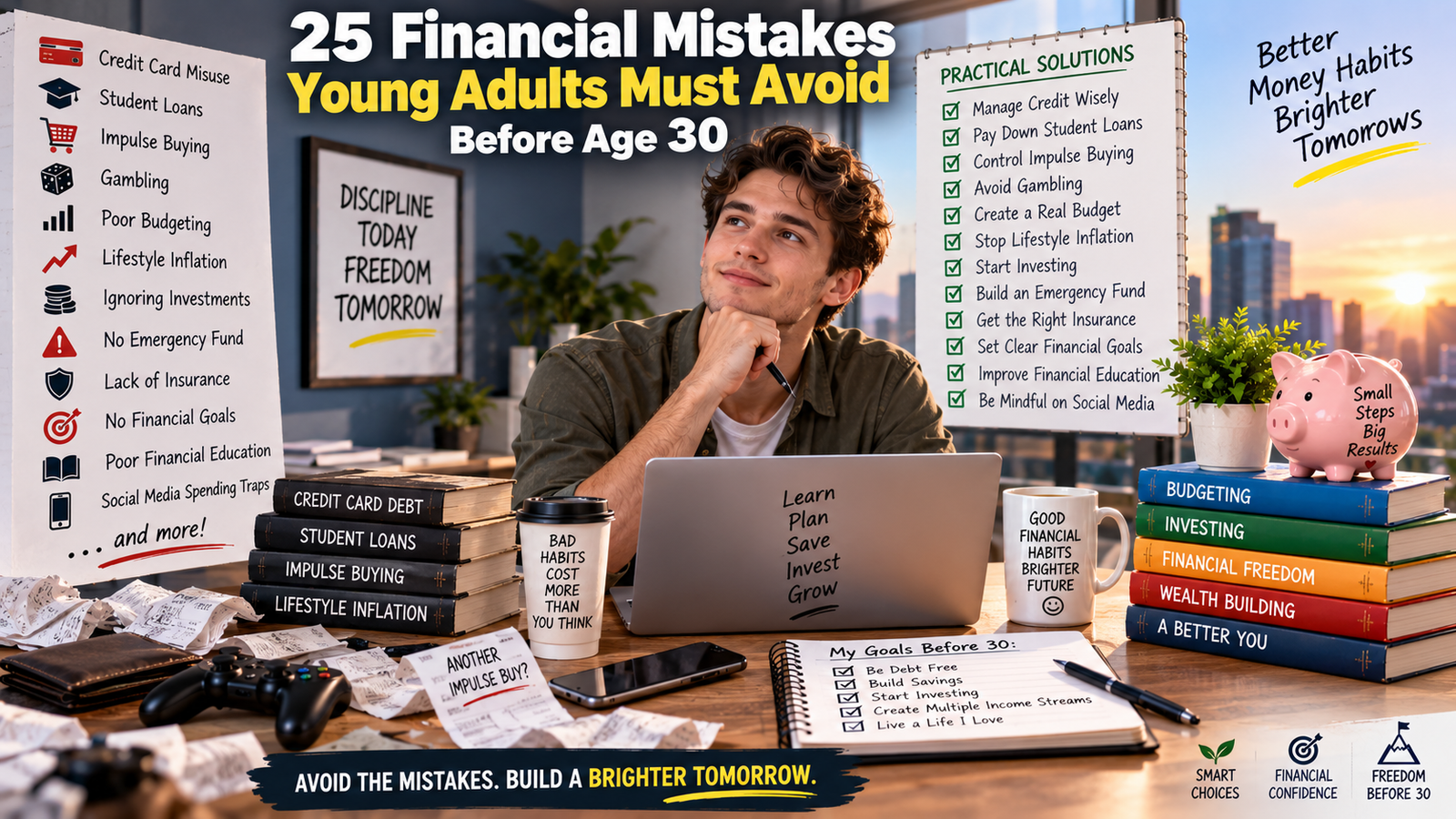
Here are 25 financial mistakes young adults should try to avoid before age 30—and practical ways to correct them.
1. Misusing Credit Cards
Credit cards can provide convenience and help establish a credit history in countries where credit scoring is widely used. But they can become expensive when purchases are carried from month to month and interest accumulates.
A common mistake is treating the available credit limit as though it were additional income.
It isn’t.
Block 9 – After Paragraph 8
Before using a card, ask:
Could I afford this purchase if I had to pay cash today?
The Consumer Financial Protection Bureau’s credit-card resources explain credit-card costs and consumer protections, while its credit-card agreement database can help U.S. consumers research card agreements.
Practical solution: Pay balances in full and on time whenever possible, understand your interest rate and fees, and avoid financing an unaffordable lifestyle with revolving credit.
2. Making Only Minimum Credit-Card Payments
Minimum payments can make a large balance appear manageable.
A $5,000 balance might require a relatively small minimum monthly payment, but paying only the minimum can extend repayment and substantially increase total interest costs.
Look at the repayment information on your statement rather than focusing only on the minimum due.
The CFPB credit-card portal provides educational resources, and USA.gov’s credit and debt resources can direct U.S. consumers toward additional official information.
Practical solution: Stop adding unnecessary purchases to the balance and establish a deliberate repayment amount above the minimum whenever your finances permit.
3. Borrowing Too Much for Education
Education can be an excellent investment when it develops valuable knowledge, qualifications and earning capacity.
But borrowing without understanding the future repayment burden can create years of financial pressure.
Before borrowing, compare:
Total education cost
Expected borrowing
Interest rates
Expected starting salary
Career opportunities
Alternative programs
Repayment requirements
U.S. borrowers can use Federal Student Aid to understand federal student loans and the official Repayment Calculator to compare repayment possibilities.
Practical solution: Borrow only what is reasonably necessary, understand the loan before signing, and evaluate education based partly on its likely career and financial return.
4. Ignoring Student Loans After Graduation
Ignoring debt does not make it disappear.
Missing payments can create serious consequences depending on the loan type and country.
U.S. federal borrowers should review their accounts and available repayment arrangements through Federal Student Aid, rather than waiting until payments become unmanageable. Borrowers can also use the Federal Student Aid Repayment Calculator to compare eligible options.
Practical solution: Know exactly how much you owe, your interest rates, required payments and repayment dates. If you are struggling, contact the legitimate lender or servicer early rather than ignoring the problem.
5. Impulse Buying
Modern shopping systems are designed to make purchasing extremely easy.
One-click checkout, saved credit cards, limited-time offers and personalized advertising reduce the time between wanting something and buying it.
Create friction.
For nonessential purchases, try a 24-hour or 48-hour waiting rule.
Remove saved payment information from shopping apps and unsubscribe from promotional messages that consistently trigger unnecessary spending.
The CFPB budgeting resources can help consumers examine spending patterns, while its savings resources can help redirect money toward more meaningful goals.
Practical solution: Put the product on a wish list and revisit it after two days. You may discover that the urgency disappears.
6. Gambling With Money You Cannot Afford to Lose
Gambling should never be treated as a reliable wealth-building strategy.
Money required for rent, food, transportation, education, debt payments, healthcare or emergency savings should not be placed at risk through betting.
The same caution applies when speculative trading begins behaving like gambling.
The National Council on Problem Gambling provides information and support resources in the United States, while readers elsewhere should consult recognized responsible-gambling or health services in their countries.
Practical solution: Never gamble with essential money, borrowed money or emergency savings. If gambling becomes difficult to control, seek professional assistance rather than trying to win back losses.
7. Living Without a Budget
A budget is not punishment.
It is a plan telling your money where it needs to go.
Without one, people can earn reasonable incomes and still wonder where the money disappeared.
Start with:
Monthly income − Essential expenses − Debt payments − Savings − Investments − Discretionary spending
The CFPB budgeting resources offer practical financial-planning tools, and the FDIC Money Smart program provides broader financial education.
Practical solution: Create a simple monthly plan and compare your actual spending against it at the end of each month.
8. Failing to Track Spending
A budget based on guesses can be misleading.
You may believe you spend $300 monthly eating out when the actual amount is $650.
Small recurring purchases can become large annual expenses.
Review bank statements, card transactions, digital-wallet activity and cash purchases.
Practical solution: Track every major spending category for at least 30 days. Then decide which expenses genuinely improve your life and which ones can be reduced.
9. Having No Emergency Fund
An unexpected vehicle repair, medical expense, family emergency or period without income can force someone into debt if there is no financial reserve.
An emergency fund provides a buffer between a financial shock and your credit card.
The CFPB’s emergency-fund guide explains how even small savings can improve financial resilience, while its savings resources provide additional tools.
Practical solution: Start with an achievable target such as $500, $1,000 or an appropriate amount in your local currency. Then work toward several months of essential expenses according to your circumstances.
10. Allowing Lifestyle Inflation to Consume Every Raise
Lifestyle inflation occurs when expenses rise every time income rises.
You earn more, so you buy a more expensive car.
Another raise arrives, so you move into a more expensive apartment.
Eventually, your salary is significantly higher—but you are still saving almost nothing.
Practical solution: Whenever you receive a raise, automatically allocate part of the increase toward savings, investments or debt reduction before upgrading your lifestyle.
Enjoy some progress, but make sure your net worth increases alongside your income.
11. Buying an Expensive Car Too Early
Transportation is necessary for many young adults.
A luxury vehicle usually isn’t.
The financial cost of a vehicle can include:
Purchase price
Interest
Insurance
Fuel
Maintenance
Repairs
Registration
Depreciation
Before financing a vehicle, calculate the complete monthly and annual cost rather than looking only at the advertised payment.
The CFPB auto-loan resources provide guidance on vehicle financing.
Practical solution: Buy reliable transportation that fits your financial position rather than using a vehicle to demonstrate financial success.
12. Trying to Look Rich Instead of Building Wealth
Social media has made visible consumption extremely powerful.
Luxury travel, expensive restaurants, designer clothing, high-end cars and beautiful homes are constantly displayed.
But you cannot see someone’s bank account, debt or net worth from a photograph.
A person driving a modest vehicle may have substantial investments.
Someone displaying luxury purchases may have enormous debt.
Practical solution: Measure progress using your savings rate, debt reduction, investment balance and net worth—not other people’s visible consumption.
13. Falling Into Social Media Spending Traps
Social platforms can create constant pressure to buy.
Influencers may be paid to promote products. Algorithms repeatedly expose users to lifestyles and products designed to generate engagement and purchases.
Before buying something promoted online, ask:
Did I want this before I saw the post?
Social media can also expose young adults to questionable investment promotions. Investor.gov warns consumers about internet and social-media investment fraud and recommends independently researching investment opportunities.
Practical solution: Unfollow accounts that consistently trigger unhealthy spending or financial comparison, and never assume popularity equals financial credibility.
14. Taking Financial Advice From Unqualified Influencers
A person having millions of followers does not make that person a qualified financial professional.
Be particularly cautious when someone promises:
Guaranteed returns
Quick wealth
Secret investments
No-risk profits
Urgent opportunities
Investor.gov’s investment fraud guidance identifies guaranteed high returns, pressure to act immediately and fear of missing out as warning signs. Its social-media fraud resources provide additional guidance.
Practical solution: Verify information independently through regulators, official sources and appropriately qualified professionals before committing money.
15. Ignoring Investing Because You Think You Are Too Young
Young adults possess an asset older investors cannot buy:
Time.
Money invested at 22 potentially has decades to grow before traditional retirement age.
Waiting until you earn a large salary can sacrifice valuable compounding years.
Investor.gov provides educational information on getting started with investing and a compound interest calculator.
Practical solution: Learn first, establish emergency savings, address expensive debt appropriately, and begin with an affordable amount rather than waiting for perfect circumstances.
16. Chasing Get-Rich-Quick Investments
Young investors sometimes believe the fastest way to become wealthy is finding the next stock, cryptocurrency or speculative asset that will increase dramatically.
Occasionally an asset does.
Many others collapse.
Investor.gov warns that promises of high returns with little or no risk are classic signs of potential investment fraud, and its common scams guide explains several ways fraudsters exploit popular investment trends.
Practical solution: Build wealth around diversification, appropriate risk, long-term goals and investments you understand rather than excitement and FOMO.
17. Investing Without Understanding Risk
Every investment involves some form of risk.
Stocks can decline.
Businesses can fail.
Property values can fall.
Currencies fluctuate.
Even keeping everything in cash exposes long-term purchasing power to inflation.
The goal is not eliminating every risk—it is understanding and managing it.
Investor.gov explains risk and return and provides educational material on diversification.
Practical solution: Never invest in something simply because someone says it is safe. Understand what you own, potential losses, fees and how the investment fits your goals.
18. Having No Financial Goals
Without goals, saving becomes vague.
“Save more money” is not a strong financial target.
Instead:
Build a $2,000 emergency fund by December.
Pay off $4,000 of credit-card debt within 12 months.
Invest $200 every month.
Save $20,000 toward a home deposit within four years.
The CFPB savings resources can help with savings planning, while Investor.gov offers several financial calculators.
Practical solution: Give every important financial goal an amount, deadline and monthly action.
19. Ignoring Insurance
Young adults sometimes believe insurance is unnecessary because serious problems happen to older people.
But accidents, illness, theft, property damage and disability can happen at any age.
Insurance needs differ by country and personal circumstances, but may include:
Health insurance
Auto insurance
Renters or homeowners insurance
Disability coverage
Life insurance when others depend on your income
Practical solution: Identify the financial events that could seriously damage your finances and investigate appropriate regulated insurance rather than assuming emergency savings can cover every catastrophic loss.
20. Depending on Only One Income Source
One job can provide stability—but it also creates dependency.
If that job disappears, 100% of your employment income can disappear with it.
Young adulthood can be a valuable period for developing additional skills and experimenting with supplementary income.
Possible sources include:
Freelancing
Part-time work
Consulting
Digital services
Small businesses
Investments
Online education
Creative work
Practical solution: Strengthen your primary career first, then gradually develop an additional income source that matches your skills and circumstances.
21. Neglecting Career and Skill Development
Your greatest financial asset in your 20s may not be your investment portfolio.
It may be your future earning ability.
Suppose one professional skill increases your income by $15,000 annually.
Over ten years, that represents potentially $150,000 in additional gross income before considering future raises or career opportunities.
Practical solution: Continuously develop skills employers and customers value. Education should not end when formal schooling ends.
The objective is to increase both your financial knowledge and your economic value.
22. Failing to Learn Basic Personal Finance
Many people spend years studying for careers but almost no time studying money.
Yet financial decisions affect almost every stage of adult life.
Learn the fundamentals of:
Budgeting
Credit
Debt
Saving
Emergency funds
Insurance
Investing
Taxes
Retirement
Fraud prevention
The FDIC Money Smart program offers financial education, while Investor.gov provides extensive investing education.
Practical solution: Dedicate at least one hour each week to improving your financial knowledge.
23. Ignoring Retirement Because It Seems Too Far Away
Retirement may feel irrelevant at 23.
But that distance is precisely what gives young adults an advantage.
Imagine investing $200 monthly from age 25 to 65.
Your direct contributions would total $96,000.
If those investments generated positive long-term returns, compound growth could potentially make the eventual balance substantially larger.
Investor.gov’s compound interest calculator allows you to experiment with different contribution and return assumptions, while its retirement resources provide additional planning information.
Practical solution: Learn about retirement accounts, pensions or tax-advantaged investment arrangements available in your country and start as early as your finances reasonably allow.
24. Comparing Your Financial Life With Everyone Else
At 25, one friend may own a house.
Another may still live with family.
Someone else may have $50,000 invested.
Another may be paying student debt.
Someone may be supporting parents or children.
Another may have inherited money.
Their starting points are different.
Financial comparison can encourage unnecessary risk and spending.
Practical solution: Compare yourself primarily with your previous financial position.
Ask:
Is my debt lower than last year?
Are my savings higher?
Has my income improved?
Am I investing more?
Is my net worth moving in the right direction?
That is more useful than competing with strangers online.
25. Reaching 30 Without a Financial Plan
The biggest mistake may be allowing your entire 20s to pass without establishing a financial direction.
You don’t need everything figured out by 30.
But ideally, you should understand:
What you earn
What you spend
What you owe
What you own
What you save
What you invest
What risks you face
What financial future you are trying to create
The CFPB’s consumer financial resources cover many everyday money decisions, while Investor.gov’s financial tools and calculators can help with longer-term planning.
Practical solution: Create a one-page financial roadmap for the next five years and review it at least annually.
Practical Financial Roadmap Before Age 30
If you recognize several of these mistakes in your own life, don’t try to fix everything tomorrow.
Start in order.
First: Know exactly where your money goes.
Second: Create a realistic budget.
Third: Stop adding unnecessary high-interest debt.
Fourth: Build an initial emergency fund.
Fifth: Establish a strategy for existing debt.
Sixth: Protect yourself against major financial risks.
Seventh: Increase your earning ability.
Eighth: Begin learning about long-term investing.
Ninth: Automate savings and investments where appropriate.
Tenth: Increase your savings rate as income grows.
Eleventh: Avoid lifestyle inflation.
Twelfth: Review your net worth and financial goals annually.
You do not need to complete these steps by a specific birthday.
The objective is to establish a financial system that becomes stronger as your career and income develop.
A Simple Monthly Financial Checkup
Once each month, spend 20–30 minutes reviewing your finances.
Check:
Income received
Total spending
Credit-card balances
Loan balances
Emergency savings
Investment contributions
Upcoming major expenses
Progress toward financial goals
Then ask one question:
What is the single financial improvement I should make next month?
Perhaps you reduce restaurant spending.
Maybe you increase emergency savings by $50.
Perhaps you make an additional debt payment.
Maybe you finally start investing.
Small improvements repeated every month can produce significant long-term change.
Conclusion
Your 20s do not have to be financially perfect.
You will probably make mistakes.
You may buy something you regret.
You may underestimate an expense.
You may choose the wrong investment.
You may take on debt that you later wish you had avoided.
Financial success is not about never making mistakes.
It is about recognizing them early enough that they do not become permanent habits.
Before age 30, concentrate on establishing the fundamentals:
Spend less than you earn.
Use credit carefully.
Understand your student debt.
Build emergency savings.
Protect yourself against major risks.
Develop valuable skills.
Set measurable financial goals.
Start investing when financially prepared.
Avoid get-rich-quick schemes.
Control lifestyle inflation.
Ignore social-media pressure.
Keep learning.
The greatest advantage of getting these things right while you are young is not simply the money you can accumulate before 30.
It is the time you still have ahead of you.
A strong financial habit developed at 25 could continue benefiting you at 35, 45, 55 and beyond.
So don’t make your goal to look wealthy before 30.
Build the habits, knowledge, savings, income and assets that can help you become financially stronger for the rest of your life.
Educational Disclaimer: This article provides general financial education and does not constitute individualized financial, investment, credit, insurance, tax, gambling-treatment or legal advice. Financial products, consumer protections, education loans, insurance systems and regulations vary by country.


Leave a Reply