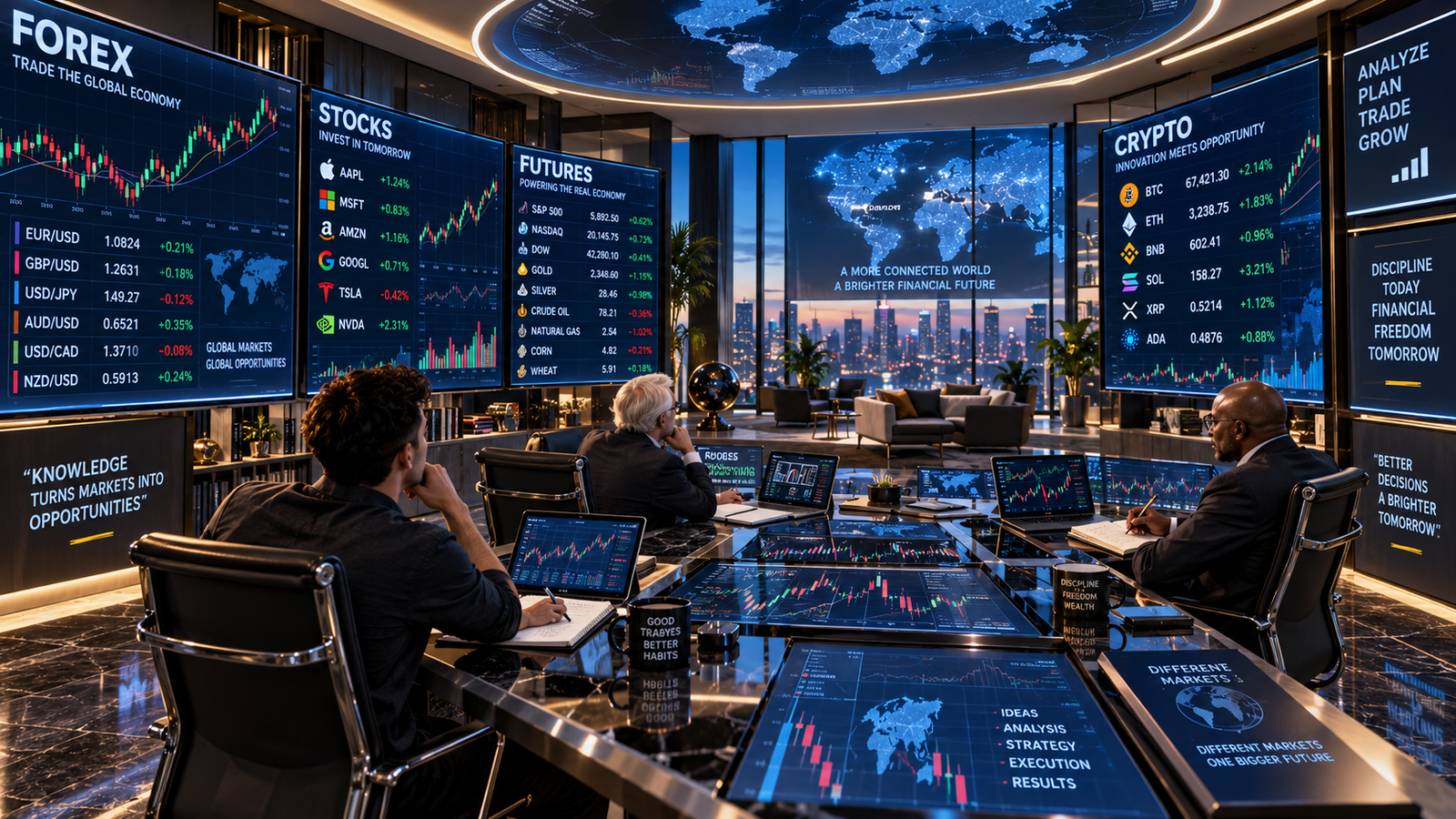
Learn How the Foreign Exchange Market Works, Manage Risk, Read Currency Charts, and Avoid Costly Beginner Mistakes
Introduction
Every day, currencies move around the world.
A tourist converts euros into Japanese yen.
A company in Kenya pays a supplier in China.
A multinational corporation converts foreign revenue back into its home currency.
An investment fund buys overseas assets.
A central bank manages reserves.
A trader speculates on whether one currency will strengthen against another.
All of these activities connect in some way to the enormous global foreign exchange market, commonly called the forex or FX market.
According to the Bank for International Settlements, average over-the-counter foreign-exchange turnover reached approximately $9.6 trillion per day in April 2025, up from about $7.5 trillion in 2022.
That enormous figure helps explain why forex is commonly described as the world’s largest financial market.
Block 9 – After Paragraph 8
But size does not mean easy profits.
Forex trading—particularly leveraged retail trading—can result in substantial losses. Regulators around the world repeatedly warn consumers about excessive leverage, unregulated platforms, unrealistic profit promises and fraudulent forex schemes.
This guide therefore has a different objective from the countless advertisements promising to teach you how to “get rich trading forex.”
The objective is to help you understand:
How the forex market works.
Why currencies move.
How currency pairs are quoted.
How brokers operate.
How leverage and margin work.
How charts are interpreted.
How traders analyze markets.
How risk should be managed.
How scams can be recognized.
How to research regulation before depositing money.
Learning should come before trading.
And protecting your capital should come before chasing profits.
1. What Is Forex Trading?
Forex stands for foreign exchange.
Foreign exchange involves exchanging one currency for another.
If you travel from one country to another and exchange your home currency for the destination’s currency, you have participated in foreign exchange.
Forex trading takes the concept further.
A trader takes a position based on how the value of one currency may change relative to another.
Currencies therefore trade in pairs.
Examples include:
EUR/USD — Euro vs. U.S. dollar
USD/JPY — U.S. dollar vs. Japanese yen
GBP/USD — British pound vs. U.S. dollar
AUD/USD — Australian dollar vs. U.S. dollar
USD/CAD — U.S. dollar vs. Canadian dollar
A trader is not simply asking:
“Will the euro rise?”
The question is:
“Will the euro strengthen or weaken relative to the other currency in this pair?”
That relationship is fundamental to understanding forex.
2. A Brief History of the Foreign Exchange Market
Currency exchange is centuries old, but the modern forex market developed through major changes in the international monetary system.
One important twentieth-century framework was the Bretton Woods system, established during the 1940s.
Under that international monetary arrangement, currencies operated within a system of fixed exchange-rate relationships centered on the U.S. dollar, while the dollar itself had a defined relationship with gold.
That system eventually broke down.
By March 1973, the world’s major currencies had moved toward floating exchange rates, marking the end of the Bretton Woods fixed-rate regime.
You can explore international monetary and financial history through the Bank for International Settlements.
Technology later transformed the market.
Electronic brokerage systems expanded in the 1990s, followed by increasingly sophisticated electronic and algorithmic trading.
Today the forex market connects:
Banks
Central banks
Investment funds
Corporations
Asset managers
Hedge funds
Trading firms
Governments
Brokers
Individual traders
across the world.
3. Why Forex Is the World’s Largest Financial Market
The forex market is enormous because currencies sit at the center of international economic activity.
Currencies are needed for:
International trade
Cross-border investment
Tourism
Foreign debt payments
Corporate transactions
Government activity
Currency reserves
Portfolio management
Hedging
Speculation
The Bank for International Settlements conducts its comprehensive Triennial Central Bank Survey to measure activity across global FX markets.
The BIS reported that average OTC FX turnover reached approximately:
$9.6 trillion per day in April 2025.
The U.S. dollar remained dominant, appearing on one side of roughly 89% of FX transactions measured in that survey.
But forex is truly global.
Emerging-market currencies collectively reached a record share of global FX turnover in 2025, according to BIS analysis.
This means forex is not merely a market for the dollar, euro, yen and pound.
It connects economies throughout:
Africa
Asia
Europe
North America
South America
Oceania
The Middle East
4. Understanding Currency Pairs
Forex prices are quoted as currency pairs.
Consider:
EUR/USD = 1.1500
EUR is the base currency.
USD is the quote currency.
The quote means approximately:
1 euro = 1.15 U.S. dollars
Now consider:
USD/JPY = 150.00
This means approximately:
1 U.S. dollar = 150 Japanese yen
When EUR/USD rises, the euro has strengthened relative to the dollar, or the dollar has weakened relative to the euro—or some combination of both.
Forex is always relative.
5. Major Currency Pairs
“Major” pairs generally involve the U.S. dollar paired with another heavily traded currency.
Common examples include:
EUR/USD
USD/JPY
GBP/USD
USD/CHF
AUD/USD
USD/CAD
NZD/USD
These markets tend to have substantial trading activity.
The BIS foreign-exchange statistics provide detailed international information about currencies and FX activity.
6. Minor or Cross-Currency Pairs
Currency pairs that do not include the U.S. dollar are often called crosses or, in retail terminology, minor pairs when they involve major currencies.
Examples include:
EUR/GBP
EUR/JPY
GBP/JPY
AUD/JPY
EUR/AUD
Crosses allow traders and businesses to consider relationships between currencies without directly trading against the dollar.
7. Exotic Currency Pairs
An exotic pair generally combines a major currency with the currency of a smaller or emerging economy.
Depending on broker availability and jurisdiction, examples might involve currencies such as:
Mexican peso
South African rand
Turkish lira
Brazilian real
Indian rupee
Thai baht
These currencies can have wider spreads, lower liquidity or greater volatility than heavily traded major pairs.
“Exotic” does not mean bad.
It means the market characteristics can differ substantially.
Beginners should understand those differences before trading them.
8. How Currency Prices Move
Currency values are influenced by supply and demand.
When demand for one currency rises relative to another, its exchange rate can strengthen.
When demand falls, it can weaken.
But what changes demand?
Many things:
Interest rates
Inflation
Economic growth
Employment
Trade
Capital flows
Government policy
Central-bank policy
Political developments
Commodity prices
Investor sentiment
Market expectations
Forex traders therefore study economies as well as charts
9. Exchange Rates Explained
An exchange rate tells you how much one currency is worth relative to another.
Suppose:
EUR/USD = 1.1000
Later:
EUR/USD = 1.1200
The euro has appreciated relative to the dollar over that interval.
Alternatively:
EUR/USD = 1.0800
The euro has depreciated relative to the dollar.
The Bank for International Settlements exchange-rate statistics and its broader statistics portal provide international exchange-rate datasets.
Central banks around the world also publish currency and economic information.
10. Bid Price vs. Ask Price
Forex quotations commonly contain two prices.
Suppose EUR/USD displays:
Bid: 1.1000
Ask: 1.1002
The bid is generally the price at which the dealer is prepared to buy the base currency from you.
The ask is generally the price at which the dealer is prepared to sell it to you.
The difference between them is the:
Spread
Here:
1.1002 − 1.1000 = 0.0002
For a pair quoted to four decimal places in the conventional way, that would commonly represent approximately 2 pips.
11. Spreads and Commissions
Trading is not free.
Depending on the broker and account structure, costs may include:
Spreads
Commissions
Financing/rollover charges
Conversion charges
Withdrawal charges
Other account fees
A broker advertising “zero commission” does not necessarily mean zero trading cost.
The cost may instead be incorporated into the spread or elsewhere.
Always read the broker’s full fee schedule.
12. What Is a Pip?
A pip is a commonly used unit for describing small movements in currency prices.
For many currency pairs:
1 pip = 0.0001
For example:
EUR/USD moves from:
1.1000 → 1.1001
That is a one-pip movement under the conventional quotation.
Pairs involving the Japanese yen are commonly quoted differently, so the conventional pip location is typically different as well.
Some brokers also quote fractional pips.
13. What Is Lot Size?
Lot size describes the size of a forex position.
Retail platforms may use terms such as:
Standard lot
Mini lot
Micro lot
A commonly used convention is:
Standard lot = 100,000 currency units
Mini lot = 10,000 currency units
Micro lot = 1,000 currency units
But never assume every platform uses exactly the same terminology or contract specifications.
Check the broker’s documentation.
The larger your position, the greater the potential monetary impact of a price movement.
14. Who Participates in the Forex Market?
Forex is much larger than retail trading.
Major participants include:
Commercial Banks
Banks facilitate international transactions and trade currencies for clients and themselves.
Central Banks
Institutions such as the:
and central banks throughout Africa, Asia, Latin America, the Middle East and Oceania can strongly influence currencies through monetary policy.
Corporations
International businesses exchange currencies when paying employees, suppliers, customers and investors across borders.
Institutional Investors
Pension funds, asset managers, insurance companies and investment funds may hold assets in multiple currencies.
Hedge Funds and Trading Firms
Professional firms may trade currencies for hedging, arbitrage or speculation.
Retail Traders
Individuals participate through brokers and trading platforms.
Retail trading represents only one part of the enormous global market.
15. Understanding Forex Trading Sessions
Forex trading follows global financial centers.
Because major centers operate in different time zones, FX activity continues across much of the working week.
Four sessions are commonly discussed in retail forex education:
Sydney Session
Associated with the opening of the Asia-Pacific trading day.
Tokyo Session
Important for Japanese yen and broader Asian market activity.
London Session
London remains the world’s largest FX trading center.
New York Session
New York is another major global financial center and overlaps with London for part of the trading day.
The London-New York overlap can be particularly active because two major centers are operating simultaneously.
Exact trading hours can vary by broker, instrument, daylight-saving changes and local holidays.
16. How Forex Brokers Work
Retail traders usually access forex markets through brokers or dealers.
Depending on jurisdiction and business model, the provider may:
Provide the trading platform
Display bid and ask prices
Execute orders
Act as counterparty
Route or hedge transactions
Provide leverage
Hold customer funds
The exact relationship matters.
The U.S. Commodity Futures Trading Commission warns retail customers to understand that in certain OTC forex arrangements, they trade against the dealer on the dealer’s platform.
Different jurisdictions regulate retail forex differently.
Therefore:
Do not assume a broker’s business model or protections are identical worldwide.
17. Leverage Explained
Leverage allows a trader to control a position larger than the money committed to support it.
Suppose you control:
$10,000
of currency exposure using:
$500
of your own capital.
You have substantial leveraged exposure.
Leverage magnifies:
Potential gains AND potential losses.
This is one of the most important concepts in forex.
A small market movement can create a much larger percentage change in your account.
The CFTC forex advisory warns that leverage amplifies both gains and losses and that, depending on the arrangement and protections applicable, losses can potentially exceed the original deposit.
Never choose the maximum available leverage simply because the broker offers it.
18. Margin Explained
Margin is the amount of money required to open or maintain a leveraged position.
For example, if a provider requires 2% margin for a $100,000 position:
Required margin = $2,000
But the market exposure remains:
$100,000
not $2,000.
That distinction explains why leveraged trading can become dangerous.
If losses reduce your available funds too far, the broker may require additional funds or automatically close positions, depending on its rules and applicable regulation.
Always understand:
Initial margin
Maintenance requirements
Margin close-out rules
Negative-balance protections
Liquidation procedures
before trading.
19. Why Leverage Rules Differ Around the World
Forex regulation is not globally uniform.
For example, the UK’s Financial Conduct Authority applies retail protections to CFDs and rolling spot forex, including leverage restrictions and other measures.
Other countries have their own frameworks.
A broker offering 500:1 or 1,000:1 leverage from one jurisdiction may not be permitted to offer the same terms to retail clients somewhere else.
This is why choosing a broker based solely on leverage is a serious mistake.
More leverage does not automatically mean a better broker.
20. Understanding Long and Short Positions
If you believe the base currency will strengthen against the quote currency, you might take a long position.
If you expect it to weaken, you might take a short position.
For example:
You buy EUR/USD at:
1.1000
and later close at:
1.1100
The market moved in the direction of the long position.
But if it falls to:
1.0900
the position moves against you.
Trading is always uncertain.
The fact that your analysis appears logical does not guarantee the market will follow it.
21. Reading Candlestick Charts
Candlestick charts display price activity across chosen periods.
Each candle generally shows:
Open
High
Low
Close
A candle might represent:
1 minute
5 minutes
1 hour
4 hours
1 day
1 week
depending on the chart.
Candlesticks can help traders visualize:
Price direction
Volatility
Momentum
Rejection
Trading ranges
But no candlestick pattern can predict the future with certainty.
Charts organize information.
They do not eliminate uncertainty.
22. Technical Analysis Basics
Technical analysis studies price and market behavior.
Common tools include:
Support and resistance
Trendlines
Moving averages
Relative Strength Index (RSI)
MACD
Price patterns
Volume-related information where relevant
Volatility measures
Support
An area where buying interest has previously appeared.
Resistance
An area where selling pressure has previously appeared.
Trend
A general direction in price.
Markets may move:
Upward
Downward
Sideways
Technical analysis is not magic.
Two skilled traders can look at the same chart and reach different conclusions.
23. Fundamental Analysis Basics
Fundamental analysis focuses on economic and financial forces affecting currencies.
Forex traders may study:
Interest rates
Inflation
Employment
Economic growth
Trade balances
Government finances
Central-bank policy
Political developments
A currency is connected to the economy and monetary system behind it.
Therefore, understanding macroeconomics can be useful for understanding forex.
Useful global sources include:
Bank for International Settlements
as well as official national statistical agencies and central banks
24. Economic News That Can Move Forex
Currencies can move sharply around economic announcements.
Important releases can include:
Inflation data
Employment reports
GDP
Retail sales
Manufacturing indicators
Interest-rate decisions
Central-bank statements
Suppose inflation is unexpectedly high.
Traders may change their expectations about future interest rates.
That can influence bond markets, investment flows and currency demand.
But market reactions are not always obvious.
A currency can sometimes fall even after apparently positive economic news because traders had expected even stronger numbers.
Forex markets often react to:
Actual result vs. market expectation
rather than simply whether the headline appears good or bad.
25. Central Banks Matter Enormously
Central banks influence currency markets through monetary policy.
They may adjust:
Policy interest rates
Liquidity conditions
Asset-purchase programs
Reserve requirements
Communication about future policy
Central banks may also intervene directly or indirectly in foreign-exchange markets under certain circumstances.
If you trade a currency, learn about the central bank responsible for it.
Don’t rely solely on social-media summaries.
Read original central-bank announcements whenever possible.
26. Technical Analysis vs. Fundamental Analysis
Technical traders emphasize:
What is price doing?
Fundamental traders emphasize:
Why might the currency be moving?
Many market participants combine both.
For example:
Fundamental analysis may suggest a currency has supportive economic conditions.
Technical analysis may help identify possible entry, exit or invalidation levels.
Neither approach guarantees success.
Risk management remains necessary regardless of analytical method
27. Trading Psychology
Trading is not purely mathematical.
Money creates emotion.
Common psychological problems include:
Fear
Greed
Overconfidence
Impatience
Revenge trading
Fear of missing out
Refusal to accept losses
Imagine losing three trades.
You become angry.
You double the size of the fourth trade because you want your money back immediately.
That is revenge trading.
The fourth trade is no longer based purely on analysis.
Emotion has taken control.
A trader’s greatest risk is sometimes not the market.
It is the trader’s own behavior.
28. Risk Management: The Skill Beginners Must Learn First
Many beginners focus on:
How much can I make?
Experienced risk thinking begins with:
How much can I lose if I am wrong?
Before entering a trade, consider:
Entry price
Position size
Potential loss
Exit level
Risk/reward relationship
Account exposure
Never risk essential money.
Do not trade with:
Rent money
Food money
Emergency savings
Medical funds
Borrowed money
Money needed for family obligations
Capital protection must come before profit seeking.
29. Position Sizing
Suppose you have:
$5,000
in trading capital.
Risking $1,000 on one speculative position means one bad decision could remove:
20% of your account.
Recovering from large losses becomes increasingly difficult.
For example, after a 50% loss, you need a 100% gain on the remaining capital simply to return to the starting value.
Position sizing therefore matters enormously.
There is no universal percentage that is appropriate for every trader.
The central principle is:
A single trade should not be capable of destroying your financial future.
30. Stop-Loss Orders
Suppose a hypothetical setup risks:
$50
for a potential gain of:
$100
The theoretical reward is twice the amount at risk.
But a favorable risk/reward ratio alone does not make a strategy profitable.
You must also consider the probability of winning, trading costs and actual execution.
Risk management combines:
Position size + Probability + Loss size + Potential reward + Trading costs
32. Keep a Trading Journal
A trading journal can record:
Date
Currency pair
Entry
Exit
Position size
Reason for trade
Risk
Result
Market conditions
Emotional state
Lessons
After 50 or 100 demo trades, patterns may become visible.
Perhaps you trade better during particular conditions.
Perhaps your losses increase after economic announcements.
Perhaps you repeatedly violate your own rules.
Without records, you may never notice.
33. Demo Trading Accounts
A demo account uses simulated money rather than real capital.
For beginners, this can be extremely useful.
Use a demo account to learn:
Order placement
Chart navigation
Position sizing
Stops
Targets
Platform mechanics
Trading plans
Journal keeping
Do not rush through demo trading simply because simulated profits feel less exciting.
The purpose is education.
A useful progression is:
Learn → Observe → Demo Trade → Journal → Review → Improve
Only then should someone even consider whether real-money trading is appropriate.
34. Demo Trading Is Not Identical to Real Trading
Demo trading has limitations.
When fake money is at risk, emotional pressure is different.
Losing $1,000 of virtual money is not psychologically equivalent to losing $1,000 you worked months to save.
Live execution and market conditions may also differ.
Therefore:
Demo success does not guarantee live-trading success.
Treat demo trading as education, not proof that future profits are guaranteed.
35. Develop a Trading Plan Before Trading Real Money
A trading plan should answer:
Which currency pairs will I study?
Which timeframes?
What conditions create a setup?
What invalidates the setup?
How will position size be determined?
When will I avoid trading?
How will results be recorded?
If your strategy is:
“I will look at the chart and see what happens,”
you do not have a strategy.
Rules reduce emotional decision-making.
36. Common Forex Beginner Mistakes
Beginners frequently make predictable errors.
Mistake 1: Using Excessive Leverage
A small market movement can produce a disproportionately large loss.
Mistake 2: Trading Without Understanding Margin
Beginners may focus on potential profit while ignoring liquidation risk.
Mistake 3: Trading Without a Plan
Random decisions create inconsistent results.
Mistake 4: Risking Too Much on One Trade
One bad position can damage the account severely.
Mistake 5: Revenge Trading
Increasing risk after losses can compound the damage.
Mistake 6: Overtrading
More trades do not necessarily produce more profit.
Mistake 7: Ignoring Economic News
Unexpected volatility can destroy poorly managed positions.
Mistake 8: Copying Social-Media Signals Blindly
You may know nothing about the provider’s incentives, risk, history or competence.
Mistake 9: Believing Guaranteed-Profit Claims
No legitimate trader can guarantee that markets will produce a particular profit.
Mistake 10: Choosing a Broker Based Only on Bonuses or Leverage
Regulation, withdrawals, fees, execution and consumer protection matter much more.
37. Forex Scams and How to Avoid Them
Forex scams exist worldwide.
Common schemes include:
Fake brokers
Fake trading platforms
Guaranteed-return programs
Account-management scams
Signal scams
Copy-trading fraud
Fake investment groups
Romance-investment scams
Clone firms
Social-media impersonators
The UK’s Financial Conduct Authority warns that fraudulent forex firms may promise very high or guaranteed returns and sometimes initially show apparent profits to gain a victim’s trust.
The U.S. Commodity Futures Trading Commission similarly warns that many forex frauds begin through social media, messaging applications, dating platforms or unsolicited communications.
Major warning signs include:
“Guaranteed daily profit.”
“Zero risk.”
“Send money now.”
“Our secret AI bot never loses.”
“Pay another fee to unlock your withdrawal.”
“We are regulated everywhere.”
Verify these claims independently.
38. Never Pay More Money Just to Release Your Withdrawal
This deserves special attention.
A fraudulent platform may show:
Account Balance: $25,000
Then when you request a withdrawal, it demands:
$2,000 tax
then:
$1,500 processing fee
then:
$3,000 account verification
The numbers on the screen may be fabricated.
The CFTC specifically warns about fraudulent dealers refusing withdrawals unless customers send additional money for supposed commissions, taxes or account-status requirements.
If someone keeps demanding additional deposits to release your money, treat it as a major warning sign.
39. Choosing a Regulated Forex Broker
Do not begin by asking:
“Which broker offers the highest leverage?”
Begin with:
“Who regulates this broker in my country?”
Then verify it independently.
Do not rely on a regulator’s logo displayed on the broker’s website.
Visit the regulator’s official database.
Check:
Legal company name
License/registration number
Authorized activities
Website/domain
Contact information
Warnings
Disciplinary history
40. How to Check Forex Regulation Around the World
There is no single regulator controlling forex everywhere.
Depending on where you live, supervision may involve securities, derivatives, financial-market or central-bank authorities.
Useful official resources include:
IOSCO — the International Organization of Securities Commissions, whose membership and resources can help users identify securities regulators internationally.
IOSCO Investor Alerts Portal — aggregates alerts submitted by participating regulators about unauthorized firms.
Financial Conduct Authority — United Kingdom.
ASIC — Australia.
MAS — Singapore financial institutions directory.
CFTC — United States derivatives/forex resources.
NFA BASIC — U.S. registration and disciplinary research.
Other countries have their own authorities.
The principle is universal:
Find your country’s official regulator → Search its register → Verify the exact company → Verify the exact website → Check warnings → Only then consider depositing money.
41. Offshore Does Not Automatically Mean Better
Some brokers market themselves globally from jurisdictions with different regulatory frameworks.
A trader may think:
“This offshore broker gives me 1:1000 leverage, so it must be better.”
But ask:
What happens if it refuses my withdrawal?
Which regulator can I contact?
Are client funds segregated?
Is negative-balance protection available?
What legal rights do I have?
Where would a dispute be resolved?
Trading conditions are only one part of broker selection.
Legal protection matters too.
42. A Beginner’s Forex Learning Roadmap
Stage 1 — Learn Currency Basics
Understand:
Currency pairs
Exchange rates
Bid/ask
Spreads
Pips
Lots
Stage 2 — Learn Market Structure
Understand:
Banks
Central banks
Brokers
Institutions
Trading sessions
Stage 3 — Learn Risk
Study:
Leverage
Margin
Position sizing
Stop losses
Drawdowns
Stage 4 — Learn Analysis
Study:
Charts
Candlesticks
Technical analysis
Fundamental analysis
Economic news
Stage 5 — Demo Trade
Practice without risking real money.
Stage 6 — Journal Your Results
Document mistakes and patterns.
Stage 7 — Research Regulation
Learn the legal framework where you live.
Stage 8 — Decide Whether Trading Is Appropriate
Not everyone needs to become a forex trader.
Learning about currencies can still improve your understanding of the global economy.
43. Forex Trading vs. Long-Term Investing
Forex trading and long-term investing are not identical.
Forex trading often focuses on relative movements between currencies.
Long-term investing may involve owning productive assets such as:
Stocks
Bonds
Businesses
Real estate
depending on the investor’s goals.
Do not confuse short-term currency speculation with a complete wealth-building plan.
A financially responsible person can understand forex while still deciding that diversified long-term investing is more appropriate for most of their capital
44. The Most Important Forex Lesson
The most important lesson is not:
Which indicator should I use?
It is not:
Which currency pair will rise tomorrow?
And it is definitely not:
How can I turn $100 into $100,000?
The most important lesson is:
Markets are uncertain.
Once you accept uncertainty, risk management becomes logical.
You stop trying to be right every time.
You begin thinking about:
Capital preservation
Probability
Position sizing
Discipline
Consistency
Long-term survival
That mindset is more valuable than any supposed secret indicator.
Frequently Asked Questions
Is Forex Trading Legal?
Forex trading is legal in many countries, but the rules governing brokers, leverage, derivatives and retail participation vary significantly.
Check your country’s financial regulator before opening an account.
Is Forex Trading Safe?
Forex itself is a legitimate global financial market.
That does not mean retail forex trading is safe.
Leveraged trading can produce significant losses, and unregulated or fraudulent providers create additional risks.
How Much Money Do I Need to Start Forex Trading?
Minimum deposits vary between brokers.
But the fact that a broker allows you to open an account with a small amount does not mean you are financially prepared to trade.
Education, emergency savings, risk capacity and financial stability matter more than the advertised minimum deposit.
Can I Start With $100?
Some brokers may permit small accounts.
However, a small account combined with high leverage can encourage excessive risk.
The goal should not be:
“How quickly can I turn $100 into thousands?”
The better question is:
“How can I learn without damaging my financial future?”
Can Forex Make You Rich?
It is possible to make money trading currencies.
It is also possible to lose substantial amounts.
No responsible educational source should promise that forex will make you rich.
Treat guaranteed-return claims as warning signs.
Is Forex Gambling?
Forex trading is a financial-market activity, but behavior can become gambling-like when someone trades without analysis, risk controls or discipline, particularly when using excessive leverage.
Simply calling an activity “trading” does not automatically make reckless speculation responsible.
Which Currency Pair Is Best for Beginners?
There is no universally best currency pair.
Highly traded major pairs can offer greater liquidity and often tighter spreads, but they still carry market risk.
Beginners should first understand how pairs behave rather than searching for a guaranteed winner.
What Is the Best Forex Strategy?
There is no strategy guaranteed to work under all market conditions.
A strategy must be evaluated based on:
Risk
Costs
Consistency
Market conditions
Execution
Drawdowns
Discipline
Be skeptical of anyone selling a “100% winning strategy.”
Can AI Predict Forex Markets?
AI can analyze data, identify patterns and assist with research.
It cannot guarantee future currency prices.
Markets react to unexpected economic, political and financial events.
Claims that an AI forex robot “never loses” should be treated with extreme skepticism.
Are Forex Signals Reliable?
Quality varies enormously.
Some signal providers may use genuine analysis.
Others may have poor track records, hidden incentives or fraudulent intentions.
Never surrender responsibility for risk simply because someone sends buy and sell instructions.
What Is the Difference Between Forex and Crypto?
Forex involves national currencies such as:
USD
EUR
JPY
GBP
CHF
AUD
Cryptocurrency markets involve digital assets such as Bitcoin and other tokens.
Their market structures, regulation, custody arrangements, volatility and risks can differ significantly.
What Is the Difference Between Forex and Stocks?
Buying stock generally means acquiring an ownership interest in a company.
Forex trading involves taking positions on the relative value of currencies.
They are fundamentally different financial activities.
Should Beginners Use High Leverage?
High leverage can magnify losses dramatically.
A broker offering extremely high leverage does not mean using it is wise.
Understanding risk should come before maximizing exposure.
Should I Pay Someone to Trade Forex for Me?
Be extremely cautious.
Managed-account fraud is a known problem.
Verify authorization, regulation, custody arrangements, fees and the identity of everyone involved before transferring money.
Never rely solely on screenshots or social-media testimonials.
How Can I Tell Whether a Forex Broker Is Genuine?
Verify the broker through the official regulator’s database.
Do not click a “regulator” link supplied by an unknown broker and assume it is authentic.
Independently locate the regulator’s official website and check the company’s:
Name
License
Domain
Address
Permissions
Warnings
Clone firms sometimes impersonate legitimate regulated companies.
Where Can I Learn More About the Global Forex Market?
Reliable starting points include:
Bank for International Settlements — global FX statistics, market structure and central-bank research.
International Monetary Fund — exchange rates, international economics and monetary systems.
World Bank — global economic data.
IOSCO — international securities-regulatory resources.
CFTC Learn & Protect — derivatives and forex risk education.
FCA Consumer Information — consumer protection and financial-scam education.
The best forex education combines market knowledge with skepticism, risk awareness and reliable sources.
Conclusion
Forex is one of the most fascinating parts of the global financial system.
Every currency tells a story about an economy.
Interest rates matter.
Inflation matters.
Economic growth matters.
International trade matters.
Central banks matter.
Politics can matter.
Investor expectations matter.
And because currencies connect economies, forex provides a window into how the global financial system operates.
But understanding forex and successfully trading leveraged forex are two very different things.
A beginner should therefore follow a disciplined sequence:
Learn first.
Understand currency pairs.
Understand exchange rates.
Learn pips and lot sizes.
Understand spreads and fees.
Study leverage.
Understand margin.
Learn charts.
Study economics.
Practice on a demo account.
Develop risk rules.
Keep a journal.
Research regulation.
Verify your broker.
Protect your capital.
Do not rush because someone on social media shows a luxury car.
Do not increase leverage because you want faster profits.
Do not send money to someone promising guaranteed returns.
Do not believe an AI bot can eliminate market risk.
Do not assume a broker is regulated simply because its website displays an impressive badge.
Forex trading is not a shortcut around financial education.
It requires more education.
For the global beginner, the strongest starting principle is simple:
Understand the market before risking your money—and understand the risk before thinking about the reward.


Leave a Reply